

On this page
Most circle questions give you the equation already expanded. NCERT's Class 11 chapter on conic sections defines a circle as the set of all points in a plane that are equidistant from a fixed point, the centre (NCERT Class 11 Mathematics, Chapter 10: Conic Sections). The JEE Main 2026 syllabus published by NTA lists "the general form of the equation of a circle, its radius and centre" under coordinate geometry (Syllabus for JEE (Main) 2026, NTA). Marks are lost to a sign, a missing half or an undivided coefficient.
How do you find the centre and radius from the general equation?
Write the general equation as x² + y² + 2gx + 2fy + c = 0 and complete the square on x and on y:
(x + g)² + (y + f)² = g² + f² − c
Compare this with the standard form (x − h)² + (y − k)² = r², which NCERT derives from the distance formula (NCERT Chapter 10):
Centre: (−g, −f), which is minus half the coefficient of x and minus half the coefficient of y.
Radius: √(g² + f² − c).
The coefficient of x is 2g, not g: +8x means the centre's x-coordinate is −4, not −8.
NCERT's Example 3 finds that x² + y² + 8x + 10y − 8 = 0 has centre (−4, −5) and radius 7 (NCERT Chapter 10, Example 3). With the formula:
2g = 8, so g = 4. 2f = 10, so f = 5. The constant is c = −8.
Centre (−g, −f) = (−4, −5).
g² + f² − c = 16 + 25 − (−8) = 49, so the radius is 7.
Because c is negative, subtracting it adds 8. Get that sign wrong and you get √33 instead of 7.
When is x² + y² + 2gx + 2fy + c = 0 a real circle?
The right-hand side, g² + f² − c, plays the role of r², so its sign decides:
g² + f² − c > 0: a real circle with radius √(g² + f² − c).
g² + f² − c = 0: a point circle. Only the single point (−g, −f) satisfies the equation.
g² + f² − c < 0: no real point satisfies it, because a sum of two squares cannot be negative. Textbooks often call this an imaginary circle.
For x² + y² + 2x + 4y + 5 = 0, g = 1, f = 2 and c = 5, so g² + f² − c = 0: only the point (−1, −2) satisfies it. Change the 5 to a 6 and the value is −1, so no real point does.
First check that x² and y² have the same coefficient and that there is no xy term. If not, as in 2x² + y² − 4x = 0, it is not a circle.
What if x² and y² have a coefficient other than 1?
The formula needs x² and y² to have coefficient 1, so divide every term by that coefficient first.
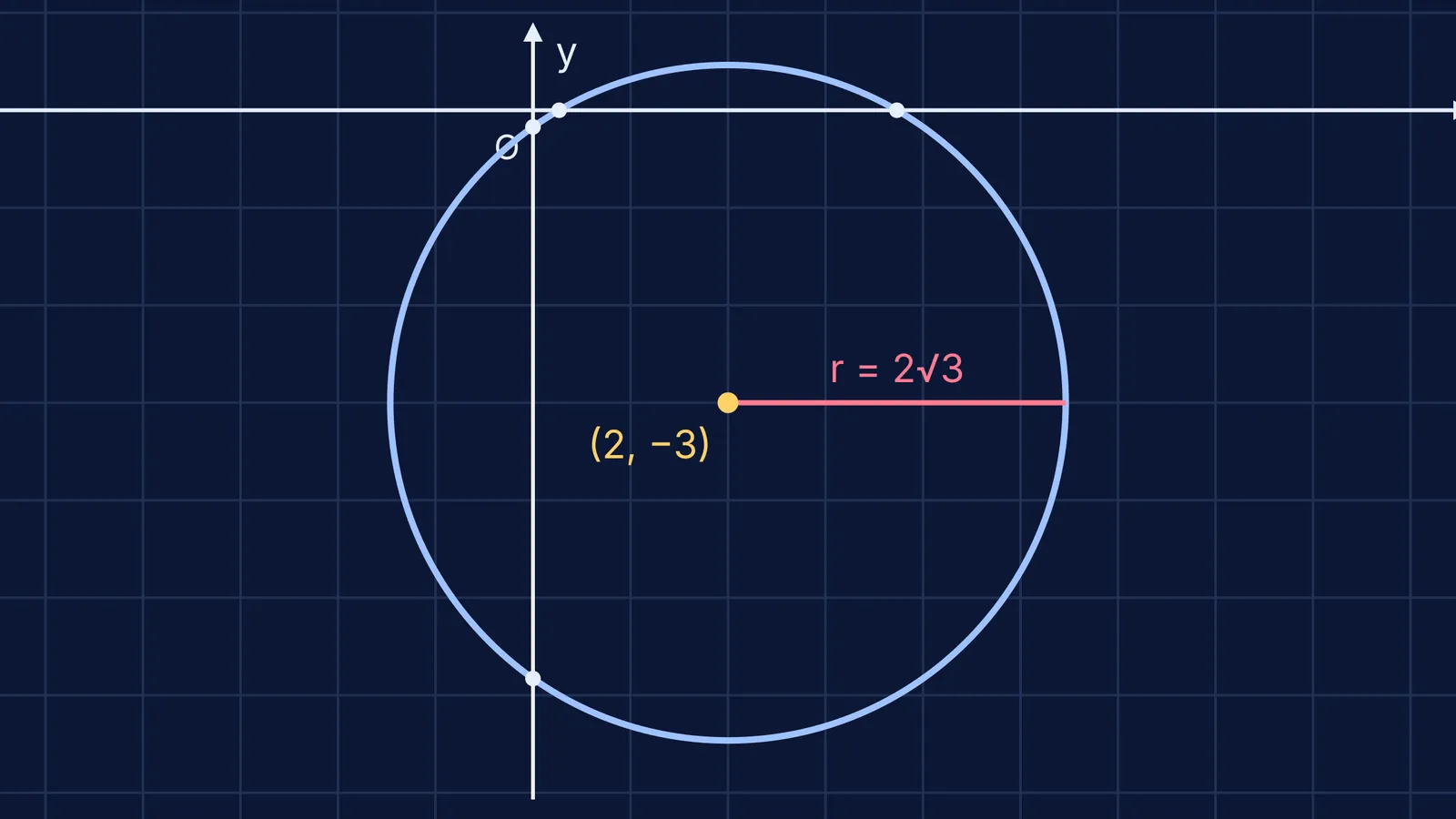
Take 3x² + 3y² − 12x + 18y + 3 = 0. Dividing by 3 gives x² + y² − 4x + 6y + 1 = 0. So g = −2, f = 3 and c = 1. The centre is (2, −3) and the radius is √(4 + 9 − 1) = 2√3, as in the diagram above.
Skip the division and you read 2g = −12, so g = −6, f = 9 and c = 3: centre (6, −9), radius √114. Both are wrong.
Other slips:
Not dividing the constant: c = 3 gives radius √10.
Writing the centre as (g, f) instead of (−g, −f).
Fractions. NCERT Exercise 10.1 includes 2x² + 2y² − x = 0 (NCERT Chapter 10). Dividing by 2 gives g = −1/4, f = 0 and c = 0, so the centre is (1/4, 0) and the radius is 1/4.
A checklist for every general-equation question
Same coefficient on x² and y², and no xy term?
Divide every term by that coefficient, constant included.
Halve the x and y coefficients and flip their signs: that is the centre.
Work out g² + f² − c, watching the sign of c.
Positive: take the root for the radius. Zero: a point circle. Negative: no real circle.
Check one point in the original equation.
Completing the square comes back in integrals with quadratic denominators. If you are given points instead of an equation, see the circle through three given points and the circumcentre in coordinate geometry.
If you keep slipping at the same step, the Fermi Problem Library has worked problems with a step-by-step solver that explains the reasoning rather than printing an answer, so you can find the line where a sign went wrong. The Fermi Concept Library gives every concept in mathematics its own lesson.


