On this page
Given a circle's equation and a point, one line of arithmetic tells you whether the point is inside, on or outside the circle, with no square roots. This is the S₁ test, and it is a quick route through JEE questions that ask for the range of a parameter.
How do you check if a point lies inside or outside a circle?
Write the circle in general form, with x² and y² both having coefficient 1: S ≡ x² + y² + 2gx + 2fy + c = 0. NCERT defines a circle as the set of all points in a plane that are equidistant from a fixed point, the centre (NCERT Class 11 Mathematics, Chapter 10). The general form of the equation of a circle, its radius and centre are listed under Unit 10 of the official JEE Main 2026 syllabus published by NTA.
Now put the point P(x₁, y₁) into the left-hand side. Call the result S₁:
S₁ = x₁² + y₁² + 2gx₁ + 2fy₁ + c
Then read the sign:
S₁ < 0: P lies inside the circle.
S₁ = 0: P lies on the circle.
S₁ > 0: P lies outside the circle.
Try it on question 15 of Exercise 10.1 in the NCERT chapter, which asks whether (−2.5, 3.5) lies inside, outside or on x² + y² = 25. Here S₁ = 6.25 + 12.25 − 25 = −6.5. It is negative, so the point is inside.
Why does the sign of S₁ work?
Complete the squares, as NCERT does in Example 3 of the same chapter. The equation becomes (x + g)² + (y + f)² = g² + f² − c, so the centre is C(−g, −f) and r² = g² + f² − c. Substituting P gives:
S₁ = (x₁ + g)² + (y₁ + f)² − (g² + f² − c) = CP² − r²
So S₁ is the squared distance from the centre minus the squared radius. Closer to C than r means negative; farther means positive. When P is outside, √S₁ is also the length of the tangent from P, which we explain in why the length of a tangent from an external point is √S₁.
How do you find the range of k for a point inside a circle?
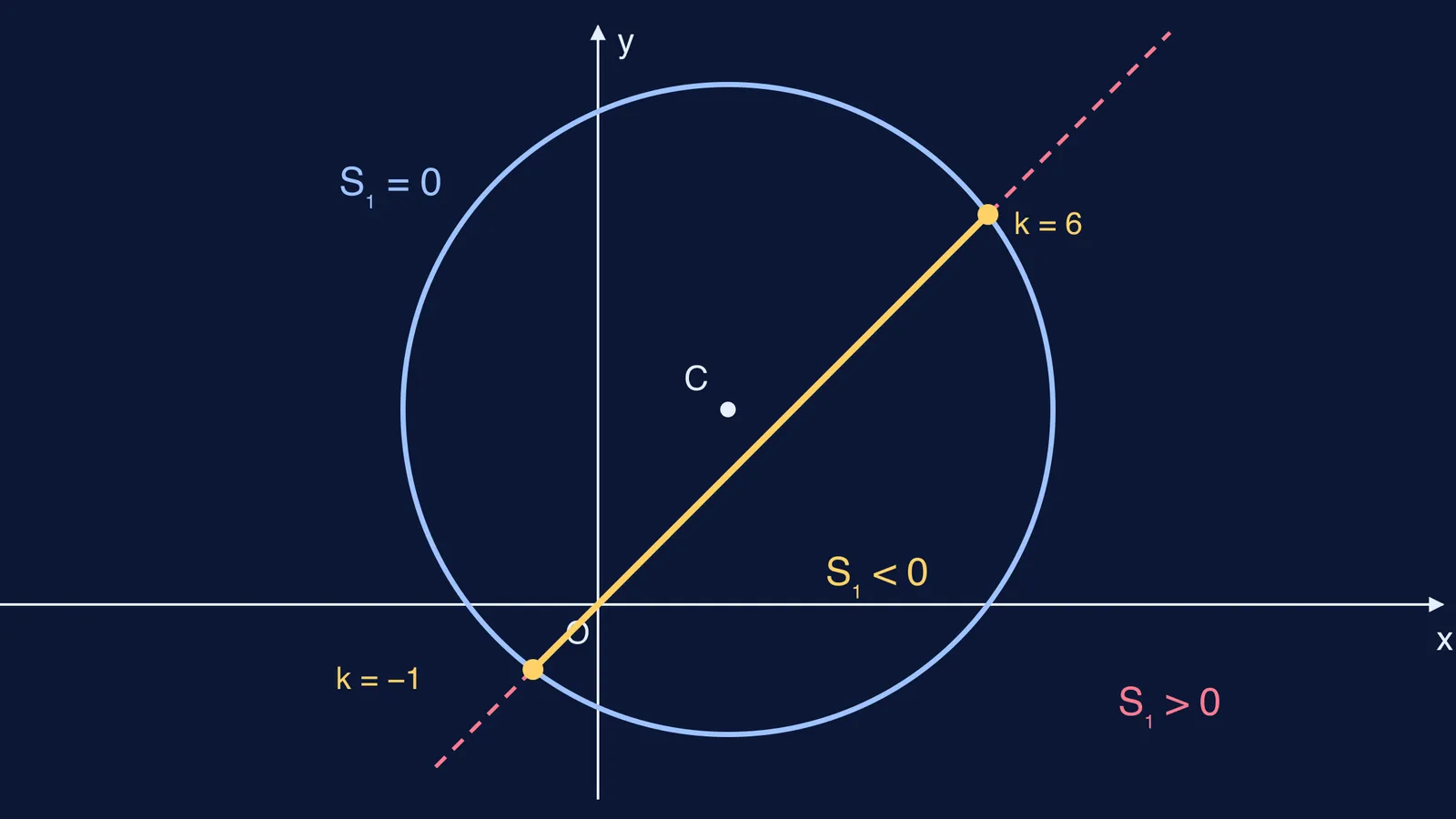
Question: for what values of k does the point (k, k) lie inside the circle x² + y² − 4x − 6y − 12 = 0?
Check the form. Here g = −2, f = −3 and c = −12, so the centre is (2, 3) and r² = 4 + 9 + 12 = 25, a real circle of radius 5.
Substitute. S₁ = k² + k² − 4k − 6k − 12 = 2k² − 10k − 12.
Write the condition. Inside means 2k² − 10k − 12 < 0, which is k² − 5k − 6 < 0.
Factorise. (k − 6)(k + 1) < 0.
Solve. The product is negative only between the roots, so −1 < k < 6.
Check the ends. At k = −1, (−1, −1) gives 1 + 1 + 4 + 6 − 12 = 0. At k = 6, (6, 6) gives 36 + 36 − 24 − 36 − 12 = 0. Both lie on the circle. The diagram at the top shows why: every point (k, k) lies on the line y = x, which cuts the circle at exactly those two points and runs inside it between them.
The same S₁ gives the other answers:
Outside: S₁ > 0, so k < −1 or k > 6.
On the circle: k = −1 or k = 6.
Inside or on: S₁ ≤ 0, so −1 ≤ k ≤ 6.
What mistakes cost marks on the S₁ test?
Before you mark your answer, check:
Are the coefficients of x² and y² both +1? If not, divide, or multiply by −1, first.
Is the circle real? g² + f² − c must be positive.
Strict or not? "Inside" means S₁ < 0; "inside or on" means S₁ ≤ 0.
If the circle itself contains the parameter, did you also require r² > 0?
S₁ answers questions about a point. If a question asks whether a line meets the circle, compare the distance from the centre to the line with the radius instead: see the condition for a line to be tangent to a circle.
Where can you practise parameter-range questions?
If you keep getting the inequality the wrong way round, the Fermi Problem Library has worked problems with a step-by-step solver that explains the reasoning rather than printing an answer. If the general form feels shaky, the Fermi Concept Library gives each mathematics concept its own lesson and its place in the map.
Next time a question gives you a point and a circle, skip the radius: substitute, read the sign, and solve the inequality.