On this page
Put the point into the circle's equation, take the square root, and you have the tangent length. The formula is easy to memorise without knowing why it works, and that gap shows when a question asks for the point from which the tangents to three circles are equal. Here is the four-line reason, then a worked example of that harder question.
What is the length of a tangent from an external point?
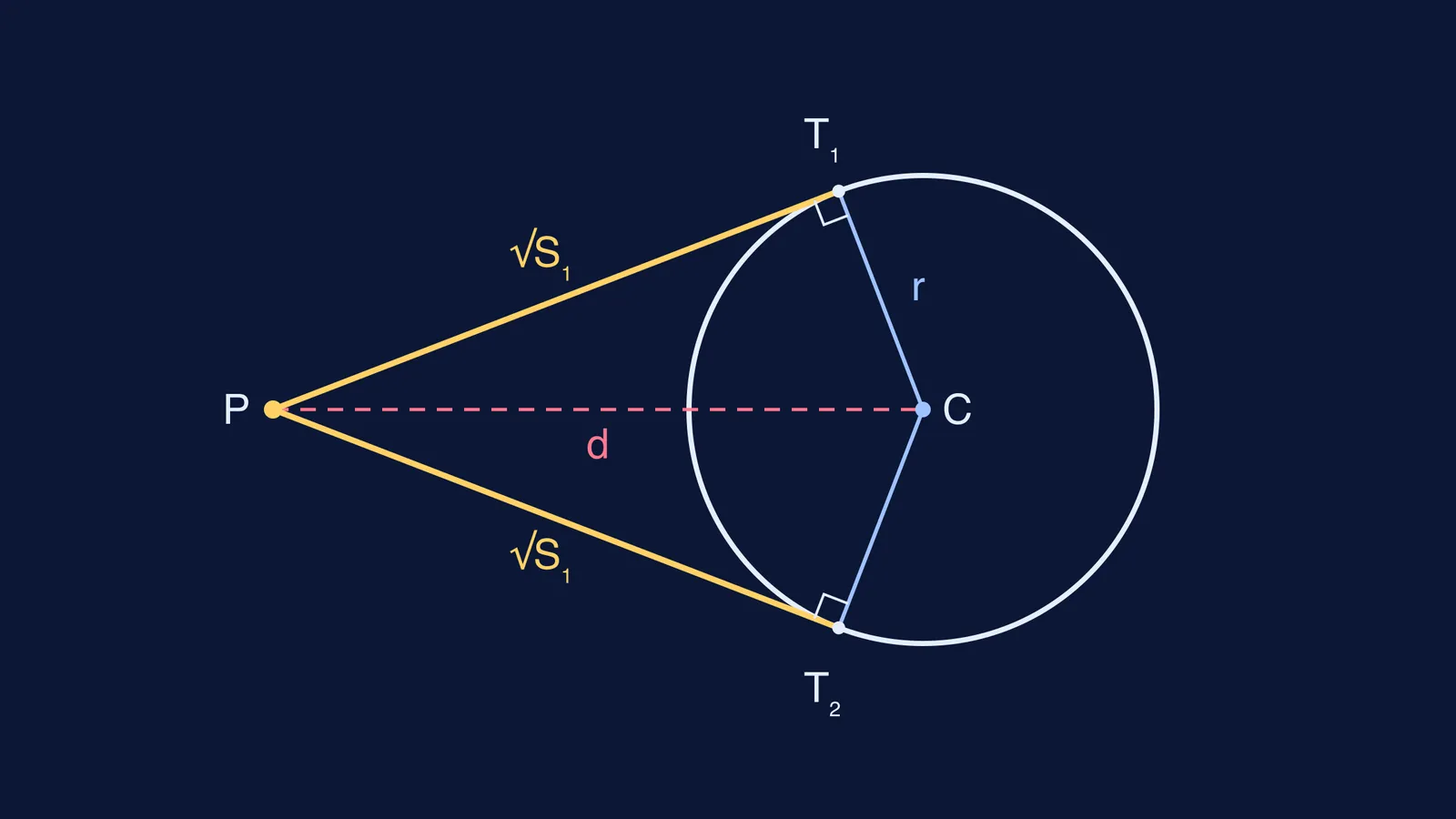
NCERT's Class 10 maths textbook defines the length of the tangent as the length of the segment from the external point P to the point of contact (NCERT, Chapter 10: Circles). The same chapter proves the two facts you need.
Theorem 10.1: the tangent at any point of a circle is perpendicular to the radius through the point of contact.
Theorem 10.2: the lengths of tangents drawn from an external point to a circle are equal.
Why is the tangent length √S₁?
Take the circle S: x² + y² + 2gx + 2fy + c = 0. Its centre is C(−g, −f) and its radius squared is r² = g² + f² − c. Let P(x₁, y₁) be a point outside it, and T the point of contact.
The radius is perpendicular to the tangent, so triangle PTC has a right angle at T.
Pythagoras gives PT² = PC² − r².
Substitute: PT² = (x₁ + g)² + (y₁ + f)² − (g² + f² − c).
Expand, and the g² and f² cancel: PT² = x₁² + y₁² + 2gx₁ + 2fy₁ + c, which is S₁.
So PT = √S₁. The NCERT chapter itself remarks that Theorem 10.2 can be proved the same way, by Pythagoras: PQ² = OP² − OQ² = OP² − OR² = PR².
The number S₁ has a name: the power of the point P with respect to the circle, defined as |PO|² − r² (Wikipedia: Power of a point). It is positive outside the circle, zero on it and negative inside, and Jakob Steiner introduced the idea in 1826 (same source). The sign gives you a free check: if S₁ comes out negative, P is inside and no tangent exists.
A quick check with numbers: take P(5, 1) and the circle x² + y² − 4x − 6y + 9 = 0. Directly, S₁ = 25 + 1 − 20 − 6 + 9 = 9, so the tangent is 3. By Pythagoras, the centre is (2, 3), PC² = 9 + 4 = 13 and r² = 4 + 9 − 9 = 4, so PT² = 13 − 4 = 9. Same answer, two routes.
How do you find the point from which tangents to circles are equal?
Equal tangents to two circles S and S′ means their powers are equal at that point, so S − S′ = 0. The x² and y² terms cancel and leave a straight line, the radical axis, which is perpendicular to the line joining the centres (Wikipedia: Radical axis). For three circles whose centres are not in a line, the three radical axes meet at one point, the radical centre (same source). That point is what the question wants.
Worked example: three circles, one point
Find the point from which the tangents to these three circles are equal, and find that tangent length.
S: x² + y² − 8x − 12y + 36 = 0, centre (4, 6)
S′: x² + y² + 6x − 4y + 6 = 0, centre (−3, 2)
S″: x² + y² − 2x + 6y − 6 = 0, centre (1, −3)
S − S′ = 0: (−8x − 12y + 36) − (6x − 4y + 6) = 0, so −14x − 8y + 30 = 0, or 7x + 4y = 15.
S − S″ = 0: (−8x − 12y + 36) − (−2x + 6y − 6) = 0, so −6x − 18y + 42 = 0, or x + 3y = 7.
Solve: x = 7 − 3y, so 7(7 − 3y) + 4y = 15, which gives y = 2 and x = 1.
Tangent length: put (1, 2) into S. 1 + 4 − 8 − 24 + 36 = 9, so the tangent is √9 = 3.
Check the other two: S′ gives 1 + 4 + 6 − 8 + 6 = 9 and S″ gives 1 + 4 − 2 + 12 − 6 = 9.
All three values match and are positive, so (1, 2) lies outside every circle and each tangent from it is 3 units long. If the three values differ, you made a sign slip while subtracting.
How do you practise this so it sticks?
Derive √S₁ once from a blank page, without notes.
For your first few problems, get the answer both ways (S₁ and PC² − r²).
In radical centre questions, always confirm the answer in all three circles.
If a step in the derivation still feels like magic, the Fermi Concept Library covers every concept in mathematics with its own lesson, so you can go back to perpendicular tangents before moving on. When the method is clear but your answers keep coming out wrong, the Fermi Problem Library has worked problems with a step-by-step solver that explains the reasoning rather than printing an answer.
Try it tonight: pick any point and any circle, and get the same tangent length both ways.