

On this page
The NCERT Class 12 chapter on aldehydes, ketones and carboxylic acids ends with three exercises that are pure deduction: you get a formula or a percentage composition, a handful of test results, and you must name the compound. They look like separate puzzles, but one routine solves all three. Work out the formula, find the degree of unsaturation, then let each clue remove options until one structure is left. Finally, check that structure against every clue, including the ones you did not need.
This post works through all three in that order. If you want the general method first, with simpler alkene and ketone examples, start with how to identify compound A, B, C in organic puzzles.
What routine solves an identify-the-compound question?
Get the molecular formula. If you are given percentages, convert them to an empirical formula and scale it up to the molar mass.
Find the degree of unsaturation (DU). DU = (2C + 2 − H) ÷ 2, ignoring oxygen. It counts rings plus π bonds.
Read each test as a yes-or-no question. 2,4-DNP says "C=O present". Tollens' says "aldehyde, not ketone". Iodoform says "CH₃CO– group". Cannizzaro says "aldehyde with no α-hydrogen".
Use degradation products to fix the skeleton. Oxidation and hydrolysis tell you how the carbons are joined.
Check the answer against every clue. A structure that fits four clues and fails the fifth is wrong.
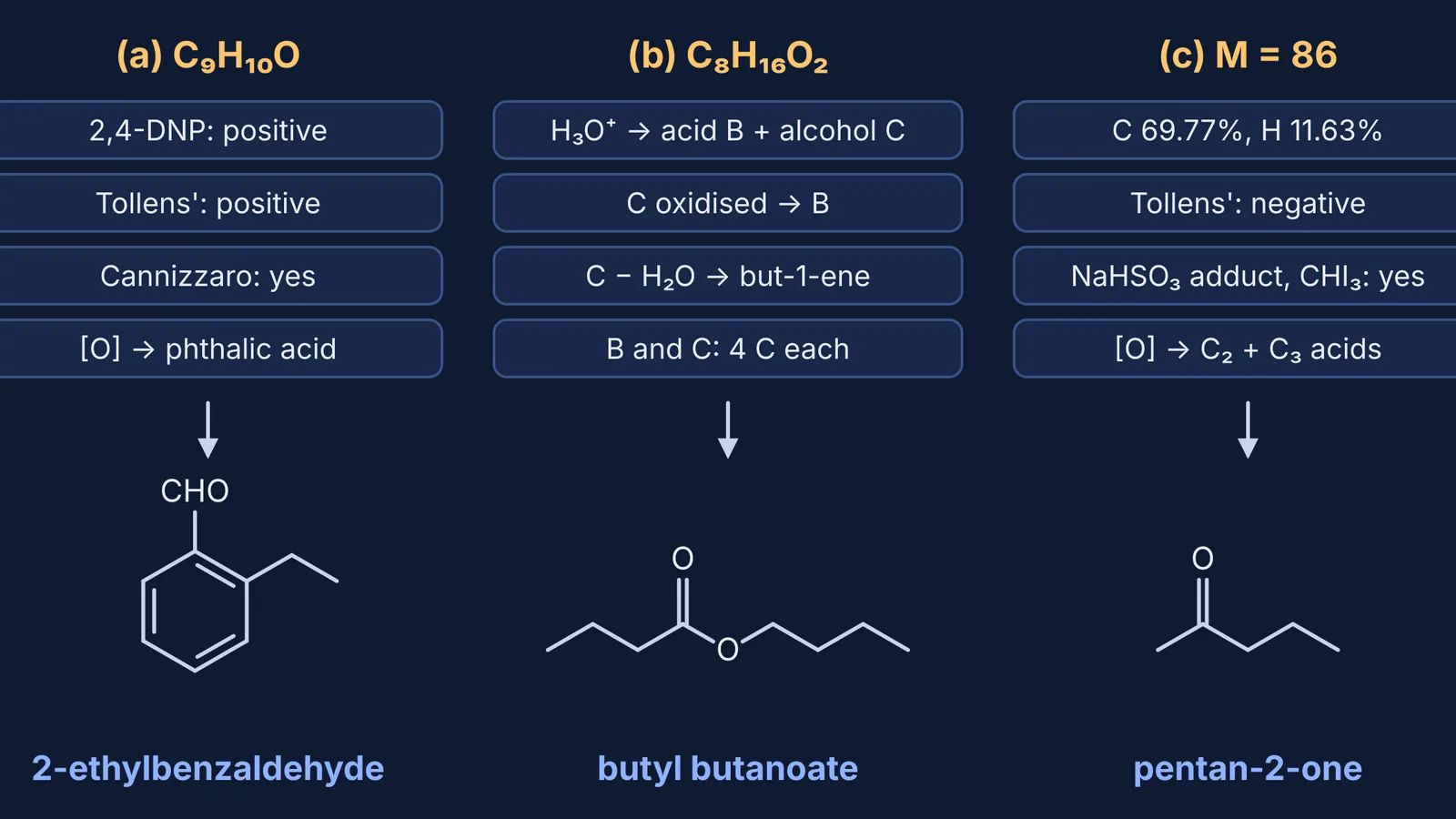
Puzzle (a): which C₉H₁₀O gives phthalic acid and Cannizzaro?
NCERT's clues: the compound forms a 2,4-DNP derivative, reduces Tollens' reagent, undergoes the Cannizzaro reaction, and on vigorous oxidation gives benzene-1,2-dicarboxylic acid (phthalic acid).
Step 1, DU. (2 × 9 + 2 − 10) ÷ 2 = 5. Nine carbons and DU 5 almost always means a benzene ring (DU 4) plus one more π bond.
Step 2, the carbonyl. A 2,4-DNP derivative means C=O, which uses the fifth DU. Tollens' positive means the C=O is an aldehyde, –CHO.
Step 3, where is the CHO? The Cannizzaro reaction needs an aldehyde with no hydrogen on the α-carbon. So the CHO must sit directly on the ring, because the ring carbon it is attached to has no hydrogen. A –CH₂CHO side chain would have α-hydrogens and would undergo aldol instead. Our post on which aldehydes undergo the Cannizzaro reaction covers this test in detail.
Step 4, the second group. Vigorous oxidation turns every side chain with a benzylic hydrogen into –COOH. A dicarboxylic acid means two side chains, and 1,2 means they are ortho. One is the CHO (one carbon). The rest of the formula is C₉H₁₀O − C₆H₄ − CHO = C₂H₅, an ethyl group.
Answer: 2-ethylbenzaldehyde. On vigorous oxidation the CHO becomes –COOH, and the ethyl group also becomes –COOH, losing its end carbon.
The point students miss. Does the ethyl group spoil the Cannizzaro clue? No. The ethyl CH₂ is benzylic: it is attached to the ring, on the carbon next to the one carrying the CHO. It is not α to the carbonyl. The α-carbon of the CHO is the ring carbon itself, and that carbon has no hydrogen. So Cannizzaro still applies:
2 C₂H₅C₆H₄CHO + NaOH → C₂H₅C₆H₄CH₂OH + C₂H₅C₆H₄COONa
Ruling out the rest. 3- and 4-ethylbenzaldehyde would give the 1,3- and 1,4-dicarboxylic acids, not phthalic acid. A dimethylbenzaldehyde has three side chains and would give a tricarboxylic acid. (2-Methylphenyl)ethanal has α-hydrogens, so it fails Cannizzaro. A ketone such as 2-methylacetophenone fails Tollens'. The C₈H₈O aromatic carbonyl isomers post uses the same ortho-to-phthalic clue one carbon down, if you want to compare.
Puzzle (b): which ester C₈H₁₆O₂ gives an acid and an alcohol with the same skeleton?
NCERT's clues: A (C₈H₁₆O₂) is hydrolysed with dilute sulphuric acid to a carboxylic acid B and an alcohol C. Oxidising C with chromic acid gives B. C on dehydration gives but-1-ene.
Step 1, DU. (16 + 2 − 16) ÷ 2 = 1. Two oxygens and one π bond, plus hydrolysis to an acid and an alcohol: A is an ester, RCOOR'.
Step 2, link B and C. Oxidation of C gives B, so C is a primary alcohol with the same carbon skeleton as B. That means B and C have the same number of carbons: 8 ÷ 2 = 4 each.
Step 3, fix the skeleton. C dehydrates to but-1-ene, CH₂=CH–CH₂–CH₃. The chain is unbranched and the OH is on an end carbon, so C is butan-1-ol. Butan-2-ol would oxidise to a ketone, not an acid, and 2-methylpropan-1-ol would give 2-methylpropene.
Answer. C is butan-1-ol, CH₃CH₂CH₂CH₂OH. B is butanoic acid, CH₃CH₂CH₂COOH. A is butyl butanoate, CH₃CH₂CH₂COOCH₂CH₂CH₂CH₃.
CH₃CH₂CH₂COOC₄H₉ + H₂O → CH₃CH₂CH₂COOH + C₄H₉OH (H⁺, heat)
Count the atoms: C₈H₁₆O₂ + H₂O gives C₄H₈O₂ + C₄H₁₀O. Both sides have 8 C, 18 H and 3 O.
One honest caveat: in a real flask, acid dehydration of butan-1-ol gives a mixture in which but-2-ene is the main alkene. NCERT's clue is there to tell you the skeleton is straight and the OH is terminal, and that is how you should read it.
Puzzle (c): which compound has 69.77% C, 11.63% H and M = 86?
NCERT's clues: the compound does not reduce Tollens' reagent, forms an addition compound with sodium hydrogensulphite, gives a positive iodoform test, and on vigorous oxidation gives ethanoic and propanoic acids.
Step 1, the formula. Oxygen is 100 − 69.77 − 11.63 = 18.60%. Divide by atomic masses: C 69.77 ÷ 12 = 5.81, H 11.63 ÷ 1 = 11.63, O 18.60 ÷ 16 = 1.16. Divide by the smallest: 5.00 : 10.0 : 1.00. The empirical formula C₅H₁₀O has mass 86, which equals M, so the molecular formula is C₅H₁₀O. Check: 60 ÷ 86 = 69.77% C and 10 ÷ 86 = 11.63% H.
Step 2, DU and the C=O. DU = (10 + 2 − 10) ÷ 2 = 1. The bisulphite adduct shows a C=O. No Tollens' reaction means a ketone.
Step 3, narrow the ketones. C₅H₁₀O has three ketones: pentan-2-one, pentan-3-one and 3-methylbutan-2-one. Iodoform needs CH₃CO–, so pentan-3-one is out. It fits the formula but gives no yellow precipitate.
Step 4, the two acids. Vigorous oxidation of a ketone breaks a C–C bond next to the C=O. Pentan-2-one, CH₃COCH₂CH₂CH₃, breaks between C2 and C3 to give CH₃COOH and CH₃CH₂COOH, which matches. 3-methylbutan-2-one, CH₃COCH(CH₃)₂, cannot give a three-carbon acid: its branched side gives propanone instead.
Answer: pentan-2-one.
How do you practise these puzzles?
Write the full isomer list for every formula you meet, because a missing candidate makes every later step unreliable. If you pick the wrong structure and cannot see where the logic broke, the Fermi Problem Library has a step-by-step solver that explains the reasoning, so you can compare your chain of deductions with a worked one.
Quick checklist
Formula first: convert percentages and scale to the molar mass.
DU next: 4 or more with six or more carbons suggests a benzene ring.
Cannizzaro means no α-hydrogen on the aldehyde, so the CHO sits on the ring or on a carbon with no H.
Oxidation to a 1,2-dicarboxylic acid means two ortho side chains.
An alcohol that oxidises to the other half of an ester shares its skeleton.
Iodoform needs CH₃CO–; a ketone splits next to its C=O on vigorous oxidation.
Tick every clue against the final structure.


