

On this page
"Compound A (C5H10O) gives a yellow precipitate with iodine and NaOH but no silver mirror. Identify A." Questions like this look like guesswork, but they are a process of elimination. The formula tells you which structures are possible, and each test result rules some of them out. (This one still fits two ketones; puzzle 2 adds the clue that decides.)
What is the degree of unsaturation, and why find it first?
The degree of unsaturation (DoU) is the number of rings plus π bonds in a molecule, calculated as DoU = (2C + 2 + N − X − H)/2 (LibreTexts, Degree of Unsaturation). C, N, X and H are the numbers of carbons, nitrogens, halogens and hydrogens. Oxygen and sulphur are left out because they do not change the count. Benzene, C6H6, has a DoU of 4: one ring and three double bonds.
Read the number like this:
DoU 0: fully saturated, with no ring, C=C or C=O.
DoU 1: exactly one C=C, one C=O or one ring.
DoU 2: two of these, or one triple bond.
DoU 4 or more with at least six carbons: suspect a benzene ring first.
Which test result points to which group?
The standard lab tests each answer one yes-or-no question (LibreTexts, Individual Tests):
Bromine water loses its orange colour: unsaturation (alkene or alkyne).
Orange, red or yellow precipitate with 2,4-DNP (Brady's reagent): an aldehyde or ketone.
Silver mirror with Tollens' reagent: an aldehyde, not a ketone.
Yellow precipitate with iodine and NaOH (iodoform test): a methyl ketone, CH3CO–, or a secondary alcohol next to a methyl group.
Purple KMnO4 turns brown: unsaturation, or a group that can be oxidised.
Reactions that break or trim the molecule give structural clues too. Ozonolysis splits a C=C into two carbonyl compounds (LibreTexts, Ozonolysis). Clemmensen reduction with zinc amalgam and concentrated HCl turns a ketone or aldehyde into an alkane (Wikipedia, Clemmensen reduction). Hot KMnO4 turns each alkyl side chain on a benzene ring into –COOH, provided that chain has a hydrogen on the carbon next to the ring (LibreTexts/OpenStax, Oxidation of Aromatic Compounds).
How do you identify compound A, B and C step by step?
Calculate the DoU.
List every isomer that fits the formula and the DoU.
Apply each test result and cross out the isomers that fail it.
Use the cleavage or reduction product to fix the carbon skeleton.
Check your answer against every clue, including the ones you did not use.
Puzzle 1: A (C4H8) decolourises bromine water. Ozonolysis followed by zinc and acetic acid gives propanone and methanal. Identify A.
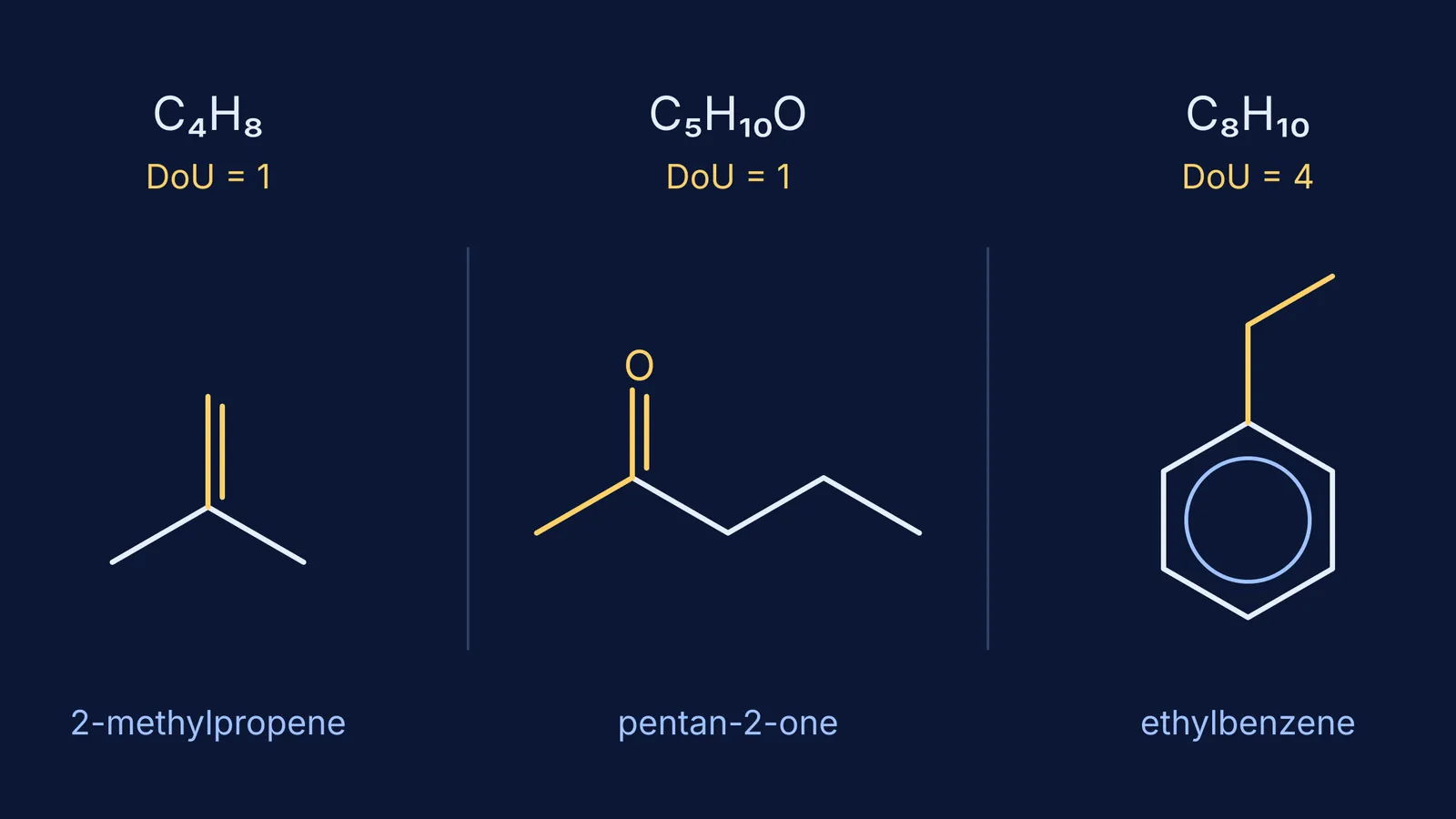
DoU = (8 + 2 − 8)/2 = 1. The candidates are but-1-ene, cis- and trans-but-2-ene, 2-methylpropene, cyclobutane and methylcyclopropane (all the C4H8 isomers). The bromine test points to a C=C, and ozonolysis cleaves one, so A is an alkene. Rebuild it by deleting both oxygens and joining the two carbonyl carbons with a double bond: (CH3)2C=O + O=CH2 gives (CH3)2C=CH2. Check: but-1-ene would give propanal and methanal, and but-2-ene two ethanal. A is 2-methylpropene.
Puzzle 2: B (C5H10O) gives an orange precipitate with 2,4-DNP, does not reduce Tollens' reagent and gives a yellow precipitate with iodine and NaOH. Clemmensen reduction of B gives n-pentane.
DoU = (10 + 2 − 10)/2 = 1. The 2,4-DNP result shows a C=O, which uses up that one DoU, and a negative Tollens' test rules out aldehydes. That leaves three ketones: pentan-2-one, pentan-3-one and 3-methylbutan-2-one (C5H10O aldehydes and ketones). The iodoform test needs a CH3CO– group, which removes pentan-3-one. Clemmensen reduction swaps C=O for CH2 and keeps the chain, and n-pentane is unbranched, so B is not 3-methylbutan-2-one (that would give 2-methylbutane). B is pentan-2-one.
Puzzle 3: C (C8H10) is aromatic. Heating it with alkaline KMnO4 and then adding acid gives D (C7H6O2). Identify C and D.
DoU = (16 + 2 − 10)/2 = 4, which means a benzene ring plus two saturated carbons. The candidates are ethylbenzene and o-, m- and p-xylene (the C8H10 aromatic isomers). KMnO4 oxidises every side chain that has a benzylic hydrogen, so each xylene would give a benzenedicarboxylic acid, C8H6O4. D has only seven carbons and two oxygens, which is one –COOH on a ring. One carbon was lost, so the single side chain had two carbons. C is ethylbenzene and D is benzoic acid, C6H5COOH.
How should you practise these puzzles?
Practise isomer lists until you can write them from memory, because a missing candidate in step 2 sinks the whole answer. If you pick the wrong candidate and can't see why, the Fermi Problem Library has worked problems with a step-by-step solver that explains the reasoning rather than printing an answer. If you are unsure what a test actually detects, look the reaction up in the Fermi Concept Library, where every chemistry concept has its own lesson.
Next step: rewrite puzzle 1 so that but-2-ene is the answer, and work out which clues the question would have to give.


