

On this page
When an exam asks you to analyse the isomers of C5H10O, it is testing your ability to draw structures systematically and apply chemical tests to them. The degree of unsaturation for C5H10O is 1, which means any aldehyde or ketone will have exactly one double bond (the carbonyl group) and an open chain.
How many C5H10O aldehydes and ketones are there?
There are 7 structural isomers of C5H10O that contain a carbonyl group: 4 aldehydes and 3 ketones [[1]](https://en.wikipedia.org/wiki/C5H10O).
The 4 aldehydes
Pentanal (straight chain)
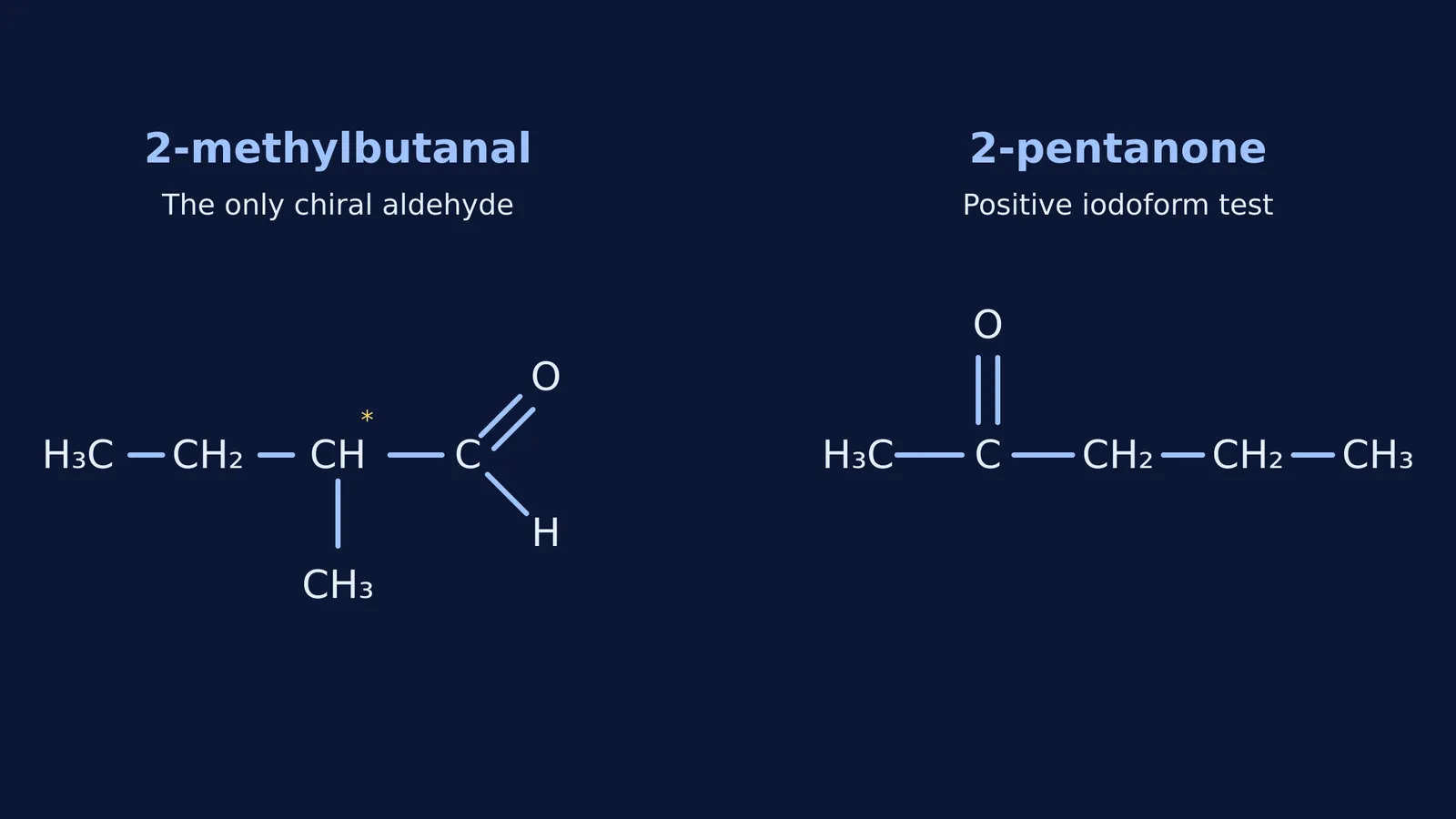
2-methylbutanal (branched at the second carbon)
3-methylbutanal (branched at the third carbon)
2,2-dimethylpropanal (branched twice on the second carbon)
The 3 ketones
2-pentanone (carbonyl at position 2)
3-pentanone (carbonyl at position 3)
3-methyl-2-butanone (branched chain)
How do you draw C5H10O isomers systematically?
When mapping out isomers, it helps to be methodical so you do not miss any structures or draw the same one twice.
Step 1: The unbranched chain (5 carbons) Start with a straight chain of five carbon atoms.
Put the C=O double bond at the very end (carbon 1), and you get pentanal.
Move the C=O to carbon 2, and you have 2-pentanone.
Move it to carbon 3, and you get 3-pentanone.
Moving it to carbon 4 is the same as carbon 2 (just numbered from the other end).
Step 2: The single-branched chain (4 carbons) Next, draw a four-carbon chain and add a methyl (-CH₃) branch.
Keep the C=O at carbon 1 (making it an aldehyde). You can place the methyl branch on carbon 2 to make 2-methylbutanal.
Move the methyl branch to carbon 3 to make 3-methylbutanal.
Now make it a ketone by placing the C=O on carbon 2. The only place left for the methyl branch without lengthening the main chain is carbon 3, giving you 3-methyl-2-butanone.
Step 3: The double-branched chain (3 carbons) Finally, draw a three-carbon chain.
Put the C=O at carbon 1. This leaves carbon 2 to take two methyl branches, giving 2,2-dimethylpropanal.
You cannot make a ketone with a three-carbon chain that holds two extra branches, because the central carbon would need five bonds.
Which C5H10O aldehyde is chiral?
A molecule is chiral if it has a carbon atom bonded to four different groups.
Looking at the structures, the only chiral aldehyde is 2-methylbutanal [[2]](https://en.wikipedia.org/wiki/2-Methylbutanal). Its second carbon (C2) is the chiral centre because it is attached to:
A hydrogen atom (-H)
A methyl group (-CH₃)
An ethyl group (-CH₂CH₃)
An aldehyde group (-CHO)
Because it lacks an internal plane of symmetry, 2-methylbutanal exists as a pair of enantiomers (the R and S forms), even though it counts as one structural isomer. None of the other aldehydes or ketones of C5H10O have a carbon with four distinct groups.
Which isomers give a positive iodoform test?
The iodoform test is used to identify the presence of a methyl ketone group (CH₃-CO-) or acetaldehyde. A positive test yields a pale yellow precipitate of iodoform (CHI₃) [[3]](https://en.wikipedia.org/wiki/Iodoform_test).
Because none of the four aldehydes is acetaldehyde (they all have five carbons), all of them will give a negative result.
To find the positive results, we must look for the CH₃-CO- group in the ketones:
2-pentanone has a methyl ketone group, so it gives a positive test.
3-methyl-2-butanone has a methyl ketone group, so it also gives a positive test.
3-pentanone has ethyl groups on both sides of the carbonyl carbon, lacking the required methyl group, so it gives a negative test.
Therefore, exactly two isomers of C5H10O give a positive iodoform test.
How do you tackle isomer questions in exams?
If you are faced with a question asking you to identify specific isomers and their reactions, follow this sequence:
Find the unsaturation: Use the formula (C + 1 - H/2) to confirm if the molecule has rings or double bonds.
Draw the longest chain first: For C5H10O, start by drawing the 5-carbon straight chain and placing the carbonyl group at the end or in the middle.
Shorten and branch: Drop to a 4-carbon chain and shift the methyl branch to different positions. Finally, try a 3-carbon chain with two branches.
Test the conditions: Check each drawn structure against the chemical test asked, such as the Tollens' test (which detects all aldehydes) or the iodoform test.
If you find yourself guessing the structures instead of deriving them, the Fermi Concept Library explains how to systematically draw organic isomers. When you miss a subtle point like a hidden chiral centre in a larger problem, Fermi's AI tutor can work out what you already know and build a plan for the session, guiding you to spot the four different groups yourself.


