

On this page
Finding all the isomers for a chemical formula is a classic puzzle in organic chemistry. For the formula C₄H₈, the first step is to calculate its degree of unsaturation. Because a fully saturated four-carbon alkane (butane) has the formula C₄H₁₀, missing two hydrogen atoms gives C₄H₈ a degree of unsaturation of one. This means every isomer must contain exactly one double bond or exactly one ring.
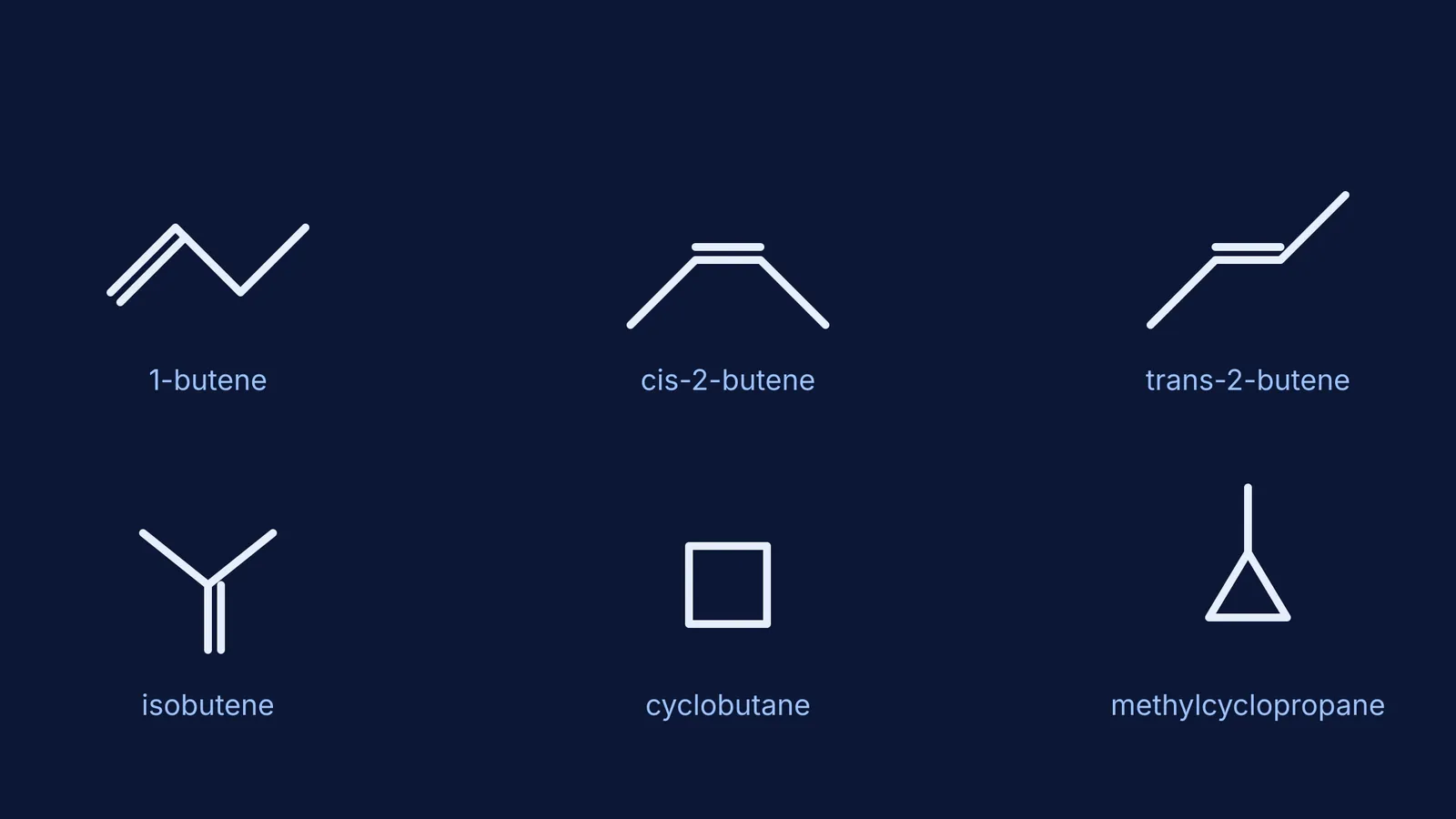
When we map out all possible arrangements, C₄H₈ yields 6 distinct isomers. Four of these are open-chain alkenes (the butenes), and two are closed-ring cycloalkanes.
What are the four alkene isomers of C4H8?
If we use our degree of unsaturation to create a carbon-carbon double bond, we get the acyclic isomers. There are three structural ways to arrange four carbons and one double bond, but one of those structures has two geometrical forms, bringing the total to four.
1-Butene: A straight chain of four carbon atoms where the double bond sits at the very end, between the first and second carbons.
cis-2-Butene: A straight chain with the double bond in the middle (between carbons 2 and 3). In the *cis* form, the two bulky methyl groups point towards the same side of the double bond.
trans-2-Butene: The exact same connectivity as cis-2-butene, but the two methyl groups lock into place on opposite sides of the double bond. Because the double bond cannot rotate, this spatial difference makes *cis* and *trans* two distinct geometrical isomers.
Isobutene (2-methylpropene): Instead of a straight chain, the four carbons form a branched structure. The main chain has three carbons with a double bond, and a methyl branch sits on the middle carbon. Branching the carbon skeleton creates structural isomers, much like how straight-chain butane splits into structural isomers for Class 10 chemistry.
What are the cyclic isomers of C4H8?
If we use the degree of unsaturation to join the ends of the carbon chain instead of making a double bond, we get the cycloalkanes. These are functional isomers to the alkenes.
Cyclobutane: All four carbon atoms join in a simple square ring.
Methylcyclopropane: Three carbon atoms form a triangle ring, with the fourth carbon hanging off as a methyl branch.
Just as finding the isomers of C4H10O requires checking both alcohols and ethers, finding C₄H₈ isomers requires checking both open chains and rings.
How do you draw the isomers systematically?
When you face a molecular formula like C₄H₈ on a test, do not guess at random shapes. Follow a systematic plan to ensure you find every isomer without drawing duplicates:
Calculate the degree of unsaturation: Use the formula (2C + 2 - H)/2. For C₄H₈, this is (2(4) + 2 - 8)/2 = 1. This tells you to look for one double bond or one ring.
Draw the longest straight chain: Start with a four-carbon chain (C-C-C-C).
Move the double bond: Place the double bond at carbon 1 (1-butene) and then at carbon 2 (2-butene). Check for symmetry; placing it at carbon 3 is exactly the same as 1-butene, just flipped over end-to-end. Recognizing this symmetry is crucial to avoid drawing duplicate structures.
Check for stereoisomers: Look at the carbons on your double bonds. If both carbons have two different groups attached, it can form *cis* and *trans* geometrical isomers. The 2-butene molecule meets this rule, splitting into two distinct shapes.
Shorten the chain and branch: Reduce the main chain to three carbons and attach the remaining carbon as a branch to the middle. Add the double bond to get isobutene.
Form rings: Take the degree of unsaturation and use it to form a ring instead of a double bond. Start with the largest possible ring (four carbons: cyclobutane). Then shrink the ring by one carbon and add the extra as a branch (three carbons: methylcyclopropane).
How do you count C4H8 isomers for exams?
Chemistry exams often use specific phrasing to test whether you know exactly which rules to apply. Here is a practical checklist for the total counts based on what a question asks:
"Total structural isomers" (5): Count 1-butene, 2-butene, isobutene, cyclobutane, and methylcyclopropane. Do not split 2-butene into *cis* and *trans* because geometrical shapes are stereoisomers, not structural ones. This is a common trap on exams where students accidentally overcount by including stereoisomers.
"Total isomers including geometrical and cyclic" (6): Count all of them: 1-butene, cis-2-butene, trans-2-butene, isobutene, cyclobutane, and methylcyclopropane. This is the most comprehensive way to count, and it is the exact answer to the question in the title.
"Total open-chain structural isomers" (3): Count only the straight and branched alkenes (1-butene, 2-butene, and isobutene), ignoring both the rings and the geometrical split entirely.
"Total alkenes including geometrical" (4): Count 1-butene, cis-2-butene, trans-2-butene, and isobutene. You must leave out the cyclic compounds because they are alkanes, not alkenes, despite having the exact same molecular formula.
When working through organic chemistry problems, keeping track of rings, branches and double bonds can get confusing. The Fermi Concept Library holds every concept in physics, chemistry, biology, mathematics and computing, each with its own lesson and its place in the map. If you are struggling with a specific drawing or naming rule, the Fermi Problem Library has worked problems with a step-by-step solver that explains the reasoning rather than printing an answer.


