

On this page
Determining structural isomers from a molecular formula is a core skill tested in competitive examinations like JEE Advanced and NEET-UG. For C8H8O, exam problems regularly focus on identifying aromatic carbonyls and predicting their reactions. To find the degree of unsaturation, or double bond equivalent (DBE), we use the standard formula:
DBE = C + 1 - (H / 2) = 8 + 1 - (8 / 2) = 5
An intact benzene ring accounts for 4 degrees of unsaturation (three double bonds and one ring). The remaining 1 degree corresponds to a carbonyl group (C=O). Therefore, every aromatic carbonyl isomer of C8H8O contains one benzene ring and one carbonyl group, with no extra unsaturations, as outlined in the NCERT Chemistry Textbooks.
Which aromatic carbonyl isomers share the formula C8H8O?
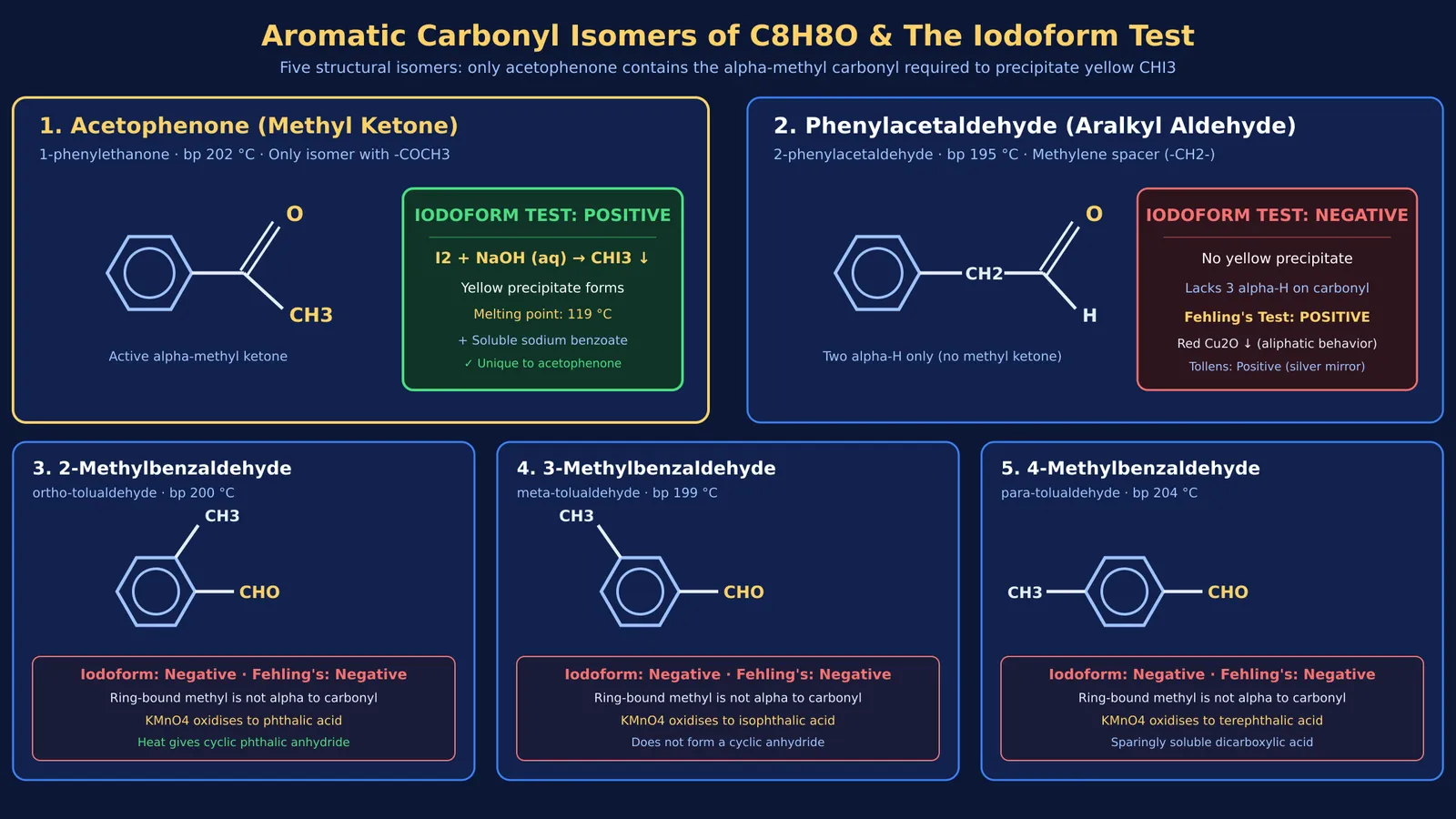
With 6 ring carbons, exactly 2 carbons remain for side chains. This allows five structural isomers containing a benzene ring and a carbonyl group:
Acetophenone (1-phenylethanone): A benzene ring with an acetyl group (-COCH3), boiling at 202 °C as recorded in PubChem Acetophenone (CID 7410).
Phenylacetaldehyde (2-phenylacetaldehyde): A benzene ring with a formylmethyl group (-CH2CHO), boiling at 195 °C according to PubChem Phenylacetaldehyde (CID 998).
2-Methylbenzaldehyde (ortho-tolualdehyde): A 1,2-disubstituted ring with -CHO and -CH3, boiling at 200 °C as listed in PubChem 2-Methylbenzaldehyde (CID 10722).
3-Methylbenzaldehyde (meta-tolualdehyde): A 1,3-disubstituted ring with -CHO and -CH3, boiling at 199 °C as recorded in PubChem 3-Methylbenzaldehyde (CID 12105).
4-Methylbenzaldehyde (para-tolualdehyde): A 1,4-disubstituted ring with -CHO and -CH3, boiling at 204 °C as documented in PubChem 4-Methylbenzaldehyde (CID 7725).
A trisubstituted isomer is impossible because three substituents require at least 3 side-chain carbons, exceeding the 8-carbon limit.
Why does only acetophenone give a positive iodoform test?
The iodoform reaction detects methyl carbonyl groups (-COCH3) or secondary alcohols (-CH(OH)CH3) that oxidise to them. Treating a methyl ketone with iodine (I2) in aqueous sodium hydroxide (NaOH) generates sodium hypoiodite (NaOI) in situ.
Aqueous base abstracts alpha-protons from the methyl group to form enolates that attack iodine. As detailed by Reynold C. Fuson and Benton A. Bull in Chemical Reviews (DOI: 10.1021/cr60052a001), successive halogenations yield a triiodomethyl ketone:
C6H5-CO-CH3 + 3 I2 + 3 NaOH → C6H5-CO-CI3 + 3 NaI + 3 H2O
Hydroxide attacks the carbonyl carbon, expelling the stabilized triiodomethyl carbanion (CI3⁻). Proton transfer produces sodium benzoate and a yellow precipitate of iodoform (CHI3), melting at 119 °C as noted in PubChem Iodoform (CID 6374):
C6H5-CO-CI3 + NaOH → C6H5-COONa + CHI3
Among the five isomers, only acetophenone contains this -COCH3 unit. Phenylacetaldehyde has a methylene group (-CH2-) adjacent to -CHO with only two alpha-hydrogens. In the three tolualdehydes, the ring-bound methyl groups (Ar-CH3) lack carbonyl alpha-activation and cannot undergo haloform cleavage.
How do you distinguish the four aldehyde isomers experimentally?
After separating acetophenone with the iodoform test, the four remaining isomers are aldehydes. They are distinguished using classical qualitative tests:
Tollens' test: All four aldehydes reduce ammoniacal silver nitrate on warming to form a silver mirror. Ketones like acetophenone fail this test.
Fehling's test: Phenylacetaldehyde contains an aliphatic formylmethyl unit insulated from the ring, reducing Fehling's solution to red Cu2O. The three tolualdehydes are conjugated aromatic aldehydes and fail to reduce Fehling's solution.
Cannizzaro reaction: Heated with concentrated sodium hydroxide, aldehydes lacking alpha-hydrogens disproportionate, as explained in our guide on identifying aldehydes that undergo the Cannizzaro reaction. The three tolualdehydes lack alpha-hydrogens and yield the corresponding alcohols and carboxylates. Phenylacetaldehyde contains benzylic alpha-hydrogens, undergoing aldol condensation instead.
Vigorous permanganate oxidation: Heating with alkaline KMnO4 followed by acidification oxidises side chains to carboxylic acids. Phenylacetaldehyde gives benzoic acid. Ortho-tolualdehyde gives phthalic acid, which dehydrates on heating to phthalic anhydride. Meta- and para-tolualdehydes give isophthalic and terephthalic acids, which cannot form cyclic anhydrides.
What is the step-by-step diagnostic roadmap for exam problems?
When solving organic deduction problems, apply this diagnostic sequence:
Confirm carbonyl function: Treat the unknown with 2,4-dinitrophenylhydrazine. An orange-yellow hydrazone precipitate confirms a carbonyl group across all five isomers, as shown in our guide on characterising carbonyls with ammonia derivatives.
Isolate acetophenone: Add iodine in aqueous NaOH. A yellow precipitate of CHI3 confirms acetophenone.
Identify phenylacetaldehyde: Warm the aldehydes with Fehling's solution. A red Cu2O precipitate identifies phenylacetaldehyde.
Separate the tolualdehydes: Oxidise the remaining three isomers with alkaline KMnO4 and heat the resulting dicarboxylic acids. Phthalic acid from the ortho isomer forms cyclic phthalic anhydride, separating it from the meta and para isomers.
These isomers can also be converted to alkylbenzenes by reducing the carbonyl group to an alkyl side chain via Clemmensen and Wolff-Kishner reactions.
When multi-step organic deduction problems mix functional group tests with structural isomerism, the Fermi Problem Library provides worked problems with a step-by-step solver that explains the reasoning rather than printing an answer. If you want to review the underlying reaction mechanisms for carbonyl additions, enolisation, and aromatic substitutions, the Fermi Concept Library covers every concept in physics, chemistry, biology, mathematics and computing, each with its own lesson and its place in the map.


