

On this page
"Study of the quantity of caffeine in tea samples" is one of the most common CBSE Class 12 chemistry investigatory projects. You boil tea leaves, pull the caffeine out into an organic solvent, evaporate the solvent and weigh what is left. Then you compare brands by percentage yield. The practical work is simple. What earns marks in the viva is explaining why each step works, and why your yield is lower than the caffeine actually in the leaves.
What is the chemistry behind extracting caffeine from tea?
Hot water dissolves caffeine from the leaves, but it also dissolves tannins, sugars and coloured pigments. The job is to separate caffeine from the rest of that brown solution.
The trick uses acid–base behaviour:
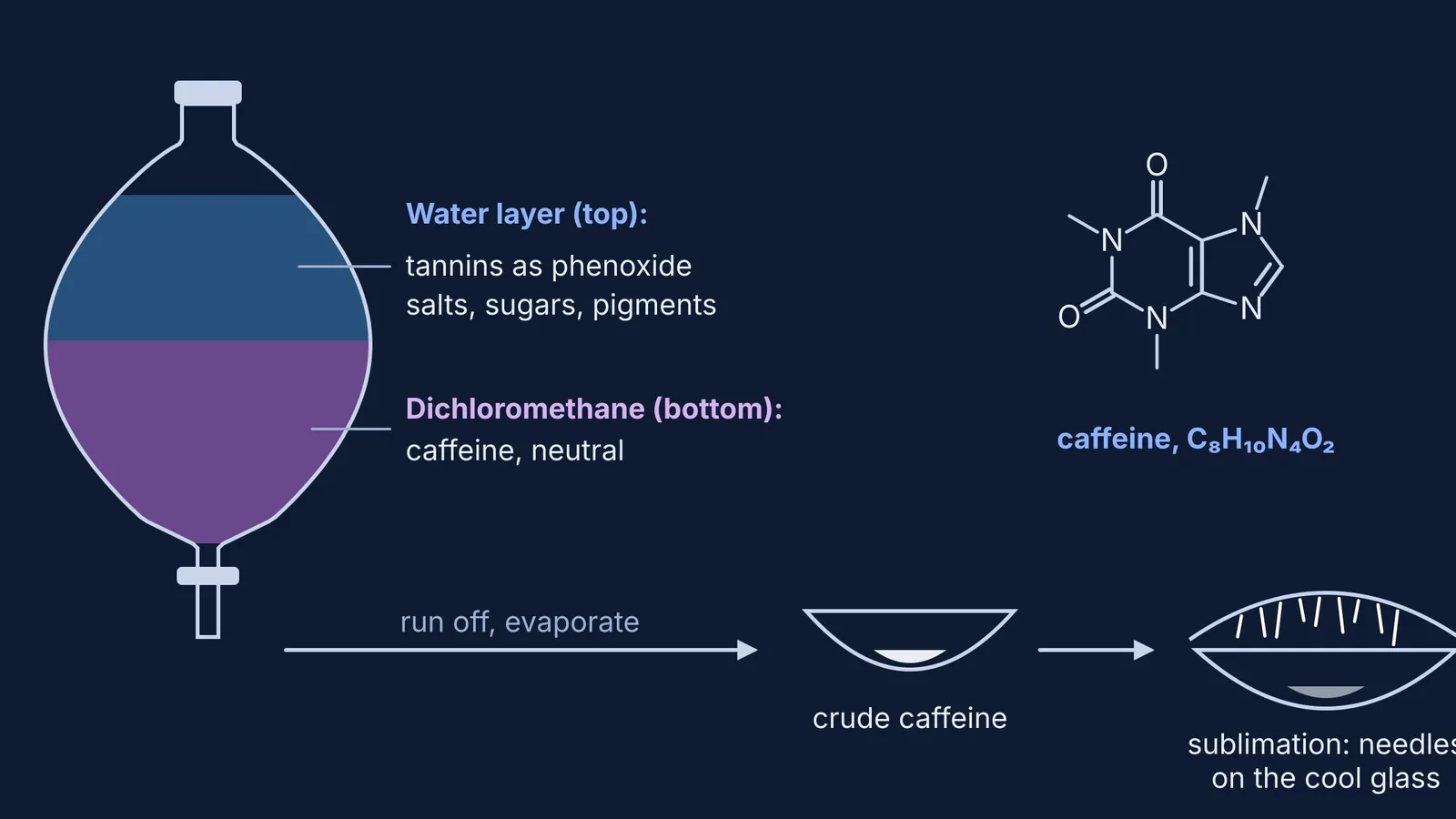
Tannins are acidic. They are polyphenols, with many –OH groups on benzene rings. Phenolic –OH is weakly acidic, so in a basic solution it loses H⁺ and forms a phenoxide salt. Salts are ionic and stay in water.
Caffeine is neutral in base. Caffeine, C₈H₁₀N₄O₂ (PubChem), has nitrogen atoms, but it is a very weak base and is protonated only in strongly acidic solution. It has no acidic hydrogen to lose either. So in a sodium carbonate solution it stays as neutral molecules, which dissolve readily in an organic solvent such as dichloromethane.
When you shake the basic tea extract with dichloromethane, the neutral caffeine moves into the organic layer and the tannin salts stay behind in water. This is the same logic as separating benzoic acid, phenol, aniline and toluene by extraction: change the charge of what you do not want, and leave the neutral compound free to move.
Why use sodium carbonate and dichloromethane, not lead acetate and chloroform?
Many older project write-ups add lead acetate to precipitate the tannins as an insoluble lead salt, then extract the caffeine with chloroform. Both work, but lead compounds are toxic and chloroform is a suspected carcinogen. Sodium carbonate does the tannin job without lead, and dichloromethane does the extraction job. Dichloromethane is not harmless either: it is volatile and you should not breathe it. Use it in a fume hood or a well-ventilated area, wear gloves and goggles, and follow your teacher's safety instructions. If your school manual uses the older recipe, describe both in your report and say why the newer one is safer.
What is the procedure, step by step?
A typical school method looks like this. Your teacher's quantities may differ.
Weigh about 10 g of tea leaves accurately.
Boil them in water with some sodium carbonate for 15 to 20 minutes, stirring occasionally.
Filter while hot and let the filtrate cool to room temperature. Dichloromethane boils at about 40 °C, so never add it to a hot solution.
Extract the cooled filtrate in a separating funnel with dichloromethane, using two or three small portions rather than one large one. Several small extractions remove more caffeine than one large extraction of the same total volume, as explained in why several small extractions beat one.
Swirl and invert gently rather than shaking hard, and vent the funnel often. Tea extracts form emulsions easily, and an emulsion traps caffeine.
Run off the lower layer each time and collect the portions together.
Dry the combined organic layer with a little anhydrous sodium sulphate, then decant or filter.
Evaporate the solvent on a warm water bath in a fume hood. Weigh the residue: this is crude caffeine.
Purify by sublimation. Gently heat the crude solid under an inverted watch glass or a cooled surface. Caffeine vapour deposits as white needle-shaped crystals on the cool surface.
Why does caffeine end up in the lower layer?
Because dichloromethane is denser than water. Its density is about 1.33 g mL⁻¹, against about 1.00 g mL⁻¹ for the water layer, so the organic layer sinks. If you used ether or ethyl acetate instead, which are less dense than water, the caffeine would be in the top layer. Always check the density before you drain a layer away.
Why does sublimation purify caffeine?
PubChem lists caffeine as melting at about 235–238 °C and subliming from about 178 °C, well below its melting point. So gentle heating turns caffeine straight from solid to vapour, and it condenses back to solid on a cool surface. Most impurities in the crude residue do not sublime at that temperature and stay behind.
How do you calculate the yield? A worked example
Suppose 10.0 g of tea leaves gives 0.18 g of crude caffeine. These numbers are illustrative, not measured.
Step 1, percentage yield. 0.18 ÷ 10.0 × 100 = 1.8%.
Step 2, moles. The molar mass of caffeine is 194.2 g mol⁻¹. Moles = 0.18 ÷ 194.2 = 9.3 × 10⁻⁴ mol.
Step 3, molecules. 9.3 × 10⁻⁴ × 6.022 × 10²³ = 5.6 × 10²⁰ molecules.
For a sense of scale, our post on how many caffeine molecules are in a cup of coffee does the same mole calculation for a drink.
To compare tea samples, use the same mass of leaves, the same volumes and the same number of extractions for each, then report each sample's percentage yield side by side. A fair comparison matters more than a high number.
Why is your yield lower than the true caffeine content?
Caffeine content varies with the type of tea, where it was grown and the age of the leaf. Boros and colleagues, writing in Pharmacognosy Magazine (2016), put caffeine at about 3–6% of dried tea leaves. A school extraction usually recovers less than that, for several reasons:
Boiling does not dissolve all the caffeine from the leaves.
Each extraction leaves some caffeine in the water layer.
Emulsions trap some of the organic layer.
Every filtration and transfer leaves a little on the glassware.
There is also an error in the other direction: crude caffeine is not pure, so its mass can include some impurities. That is why you should state whether you are reporting the crude or the sublimed mass.
If you want to check your mole and percentage calculations step by step, the Fermi Problem Library has a step-by-step solver that explains the reasoning.
Project checklist
Weigh the leaves accurately and use the same method for every sample.
Add sodium carbonate so tannins stay in water as salts.
Cool the extract before adding dichloromethane.
Extract in several small portions and swirl gently.
Collect the lower layer; dichloromethane is denser than water.
Dry, evaporate in a fume hood, weigh, then sublime.
Report percentage yield and label it crude or purified.
Explain why your yield is below the 3–6% found in dried leaves.


