

On this page
The mole concept often feels abstract when you first meet it in chemistry class. A good way to build intuition is to apply it to something you can hold in your hand. Let us use an everyday example — a cup of coffee — to walk through converting mass to moles, and then moles to molecules.
How many milligrams of caffeine are in a cup of coffee?
The exact amount of caffeine in your cup varies by the bean, the roast, and the brewing method. However, a standard 8-ounce cup of coffee contains between 80 and 100 milligrams of caffeine (FDA).
What is inside a caffeine molecule?
Before we run the numbers, it helps to understand what you are counting. The chemical formula of caffeine is C₈H₁₀N₄O₂, giving it a molar mass of 194.19 g/mol (PubChem).
By looking at the formula, you can see exactly how a single molecule is built. Every individual molecule of caffeine is made of 8 carbon atoms, 10 hydrogen atoms, 4 nitrogen atoms, and 2 oxygen atoms. This means there are 24 atoms in total in just one molecule.
The molar mass of 194.19 g/mol tells us that if you had one full mole of pure caffeine — approximately 6.022 × 10²³ molecules — it would weigh exactly 194.19 grams. That is a small pile of white powder, roughly the weight of a large apple.
How do you convert mass to moles?
Let us take the upper estimate of 100 mg of caffeine for our calculation.
First, we must match our units. Molar mass is expressed in grams per mole (g/mol), so we cannot use milligrams directly in our equation. We must first convert the milligrams to grams by dividing by 1,000.
100 mg = 0.100 g
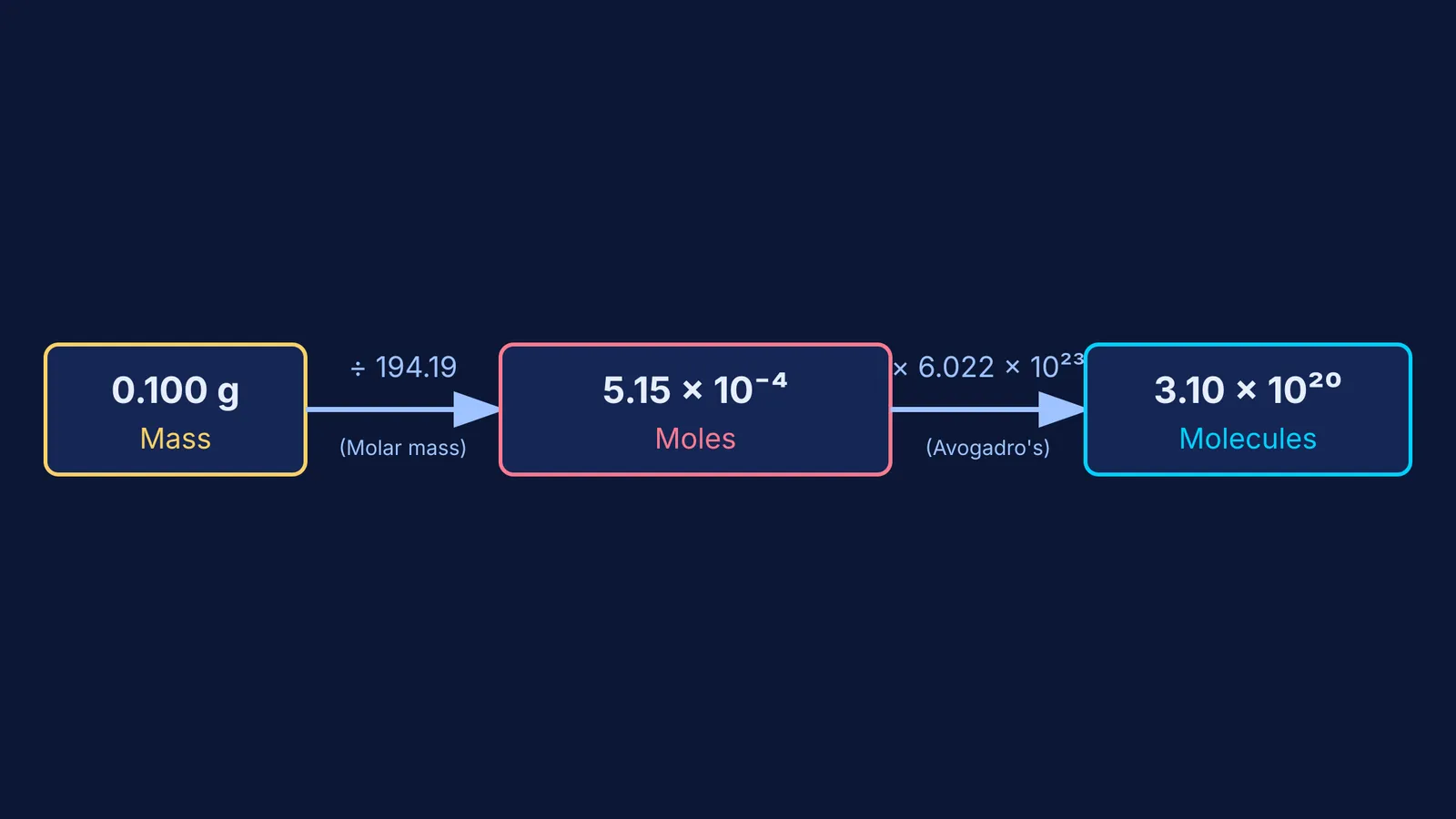
Next, we use the core formula of the mole concept to find the number of moles. The formula is: Moles = Mass ÷ Molar Mass
Moles of caffeine = 0.100 g ÷ 194.19 g/mol
Moles of caffeine = 0.000515 mol (or 5.15 × 10⁻⁴ mol)
This tells us that a standard cup of coffee contains a tiny fraction of a single mole of caffeine.
How many caffeine molecules are in a cup of coffee?
Now that we know the number of moles, we can find the exact number of molecules. One mole of any substance contains a specific number of molecules, known as the Avogadro constant. The exact value of the Avogadro constant is 6.02214076 × 10²³ molecules per mole (Wikipedia).
To find the total molecules, we multiply our moles by Avogadro's number. Number of molecules = Moles × Avogadro's number
Molecules = (5.15 × 10⁻⁴ mol) × (6.022 × 10²³ molecules/mol)
Molecules = 3.10 × 10²⁰
This means that every time you drink a cup of coffee, you are consuming approximately 310 quintillion molecules of caffeine.
How many atoms are in a cup of coffee's caffeine?
Now that we have the total number of molecules, we can take our calculation one step further. As we established earlier, a single molecule of caffeine contains 24 atoms.
To find the total number of atoms that make up the caffeine in your cup, you simply multiply the total number of molecules by the number of atoms per molecule. Total atoms = Number of molecules × Atoms per molecule
Total atoms = (3.10 × 10²⁰ molecules) × (24 atoms/molecule)
Total atoms = 7.44 × 10²¹ atoms
This shows how rapidly numbers scale up when dealing with atoms and molecules. While 310 quintillion molecules is already an unimaginably large number, the total atom count reaches over 7 sextillion atoms. These staggering figures are exactly why chemists rely on the mole concept rather than counting individual particles. Using moles keeps the numbers manageable for laboratory work and theoretical calculations.
Why does this kind of estimation matter?
Taking an abstract number like Avogadro's constant and applying it to a physical object helps you spot errors quickly in exams like JEE and NEET. When you calculate the number of molecules in a small sample, you should expect a very large, positive exponent.
If your calculation suggests there are only 50 molecules in a cup of coffee, or perhaps 10⁵⁰ molecules, your intuition will now tell you that a power of 10 is missing or you multiplied when you should have divided. This kind of estimation is vital when checking options in multiple-choice questions without having to recalculate every step.
If you are preparing for exams, you can find more step-by-step mole concept drills in the Fermi Problem Library. The library contains worked problems with a step-by-step solver that explains the reasoning rather than printing an answer. This helps you catch exactly where a calculation went wrong.
For more ways to spot errors in your calculations, read our guide on Using AI for mole concept numericals: the mistakes to check. You can also find tips on reading chemical formulas and calculating molar masses in How to write chemical formulas using valency in Class 9.


