

On this page
Reflections, rotations and enlargements send lines to lines. Inversion is stranger and more useful: it can turn a circle into a straight line, and that one trick makes some hard olympiad problems short.
It was found by several people at about the same time; Wikipedia's article on inversive geometry lists Steiner (1824), Quetelet (1825), Bellavitis (1836), Stubbs and Ingram (1842–3) and Kelvin (1845).
What is inversion in a circle?
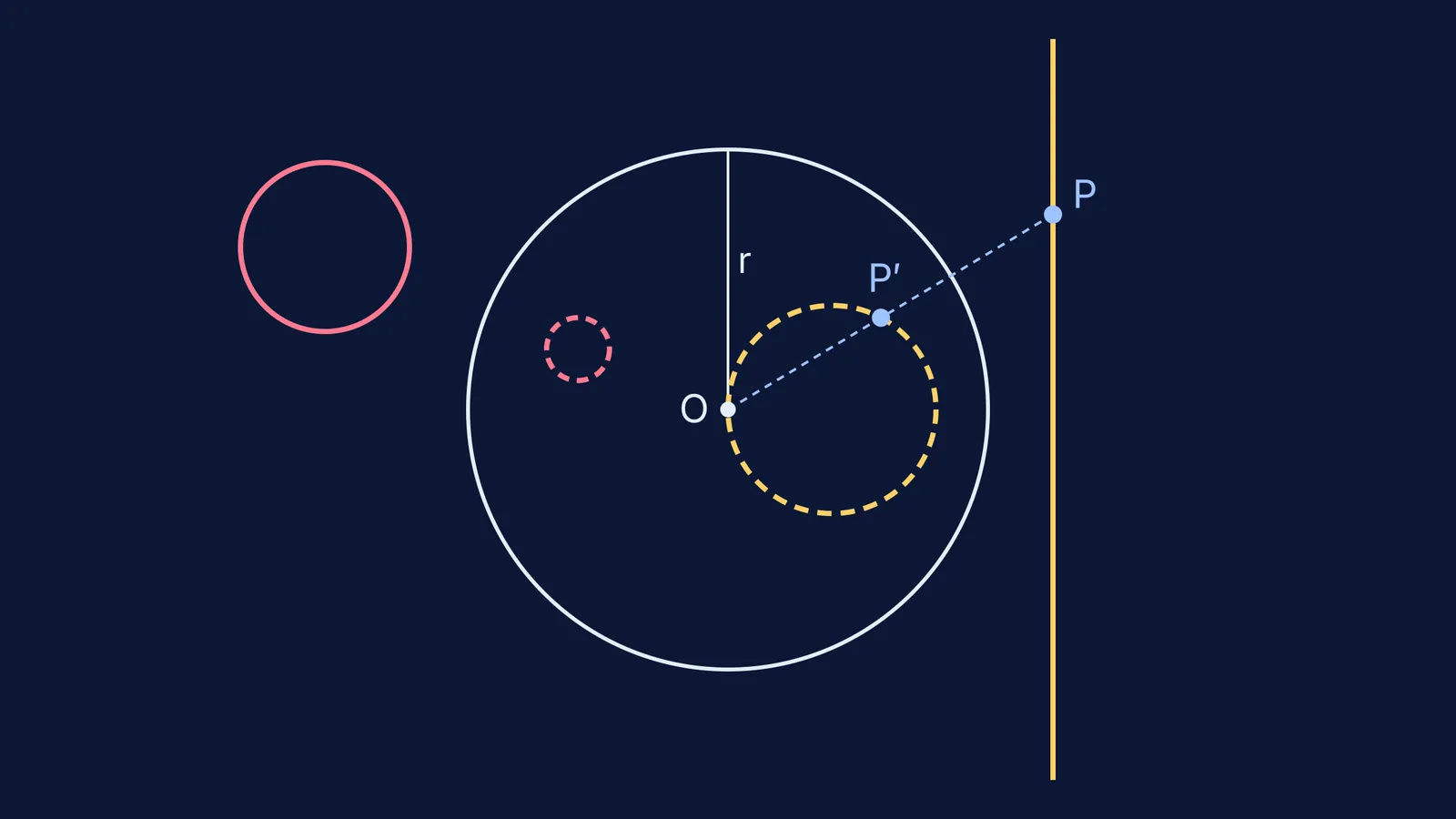
Take a reference circle with centre O and radius r. The inverse of a point P is the point P′ on the ray from O through P such that OP·OP′ = r² (inversive geometry).
Three things follow straight from that formula:
A point on the circle stays where it is, because OP = r forces OP′ = r.
A point inside goes outside, and a point outside comes inside. Halve OP and OP′ doubles.
Doing the inversion twice brings every point back, so the map is its own inverse.
The centre O has no partner, since nothing times zero is r². Geometers pair it with a single "point at infinity".
A quick example: with r = 6, a point 4 units from O goes to the point 9 units from O on the same ray, because 4 × 9 = 36.
What happens to lines and circles under inversion?
Wolfram MathWorld puts it in one line: treating lines as circles of infinite radius, all circles invert to circles (MathWorld: Inversion). Split into cases, using the inversive geometry article:
A line through O goes to itself (its points move, but the line stays).
A line not through O goes to a circle through O.
A circle through O goes to a line not through O, parallel to the tangent to the circle at O.
A circle not through O goes to another circle not through O.
Inversion also keeps the size of angles, so curves that touch still touch after inverting, and curves that cross at right angles still do (MathWorld: Inversion).
How do distances change after inversion?
You need one formula, and you can prove it in two lines. Take points P and Q with inverses P′ and Q′. Since OP·OP′ = OQ·OQ′ = r², we get OP′/OQ = OQ′/OP. Triangles OPQ and OQ′P′ share the angle at O, so they are similar, and
P′Q′ = r² · PQ / (OP · OQ).
A new distance is the old one divided by the two distances from the centre. That is exactly what the next problem needs.
Which problem does inversion make easy?
Ptolemy's inequality says that for any four points A, B, C, D in the plane, AB·CD + BC·AD ≥ AC·BD, with equality when the points lie on a circle in that order, or on a line in that order (Ptolemy's inequality). The same article notes that for points in the plane it can be derived from the triangle inequality by an inversion centred at one of the four points. Here is that proof in full.
Invert about A with radius 1. Call the images B′, C′, D′.
Use the distance formula with r = 1: B′C′ = BC/(AB·AC), C′D′ = CD/(AC·AD), B′D′ = BD/(AB·AD).
Apply the triangle inequality to B′, C′, D′: B′D′ ≤ B′C′ + C′D′.
Substitute: BD/(AB·AD) ≤ BC/(AB·AC) + CD/(AC·AD).
Multiply both sides by AB·AC·AD: AC·BD ≤ AD·BC + AB·CD. That is Ptolemy's inequality.
The equality case comes free. Equality in step 3 means C′ lies on segment B′D′. A line not through A comes from a circle through A, so A, B, C, D sit on one circle, in order (or on one line, if B′C′D′ passes through A). That is Ptolemy's theorem, with no angle chasing. For an algebraic route, see collinear and concyclic points with complex numbers.
When should you reach for inversion?
Look for these signs:
Several circles pass through one point. Invert there and they become lines.
The problem is about circles touching. Tangency survives inversion: centred at the point where two circles touch, they become two parallel lines; centred at another point on one of them, a line touching a circle. Revise the condition for two circles to touch first.
The statement mixes products of lengths, like AB·CD. The distance formula divides each length by a product, so a relation between products can become one between plain lengths, as in Ptolemy above.
Right angles to a circle matter. Circles at right angles to the circle of inversion map to themselves (MathWorld: Inversion).
If none of these apply, coordinates or angle chasing are usually faster.
If the background ideas are shaky, such as power of a point or why a tangent is perpendicular to the radius, the Fermi Concept Library has a lesson for each concept and shows where it sits in the map. To try inversion on real questions, the Fermi Problem Library has worked problems with a step-by-step solver that explains the reasoning rather than printing an answer.
Start small: invert a few lines and circles on squared paper and check each against the four cases above.


