On this page
Pick any three points on a page that do not lie on one straight line, and exactly one circle passes through all of them. Finding it takes two lines, and once you see why they work, you will not need to memorise the method. Below: the idea, one worked example, and predictions to test yourself, including the right-angled case exams love.
Why do perpendicular bisectors find the centre of a circle?
The perpendicular bisector of a segment AB is the line that cuts AB in half at a right angle. Every point on it is the same distance from A as from B, which is why it works here.
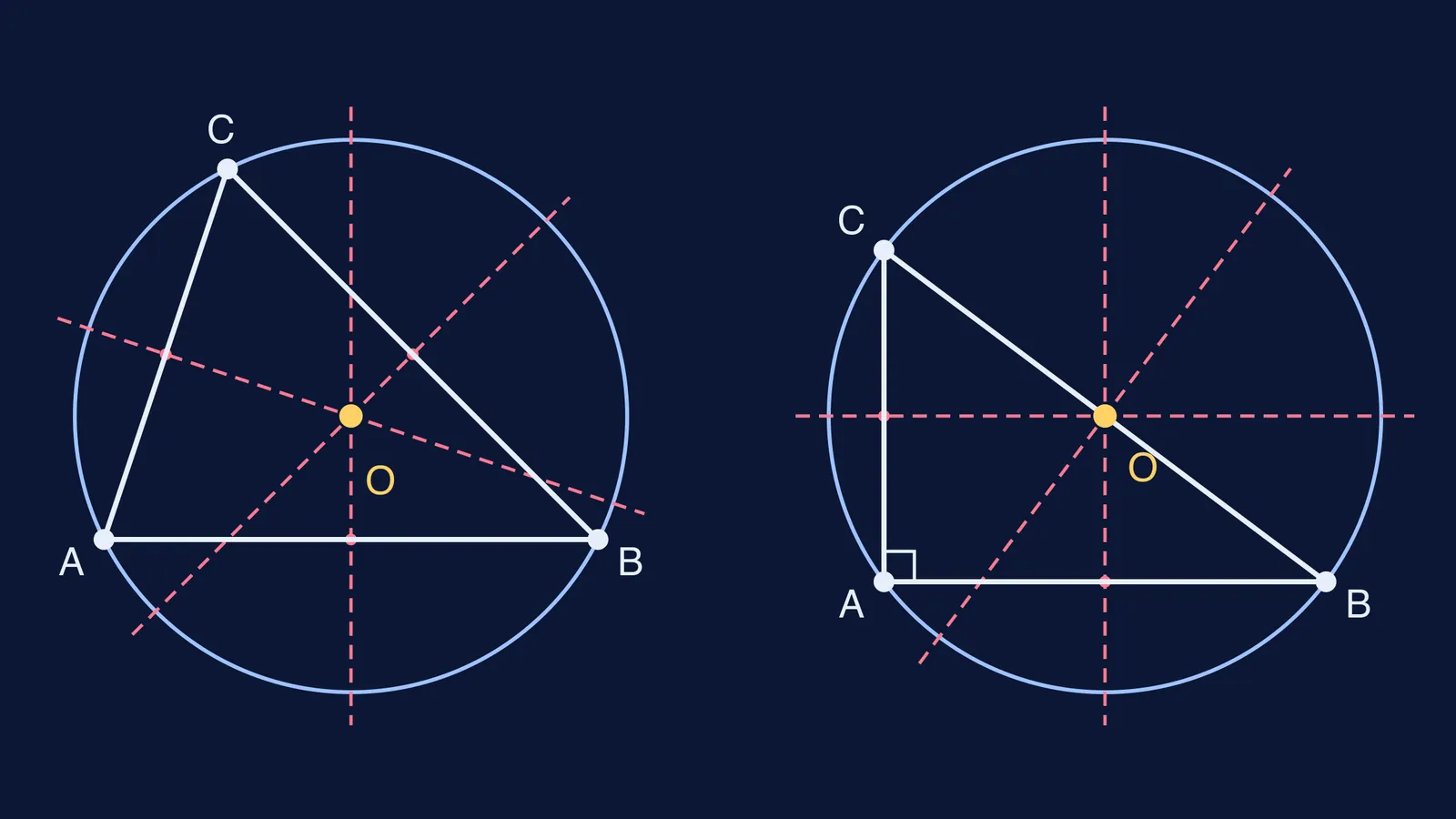
The centre of a circle through A, B and C must be equally far from all three, so it lies on the bisector of AB and on the bisector of BC. Where those two lines cross is the only point that does both jobs.
Wolfram MathWorld defines the circumcircle as "the unique circle that passes through each of the triangle's three vertices", and notes that a triangle's three perpendicular bisectors meet at its centre, the circumcentre (MathWorld: Circumcircle). The third bisector is a free check: it has to pass through the same point.
Where do the perpendicular bisectors of a triangle meet?
That depends on the triangle's largest angle. Euclid's Elements, Book IV, Proposition 5, is the construction "to circumscribe a circle about a given triangle", and the remark after it ties the centre's position to the angle opposite BC (Euclid IV.5, David Joyce's edition at Clark University). Applied to the largest angle, that gives three cases:
Acute triangle: the circumcentre falls inside the triangle.
Right-angled triangle: the circumcentre falls on the longest side, the hypotenuse.
Obtuse triangle: the circumcentre falls outside the triangle.
As one angle grows past 90°, the centre slides across the opposite side and out of the triangle.
What happens in a right-angled triangle?
The circumcentre is the midpoint of the hypotenuse, and the radius is half the hypotenuse. This is the same fact as the angle-in-a-semicircle theorem read backwards: Euclid's Book III, Proposition 31 states that "in a circle the angle in the semicircle is right" (Euclid III.31). If the angle at C is 90°, C sits on the circle with diameter AB. Test it in the angle in a semicircle and other circle theorems.
How do you find the circle through three points step by step?
Take A(0, 0), B(8, 0) and C(2, 6).
Bisector of AB. The midpoint is (4, 0) and AB is horizontal, so the bisector is the vertical line x = 4.
Bisector of AC. The midpoint is (1, 3). The slope of AC is 6/2 = 3, so the perpendicular slope is −1/3. The line is y − 3 = −(1/3)(x − 1).
Intersect. Put x = 4 into the second line: y = 3 − 1 = 2. The centre is O(4, 2).
Radius. OA² = 4² + 2² = 20, so r = 2√5, about 4.47.
Check with C: (2 − 4)² + (6 − 2)² = 4 + 16 = 20. It matches.
Check with the third bisector. BC has midpoint (5, 3) and slope −1, so its bisector is y = x − 2, which also passes through (4, 2).
All three angles here are acute, and O(4, 2) is inside the triangle, as the rule predicts.
Now move only C. Put it at (0, 6), making a right angle at A. The centre jumps to (4, 3), the midpoint of BC, and the radius is 5, half of the hypotenuse BC = 10. Move C to (2, 1) instead, so the angle at C is obtuse, and the same steps give O(4, −5.5): below AB, outside the triangle. For the general formulas behind these steps, see centroid, incentre and circumcentre in coordinate geometry, and for writing each bisector's equation two ways, the equation of a perpendicular bisector.
What should you predict before moving the points?
Write each prediction down first, then check.
Keep A and B fixed and slide C along a line parallel to AB. Does the centre stay on x = 4? (It must: the bisector of AB does not move.)
Where must C be for the centre to land exactly on AB? (Anywhere on the circle with AB as diameter, because then the angle at C is 90°.)
Move C towards the line AB, keeping it away from A and B. What happens to the radius? (It grows without limit. When the three points are collinear, the bisectors are parallel and no circle exists.)
Make the triangle equilateral. Where are the circumcentre and the centroid? (At the same point, by symmetry.)
The Fermi Simulation Lab has interactive simulations for the ideas that are easier to see than to read.
Next time, look at the biggest angle and say where the centre should land before you calculate anything.