

On this page
You have a triangle, two cevians crossing inside it, and a question like find AP:PD. Similar triangles or Menelaus's theorem will get you there. Mass points get you there in five lines of arithmetic, using an idea you already know from physics: a see-saw balances when the heavier child sits closer to the pivot.
What is mass point geometry?
Mass point geometry applies the physical principle of the centre of mass to geometry problems involving triangles and intersecting cevians (Wikipedia: Mass point geometry). A cevian is a segment from a vertex to a point on the opposite side. The same article says the modern method was developed in the 1960s by New York high school students, and that the idea was used as early as 1827 by August Ferdinand Möbius in his work on homogeneous coordinates.
The physics underneath is the law of the lever, discussed by Archimedes: two loads on a rod balance when each load times its distance from the fulcrum is the same on both sides (Wikipedia: Lever).
How do you assign masses to the vertices?
Three rules carry most problems. The mass point article defines the sum of mass m at P and mass n at Q as mass m + n at the point R on PQ with PR:RQ = n:m (Wikipedia: Mass point geometry).
Balance: if D on BC has BD:DC = p:q, then mass at B : mass at C = q:p. The heavier end is the nearer one.
Add: the point on the side carries the sum of its two end masses.
Scale: multiplying every mass by the same positive number changes nothing. Use it to make a vertex shared by two sides agree.
Then read the answer: on any cevian through the balance point P, the two pieces are in the inverse ratio of the masses at the ends, so AP:PD = mass at D : mass at A.
A worked triangle: how do you find AP:PD?
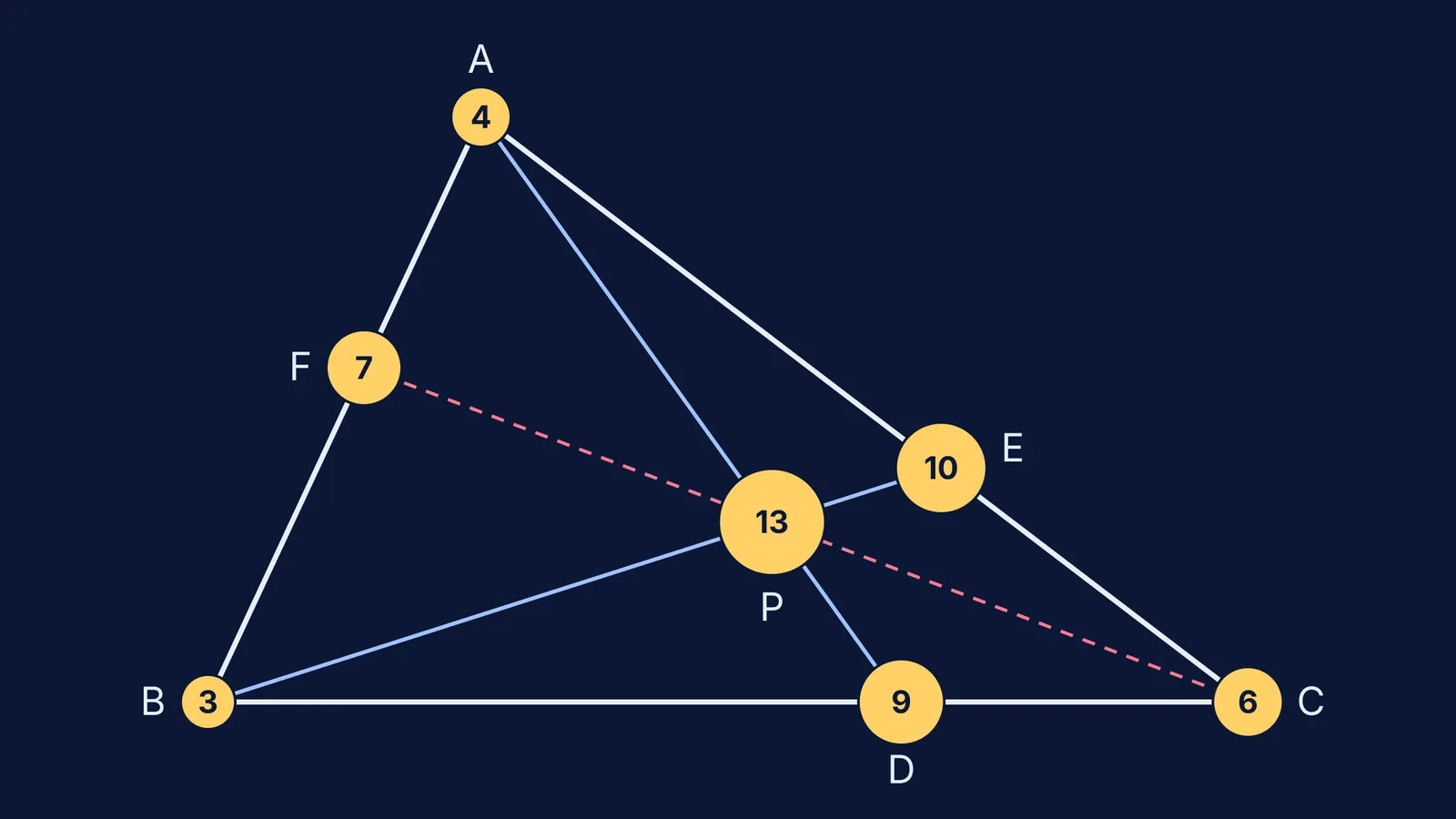
Problem: in triangle ABC, D lies on BC with BD:DC = 2:1, and E lies on CA with AE:EC = 3:2. AD and BE meet at P. Find AP:PD and BP:PE.
Side BC: BD:DC = 2:1, so mass B : mass C = 1:2.
Side CA: AE:EC = 3:2, so mass A : mass C = 2:3.
Scale so C, shared by both sides, gets 6: B = 3, A = 4, C = 6.
Add: D = 3 + 6 = 9, E = 4 + 6 = 10, and P gets 4 + 3 + 6 = 13.
Read: AP:PD = 9:4 and BP:PE = 10:3.
You also get the third cevian free. Line CP meets AB at F with AF:FB = 3:4 (mass B : mass A), F carries 7, and CP:PF = 7:6. Multiply round the triangle: (AF/FB)(BD/DC)(CE/EA) = (3/4)(2)(2/3) = 1. That is Ceva's condition; written with signed lengths, its equation differs from Menelaus's only in sign (Wikipedia: Menelaus's theorem).
Does it agree with Menelaus's theorem?
Menelaus's theorem says that if a line crosses the sides BC, CA and AB of triangle ABC (extended if needed) at D, E and F, then |AF/FB| x |BD/DC| x |CE/EA| = 1 (Wikipedia: Menelaus's theorem). The oldest surviving statement of it is in the Spherics of Menelaus of Alexandria, according to the same article.
To check our answer, use triangle ADC and the straight line through B, P and E. It cuts AD at P, the extension of DC at B, and CA at E. Going round A to D to C and back to A:
(AP/PD) x (DB/BC) x (CE/EA) = 1
BC is 3 parts and DB is 2, so DB/BC = 2/3. CE/EA = 2/3. That leaves AP/PD = (3/2)(3/2) = 9/4, exactly what the masses gave.
They agree because the masses are bookkeeping for the same ratios Menelaus multiplies; mass points just skip choosing the triangle and transversal, where most mistakes happen. If you want a third, independent check of collinear points, see how to test collinear and concyclic points with complex numbers.
When do mass points stop working?
A line cutting two sides without passing through a vertex: you need split masses, where one vertex carries a different mass towards each side (Wikipedia: Mass point geometry).
Lengths, angles or areas: masses give ratios only. Turn ratios into areas with triangles of equal height, and revise the basic proportionality theorem and similarity if those steps feel shaky.
A written proof: a marker may expect a named theorem. Use mass points to find the answer fast, then write the Menelaus or coordinate argument. Collinearity proofs like the Simson line need that kind of argument.
If you keep inverting ratios, work a few cevian problems in the Fermi Problem Library, where the step-by-step solver explains the reasoning rather than printing an answer. For Ceva and Menelaus as topics in their own right, the Fermi Concept Library gives each concept its own lesson.
Try it now: change BD:DC to 3:1 and AE:EC to 1:1, and check your AP:PD against Menelaus.


