

On this page
If you have drawn an enlargement in school, you have used a homothety: fix a point, then stretch every point's distance from it by the same factor. Below are two worked examples and a short collinearity proof.
What is a homothety in geometry?
A homothety with centre S and ratio k (k not zero) sends each point X to the point X′ with SX′ = k·SX as vectors (Wikipedia: Homothety). In coordinates, X′ = S + k(X − S). According to the same page, the term was coined by the French mathematician Michel Chasles and comes from Greek words for "similar" and "position".
Three facts from that page do most of the work:
A homothety of ratio k multiplies every distance by |k| and every area by k².
Every line goes to a parallel line, so angles do not change.
For k > 0 directions are kept; for k < 0 they are reversed, and k = −1 is a point reflection through S.
If similar triangles feel shaky, start with our triangles formulas guide on BPT and similarity. A homothety is that idea with the centre made explicit.
How do you enlarge a point about a centre?
Take centre S = (1, 0) and point P = (3, 2).
Find the vector from the centre: P − S = (2, 2).
Multiply by k. For k = 2 this gives (4, 4).
Add S back: P′ = (5, 4).
Repeat with k = −1/2: the vector becomes (−1, −1), so P′ = (0, −1). It lands on the other side of S, half as far away.
In both cases S, P and P′ lie on one line; that fact powers every proof below.
How do you find the centre of similarity of two circles?
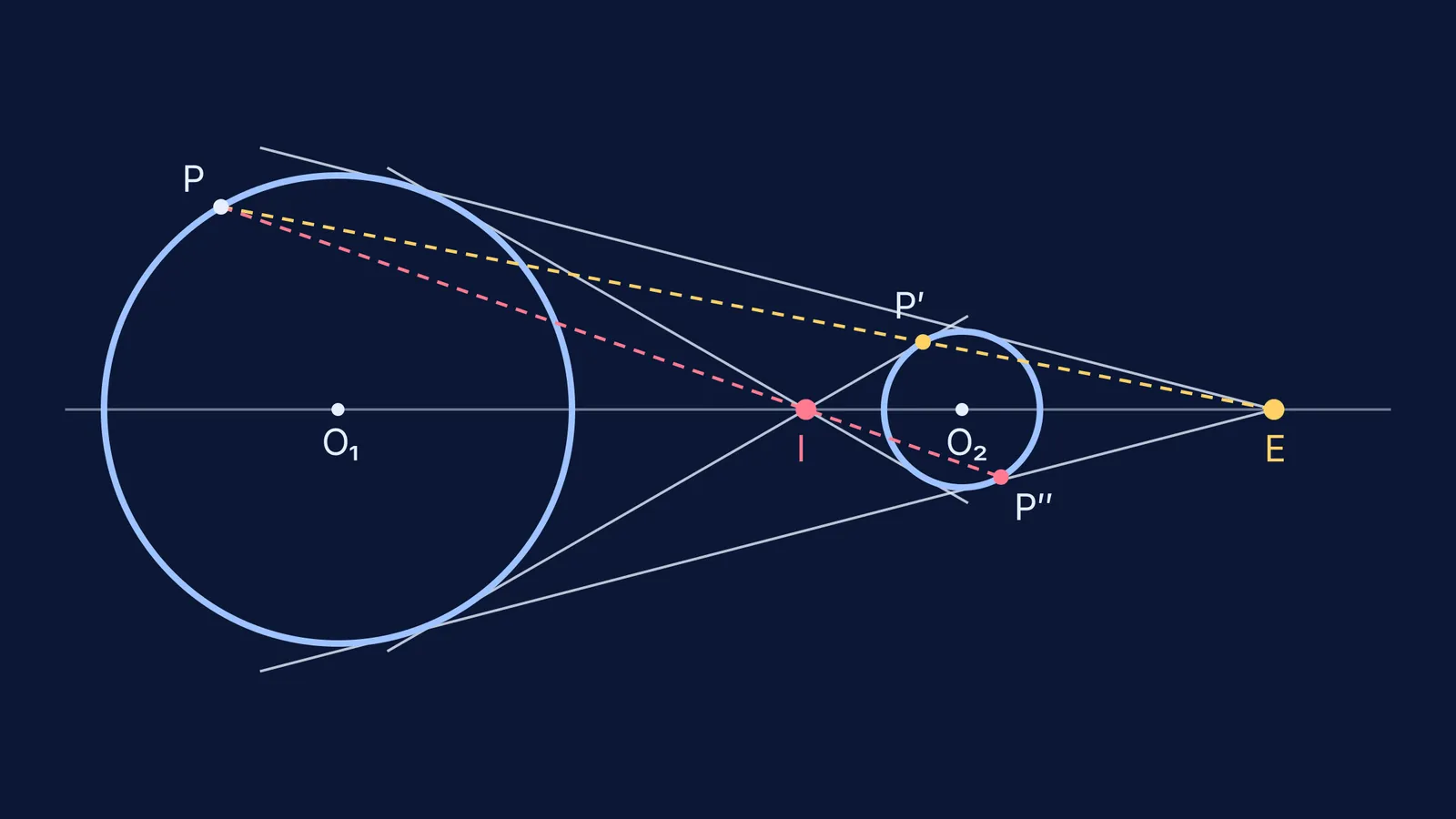
A centre of similarity (or homothetic centre) is a point from which one figure is a dilation or contraction of the other (Wikipedia: Homothetic center). Two circles have an external centre and an internal centre, both on the line joining their centres. A common tangent passes through the external centre if the circles lie on the same side of it, and through the internal centre otherwise. Equal radii give no external centre in the ordinary plane.
The homothety that sends circle 1 to circle 2 must send O₁ to O₂, with k = r₂/r₁ (external) or k = −r₂/r₁ (internal).
Worked example. Circle 1 has centre O₁ = (0, 0) and radius 3; circle 2 has centre O₂ = (8, 0) and radius 1.
External centre, k = 1/3. Solve E + (1/3)(O₁ − E) = O₂ on the x-axis: (2/3)E = 8, so E = (12, 0). Check: EO₁ = 12 and EO₂ = 4, a ratio of 3 : 1, the ratio of the radii.
Internal centre, k = −1/3. Solve I − (1/3)(O₁ − I) = O₂: (4/3)I = 8, so I = (6, 0). Check: IO₁ = 6 and IO₂ = 2, again 3 : 1.
Tangent check. From E, the tangent angle has sine 3/12 = 1/4 for circle 1 and 1/4 for circle 2, so one line touches both. From I the sines are 3/6 and 1/2.
In general, E = (r₁O₂ − r₂O₁)/(r₁ − r₂) and I = (r₁O₂ + r₂O₁)/(r₁ + r₂). The diagram at the top is this example.
How does homothety prove points are collinear?
A centre, a point and its image always lie on one line, so to prove three points collinear, look for a homothety centred at one of them. The second tool is composition: two homotheties with different centres and ratios k₁ and k₂, where k₁k₂ ≠ 1, combine into a homothety of ratio k₁k₂. Its centre lies on the line through the first two centres (Wikipedia: Homothety).
Monge's theorem, named after Gaspard Monge, is about three circles in a plane, none completely inside another. It says that the three points where pairs of external tangents meet are collinear (Wikipedia: Monge's theorem). Those meeting points are the external centres of similarity. That page's proofs use cones in 3D, Desargues' theorem or Menelaus' theorem; composition is shorter when all three radii differ:
The homothety about A with ratio r₂/r₁ sends circle 1 to circle 2.
The homothety about B with ratio r₃/r₂ sends circle 2 to circle 3.
Together they send circle 1 to circle 3 with ratio r₃/r₁, which is positive and not 1, so their combined centre lies on line AB.
The only positive-ratio homothety taking circle 1 to circle 3 is the one about their external centre C. So C lies on AB.
Compare the algebraic route in our complex-number test for collinear and concyclic points, or try the Simson line proof, another collinearity.
A checklist for spotting a homothety
Two similar figures with matching sides parallel: look for a centre where the joining lines meet.
Two circles that touch: the point of contact is a centre of similarity.
A triangle and its medial triangle: the centroid is the centre, with k = −1/2.
"Prove these three points are collinear": ask whether one of them could be a centre.
Before computing, decide the sign of k: same side of the centre means positive.
If a step stalls, the Fermi Problem Library has worked problems with a step-by-step solver that explains the reasoning rather than printing an answer. The Fermi Concept Library gives each mathematics concept, from similarity to transformations, its own lesson.
Redraw the two-circle example yourself, then change one radius and predict where E and I move before you calculate.


