On this page
When you titrate iodine against sodium thiosulphate, each thiosulphate ion gives up one electron, each iodine molecule takes two, and the sulphur-containing product is the tetrathionate ion, S4O6²⁻. Balanced, the reaction is 2S2O3²⁻ + I2 → S4O6²⁻ + 2I⁻, and it appears as equation 7.60 in the NCERT Class 11 Chemistry chapter on redox reactions. Here is how to balance it, and why sulphur ends up at 2.5.
What happens when sodium thiosulphate reacts with iodine?
Iodine is the oxidising agent and is reduced to iodide. Thiosulphate is the reducing agent: two of its ions join through a new sulphur–sulphur bond to make one tetrathionate ion. NCERT notes that iodine gives an intense blue colour with starch and has a very specific reaction with thiosulphate, so the blue disappears as soon as thiosulphate uses up the iodine, which makes the end point easy to track (NCERT, section 7.3.3). For the full titration method, see our guide to iodometric vs iodimetric titration with worked calculations.
How do you balance 2S2O3²⁻ + I2 → S4O6²⁻ + 2I⁻?
Start from the skeleton S2O3²⁻ + I2 → S4O6²⁻ + I⁻ and use the half-reaction method.
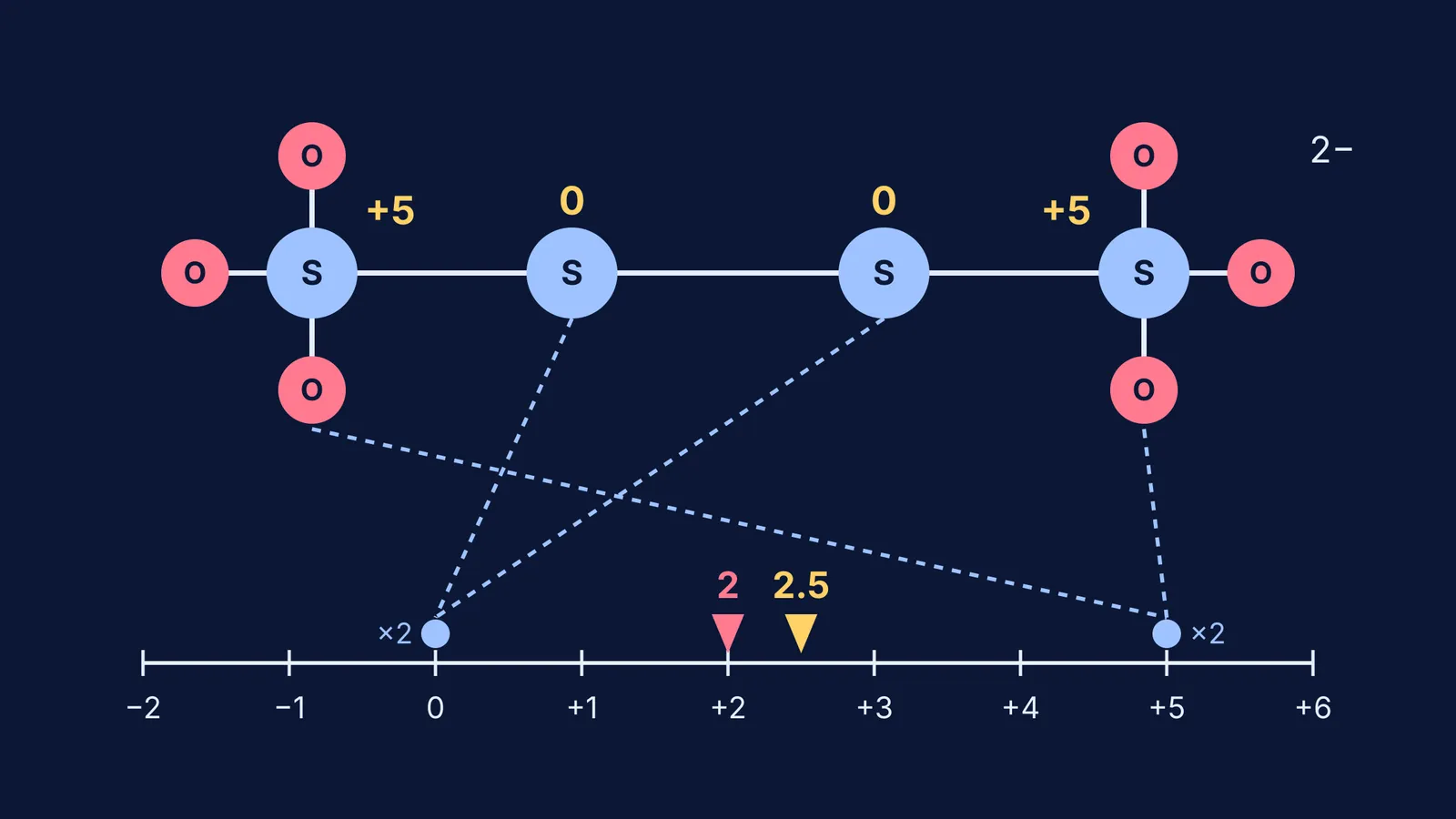
Assign average oxidation numbers. In S2O3²⁻, 2x + 3(−2) = −2, so x = +2. In S4O6²⁻, 4x + 6(−2) = −2, so x = +2.5. Iodine goes from 0 in I2 to −1 in I⁻.
Write the oxidation half and balance sulphur: 2S2O3²⁻ → S4O6²⁻. Four sulphurs each rise by 0.5, a total rise of 2. So 2S2O3²⁻ → S4O6²⁻ + 2e⁻.
Write the reduction half: I2 + 2e⁻ → 2I⁻. Two iodine atoms each fall by 1, a total fall of 2.
The electrons already match, so add the halves: 2S2O3²⁻ + I2 → S4O6²⁻ + 2I⁻.
Check. Atoms: 4 S, 6 O and 2 I on each side. Charge: −4 on the left; −2 + 2(−1) = −4 on the right. No H⁺, OH⁻ or water is needed.
For more practice, see our post on practising redox balancing with the ion-electron method.
Why is the oxidation state of sulphur in tetrathionate 2.5?
NCERT's rule is that when an element appears more than once in a formula, as sulphur does in Na2S2O3, the oxidation number you calculate is the average over all those atoms (NCERT Class 11, Unit 7). A fraction is a sign that the atoms are not all in the same state.
The same chapter's box on the paradox of fractional oxidation numbers settles tetrathionate: the two end sulphurs are +5 and the two middle sulphurs are 0, and (5 + 0 + 0 + 5) ÷ 4 = 2.5. Each end sulphur is bonded to three oxygen atoms, which pull electrons away from it. The middle sulphurs are bonded only to sulphur, and a bond between identical atoms moves no electrons in the book-keeping, so they stay at 0. Wikipedia's tetrathionate article gives the same split: two sulphurs at 0 and two at +5.
NCERT gives C3O2 (carbon at 4/3) and Br3O8 (bromine at 16/3) as other averages of this kind. Our post on finding the fraction of Fe³⁺ ions in Fe0.93O applies the same idea to a solid.
Does the average give wrong answers in exam questions?
For balancing and stoichiometry, no. It misleads you only in structure questions, such as how many sulphur atoms in S4O6²⁻ are in the zero oxidation state (two). A quick routine for any fractional oxidation number:
Calculate the average from the formula and the charge.
Ask whether the question is about electrons (use the average) or about particular atoms (draw the structure).
In the structure, count bonds to more electronegative atoms; bonds between identical atoms count as zero.
Worked example: a titration calculation
Using the 2 : 1 ratio from NCERT equation 7.60, suppose 20.0 mL of 0.100 M sodium thiosulphate is needed to remove the starch–iodine blue. Moles of thiosulphate = 0.0200 L × 0.100 mol/L = 0.00200 mol. Moles of I2 = 0.00200 ÷ 2 = 0.00100 mol. If that iodine was in 25.0 mL of solution, its concentration was 0.00100 ÷ 0.0250 = 0.0400 M.
Get the ratio backwards and every later answer is off by a factor of four, so write the balanced equation before you touch the numbers. The Fermi Problem Library has worked problems with a step-by-step solver that explains the reasoning rather than printing an answer, so you can see exactly where a ratio slipped. If the gap is the idea of oxidation number itself, the Fermi Concept Library gives each concept its own lesson and its place in the map.
Next time you meet a fraction like 2.5 or 4/3, sketch the structure before you trust the number.