

On this page
The two names differ by one letter, but the difference decides what goes in the burette, when you add starch and which mole ratio you use.
What is the difference between iodometric and iodimetric titration?
The cleanest definition comes from a University of Delaware quantitative chemistry lab manual. If a standard iodine solution is the titrant for a substance that can be oxidised, the technique is iodimetry. If excess iodide reacts with an oxidising agent to form iodine, and that iodine is then titrated with thiosulphate, the technique is iodometry.
Iodimetry (direct): iodine goes in the burette. It measures reducing agents. Wikipedia's iodometry article gives sulphites and hydrogensulphites as its iodimetry example.
Iodometry (indirect): sodium thiosulphate goes in the burette. It measures oxidising agents. The same article lists copper(II), chlorate, hydrogen peroxide and dissolved oxygen.
The starch end point runs in opposite directions. The Delaware manual says the end point in iodimetry is a sudden change to blue, and in iodometry it is a sudden loss of blue. In iodometry, add the starch only once the yellow-brown iodine colour has started to fade, because a lot of iodine can damage the starch.
What is the thiosulphate-iodine ratio?
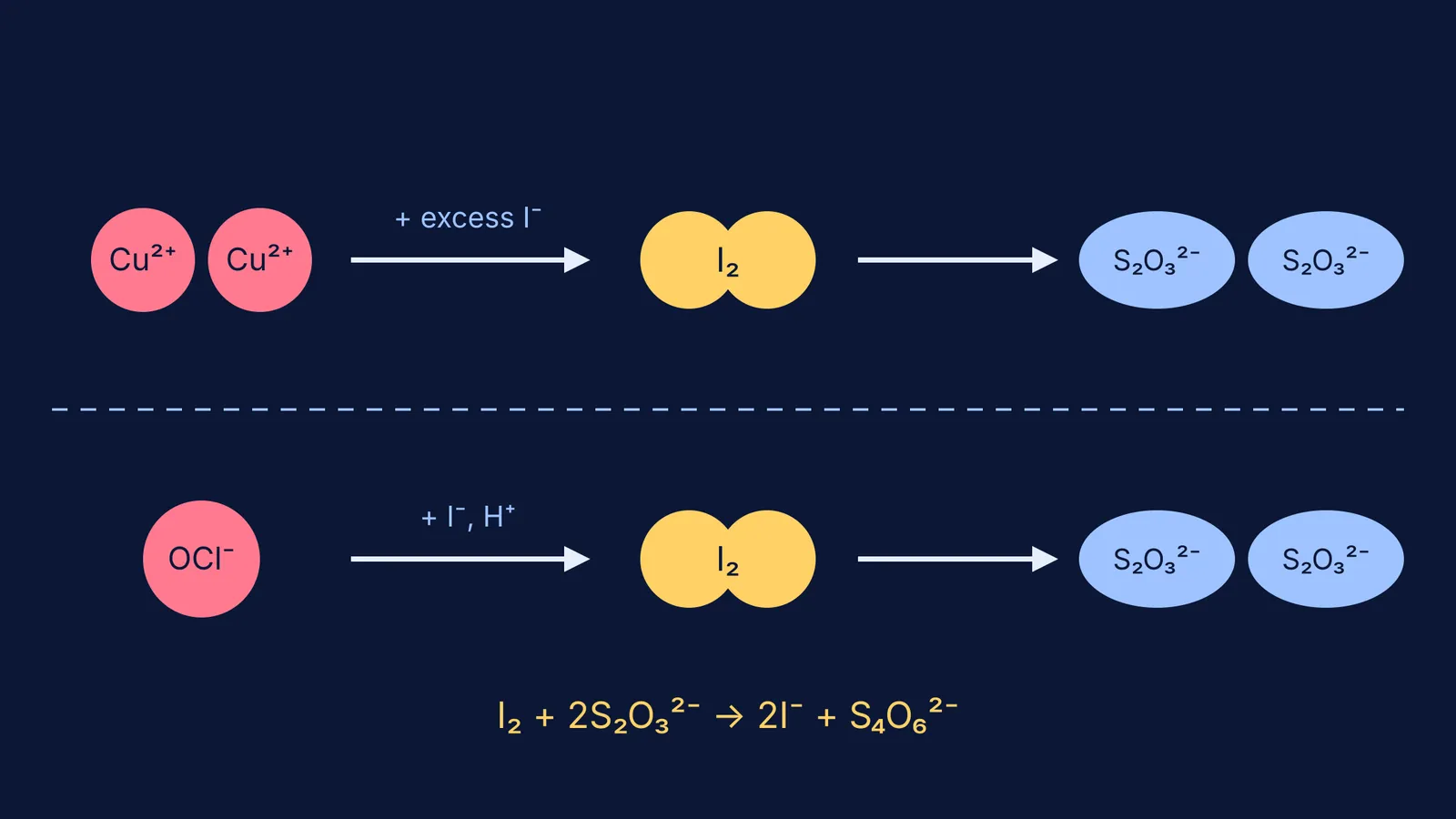
Iodometric calculations all run through one equation: I₂ + 2S₂O₃²⁻ → 2I⁻ + S₄O₆²⁻, so one mole of iodine uses two moles of thiosulphate (LibreTexts, iodometric copper in brass). Thiosulphate goes from an average sulphur oxidation state of +2 to +2.5 in tetrathionate. That means it loses one electron per ion, so its n-factor is 1. If equivalents feel shaky, revise them in our post on the n-factor and the equivalent concept in redox titrations before you go on.
How do you calculate copper content by iodometric titration?
Cu²⁺ oxidises iodide and precipitates as copper(I) iodide: 2Cu²⁺ + 4I⁻ → 2CuI + I₂ (titrations.info). Combining this with the thiosulphate step gives a 1:1 ratio between Cu²⁺ and S₂O₃²⁻. The same source says the reaction works best in slightly acidic solution, around pH 4 to 5. It also warns that thiosulphate solutions are not stable and should be standardised every 2 to 3 months.
Worked example: a 0.300 g brass sample is dissolved and buffered, then excess KI is added. The liberated iodine needs 31.5 mL of 0.100 M sodium thiosulphate.
Moles of thiosulphate = 0.100 × 0.0315 = 3.15 × 10⁻³ mol.
Moles of Cu²⁺ = 3.15 × 10⁻³ mol (1:1 ratio).
Mass of Cu = 3.15 × 10⁻³ × 63.55 = 0.200 g.
Percentage of copper = 0.200 ÷ 0.300 × 100 = 66.7%.
The common mistake is halving or doubling at step 2. The 2:1 ratio between Cu²⁺ and I₂ cancels the 1:2 ratio between I₂ and thiosulphate.
How do you find available chlorine in bleaching powder?
Available chlorine expresses a bleach's oxidising power as an equivalent mass of chlorine gas. Wikipedia's article on percent active chlorine defines it as the bleaching capacity of the same mass of free chlorine, usually measured by iodometric titration, where 2 moles of thiosulphate are equivalent to 70.9 g of active chlorine. In acid, hypochlorite releases iodine one-for-one: OCl⁻ + 2I⁻ + 2H⁺ → I₂ + Cl⁻ + H₂O (Le Moyne College bleach lab).
Worked example: 2.50 g of bleaching powder is shaken with water and made up to 250 mL. A 25.0 mL portion is treated with excess KI and acid. The iodine needs 22.0 mL of 0.100 M thiosulphate.
Moles of thiosulphate = 0.100 × 0.0220 = 2.20 × 10⁻³ mol.
Moles of I₂ = moles of Cl₂ equivalent = 1.10 × 10⁻³ mol.
Mass of available chlorine = 1.10 × 10⁻³ × 70.9 = 0.0780 g.
Powder in the portion = 2.50 × 25.0 ÷ 250 = 0.250 g.
Available chlorine = 0.0780 ÷ 0.250 × 100 = 31.2%.
The usual trap is step 4. Forgetting the dilution gives an answer ten times too small. The same logic of reacting with excess and then titrating what is left over appears in back titration problems on purity.
How do you solve any iodine titration question?
Check the burette. Iodine means iodimetry, which measures a reductant. Thiosulphate means iodometry, which measures an oxidant.
Write the analyte-to-I₂ equation and the I₂ + 2S₂O₃²⁻ equation.
Cancel I₂ to get the analyte-to-thiosulphate ratio before you use any numbers.
Account for dilutions, then convert to mass or percentage last.
Our walk-through of titrating oxalic acid with KMnO₄ builds the same mole-ratio habit. If your answer is off by a factor of two, the Fermi Problem Library has worked problems with a step-by-step solver that explains the reasoning rather than printing an answer, so you can see where the ratio slipped.


