On this page
The ion-electron method is one of those Class 11 topics where you can follow every line of a solved example and still freeze in front of a blank page. A chatbot will balance the whole equation for you, and it will feel as if you learnt it. A better routine: balance it yourself first, then use the AI as a checker, one step at a time.
Why should you balance it yourself before asking AI?
A 2025 field experiment by Hamsa Bastani and colleagues, published in PNAS, gave nearly a thousand high school maths students access to GPT-4 tutors during practice. With a standard ChatGPT-style tutor, practice grades rose by 48% while students had access. When access was taken away, those same students scored 17% lower than students who never had it. The authors write that, without guardrails, students tried to use GPT-4 as a “crutch” during practice. A second version, with prompts designed to safeguard learning, largely removed this harm.
The lesson for redox is simple: the steps you hand over are the steps you never practise. Keep the AI out of the doing and bring it in for the checking.
What are the steps of the ion-electron method?
The ion-electron (half-reaction) method splits a redox reaction into an oxidation half and a reduction half, balances each separately, and adds them so that electrons lost equal electrons gained. OpenStax Chemistry 2e lists the steps as:
Write skeleton equations for the two half-reactions.
Balance every element except O and H.
Balance O by adding H₂O.
Balance H by adding H⁺.
Balance charge by adding electrons.
Multiply so both halves transfer the same number of electrons.
Add the halves and cancel anything that appears on both sides.
In basic solution, add OH⁻ to both sides to turn each H⁺ into H₂O, then cancel again.
Some teachers add OH⁻ inside each half instead; both routes give the same answer.
How do you balance a redox equation in basic medium?
A classic: permanganate oxidises iodide to iodate in basic solution. The skeleton is MnO₄⁻ + I⁻ → MnO₂ + IO₃⁻. Try it on paper before reading on.
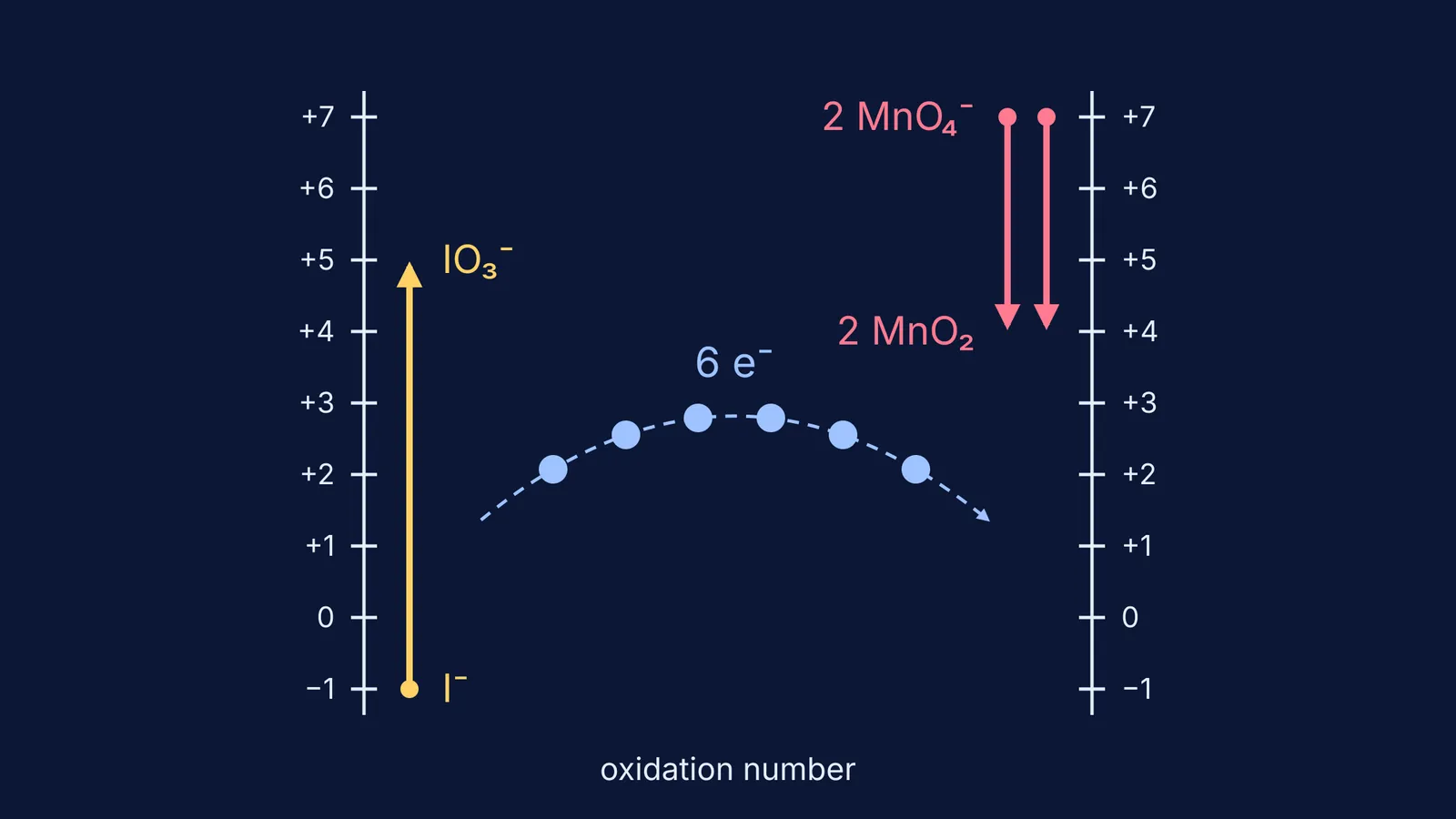
Oxidation half: iodine goes from −1 to +5, so it loses 6 electrons. Add 3H₂O on the left and 6H⁺ on the right: I⁻ + 3H₂O → IO₃⁻ + 6H⁺ + 6e⁻. Charge: −1 on each side.
Reduction half: manganese goes from +7 to +4, gaining 3 electrons: MnO₄⁻ + 4H⁺ + 3e⁻ → MnO₂ + 2H₂O. Charge: 0 on each side.
Match electrons: double the reduction half so both halves involve 6e⁻.
Add and cancel: 2MnO₄⁻ + I⁻ + 2H⁺ → 2MnO₂ + IO₃⁻ + H₂O.
Make it basic: add 2OH⁻ to both sides, turn 2H⁺ + 2OH⁻ into 2H₂O, and cancel one H₂O. Final: 2MnO₄⁻ + I⁻ + H₂O → 2MnO₂ + IO₃⁻ + 2OH⁻.
Now run the two-line check. Each side has 2 Mn, 1 I, 9 O and 2 H, and a total charge of −3.
What should you ask the AI to check?
Paste in your working, not just the question, and ask for one check at a time so you find your own mistake. Copy this script:
“Here is my oxidation half-reaction. Don't give me the answer. Are the atoms balanced? If not, which element is off?”
“Is the charge equal on both sides of each half? Show me only the totals.”
“Does my electron count match the change in oxidation number?”
“The medium is basic. Is there any H⁺ left in my final equation?”
“Give me a similar reaction in acidic medium to try next, without the answer.”
Don't treat the AI's reply as the final word either. The same PNAS paper notes that generative AI “is fallible and users must check its outputs”. If you disagree, count atoms and charges again until you know who is right.
How can you practise this in a week?
Days 1–2: three acidic-medium problems, such as dichromate with Fe²⁺. Your final equation should carry the same total charge on both sides.
Days 3–4: three basic-medium problems, like the permanganate example above.
Day 5: a mixed set, timed, with no AI until every problem is done.
Day 6: AI checks using the script, and a note of each error type: atoms, charge, electrons or medium.
Day 7: redo only the problems you got wrong, from a blank page.
If the same kind of error keeps coming back, the Fermi Problem Library has worked problems with a step-by-step solver that explains the reasoning rather than printing an answer. Fermi's AI tutor notices where a student is stuck and decides whether to explain, ask or show, so a wrong electron count becomes a question for you to answer, not a correction to copy.
Pick one equation from your textbook tonight, balance it yourself, and only then open the chat.