On this page
If you have made an iodine solution in the lab, you know the trick: you dissolve iodine in potassium iodide (KI) solution, not plain water. The reason is a small ion with a neat shape, and the same reasoning explains a family of ions that turn up in JEE and board exams.
Why does iodine dissolve in KI solution but not in water?
Iodine (I2) is a non-polar molecule, so water has little to hold on to. The WHO's background document on iodine in drinking-water lists its water solubility as 0.34 g per litre at 25 °C.
Add iodide ions and the picture changes. I2 combines with I− in the equilibrium I2 + I− ⇌ I3−, forming the triiodide ion. In this reaction iodide acts as a Lewis base and iodine as a Lewis acid, as the Wikipedia summary of triiodide puts it. Because I3− is an ion, water can solvate it much better than neutral I2, so tying I2 up as triiodide lets more solid iodine dissolve.
The same source notes that Lugol's iodine, made from potassium iodide and iodine, contains significant triiodide, and that triiodide gives the blue-black starch colour; iodide alone does not react with starch.
What shape is the I3− ion, and why is it linear?
Treat it as a VSEPR problem. If you need a refresher on the method itself, our guide to predicting molecular shapes with VSEPR covers the basics.
Pick the central atom: the middle iodine, bonded to the two outer iodines.
Count electrons around it: 7 valence electrons of iodine, plus 1 from each of the 2 bonded atoms, plus 1 for the negative charge. That gives 7 + 2 + 1 = 10.
Divide by 2: 5 electron pairs, so the electron geometry is trigonal bipyramidal.
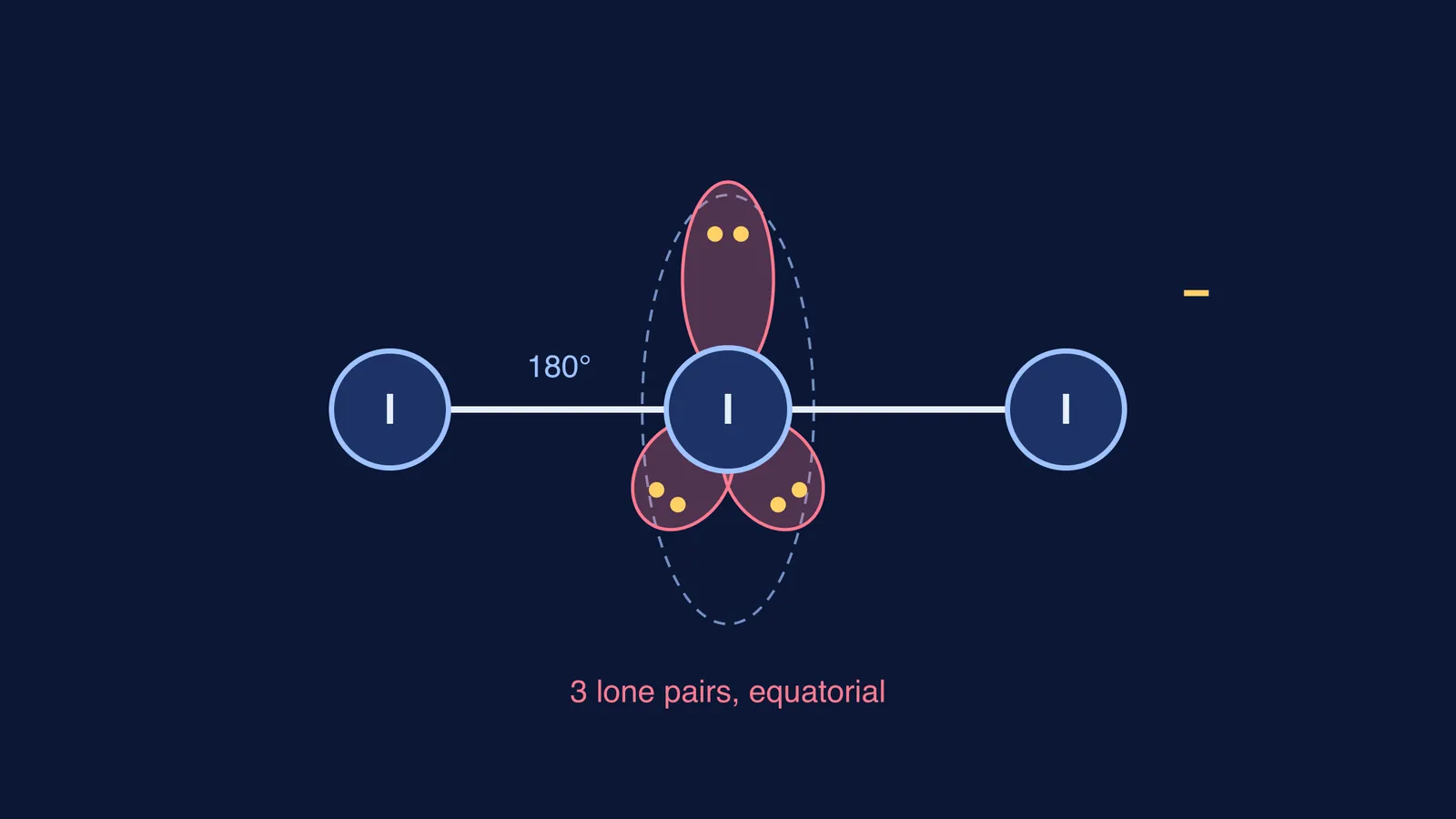
Two pairs are bonds, so three are lone pairs.
Place the lone pairs in the equatorial positions, where they sit at 120° to each other instead of 90°, which keeps repulsion lowest.
The two bonded iodines are left on the axial positions, directly opposite each other. The ion is linear, with a bond angle of 180°.
The triiodide article confirms it: three equatorial lone pairs, with the terminal iodines bonded axially. In molecular orbital language, the central bonding is often described as a three-centre four-electron bond.
The same rule decides the shapes of SF4 and ClF3; our post on why lone pairs go equatorial in a trigonal bipyramid works through those cases.
Why do other polyhalide ions like ICl2− form?
I3− is one member of a larger family. When a halide ion meets a halogen or interhalogen molecule, the molecule can act as a Lewis acid and accept it. ICl takes up Cl− to give ICl2−, with the larger, less electronegative iodine in the centre. Iodine is large enough to accommodate five electron pairs around it, which is why it so often ends up as the central atom.
The electron count is identical to I3−: 7 + 2 + 1 = 10, five pairs, three lone pairs, linear. Crystal structures agree. A 2009 study in Acta Crystallographica Section E reported Cl–I–Cl angles of 179.55° and 178.30° in the two ICl2− anions it measured, and described them as linear and nearly linear.
For the neutral molecules these ions are built from, see our guide to shapes of interhalogen compounds.
How do you find the shape of any polyhalide ion quickly?
Use one formula for the number of electron pairs around the central atom, where each bonded atom is a halogen: (valence electrons of central atom + number of atoms bonded to it − positive charge + negative charge) ÷ 2. Then subtract the bonds to get lone pairs.
Practice set:
I3−: (7 + 2 + 1) ÷ 2 = 5 pairs, 3 lone pairs, linear.
ICl2−: (7 + 2 + 1) ÷ 2 = 5 pairs, 3 lone pairs, linear.
ICl2+: (7 + 2 − 1) ÷ 2 = 4 pairs, 2 lone pairs, bent.
ICl4−: (7 + 4 + 1) ÷ 2 = 6 pairs, 2 lone pairs, square planar.
Notice the pair ICl2− and ICl2+. Same atoms, but going from a −1 to a +1 charge removes two electrons, one lone pair, and the shape changes from linear to bent. This contrast is easy to miss, so always read the sign of the charge before you count.
If you want to see where VSEPR, Lewis acids and hypervalent bonding connect, the Fermi Concept Library gives each chemistry concept its own lesson and its place in the map. For practice, the Fermi Problem Library has worked problems with a step-by-step solver that explains the reasoning rather than printing an answer, so you can check your electron counts one step at a time.
Next time you see a brown iodine solution made with KI, you know much of the iodine in it is triiodide: a straight line of three iodine atoms.