

On this page
When a central atom is surrounded by five regions of electron density, it adopts a trigonal bipyramidal electron-pair geometry. But when some of these regions are non-bonding lone pairs—as in sulfur tetrafluoride (SF4), chlorine trifluoride (ClF3), or xenon difluoride (XeF2)—a structural choice must be made. Do the lone pairs go to the "top and bottom" axial sites, or the "around the middle" equatorial sites?
According to Valence Shell Electron Pair Repulsion (VSEPR) theory, lone pairs always choose the equatorial positions. Understanding why this happens is the key to mastering the molecular shapes of these compounds without relying on pure memorisation.
Why do lone pairs occupy equatorial positions?
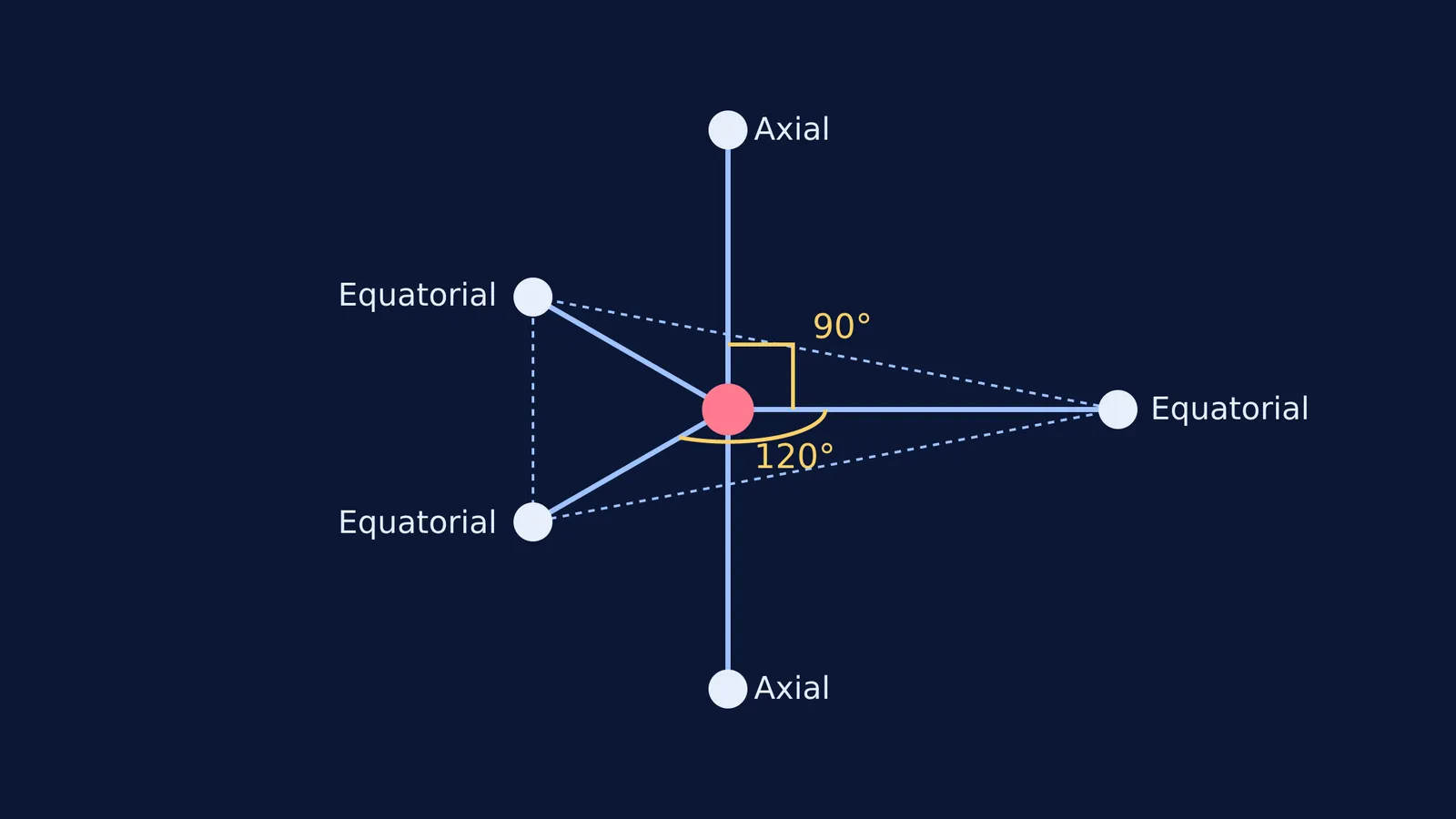
To understand this preference, we first need to look at the unique geometry of a trigonal bipyramid. Unlike a perfect tetrahedron or octahedron, the five positions in a trigonal bipyramid are not equivalent:
Axial positions: These two sites sit on the vertical axis, directly opposite each other. An electron pair in an axial position is surrounded by three neighboring equatorial pairs at a 90° angle.
Equatorial positions: These three sites form a flat triangle around the equator of the molecule. An electron pair here has only two neighbors at 90° (the axial pairs) and two neighbors at a much wider 120° (the other equatorial pairs).
Why does this matter for lone pairs? A bonding pair of electrons is shared between two positively charged nuclei, which pulls the electron cloud into a tight, focused region. A lone pair, however, is attracted to only one nucleus. Without a second nucleus to anchor it, its electron cloud spreads out closer to the central atom, taking up significantly more volume.
Because they occupy more space, lone pairs exert stronger repulsive forces on neighboring electrons. To achieve the most stable, lowest-energy state, molecules arrange themselves to keep lone pairs as far away from other electron pairs as possible. By occupying equatorial positions, lone pairs benefit from the spacious 120° angles and encounter only two tight 90° repulsions, rather than the three they would face at an axial site.
If you struggle to picture these 3D repulsions from flat 2D textbook diagrams, the Fermi Concept Library has every concept in chemistry, each with its own lesson and its place in the map.
Why is SF4 a see-saw and ClF3 T-shaped?
When we apply this repulsion rule to specific molecules, we see exactly how equatorial lone pairs dictate the final molecular structure.
Sulfur tetrafluoride (SF4) has five electron domains around the central sulfur atom: four single bonds to fluorine and one lone pair.
If the lone pair were axial, it would suffer three 90° repulsions from the equatorial bonds.
Placed equatorially, it suffers only two 90° repulsions from the axial bonds.
The lone pair takes an equatorial slot, pushing the remaining four bonds slightly away. The resulting molecular shape—the visible arrangement of the atoms—resembles a see-saw.
Chlorine trifluoride (ClF3) has five domains: three bonds to fluorine and two lone pairs.
If both lone pairs were axial, they would experience strong 90° repulsions with all three equatorial bonding pairs.
If both are equatorial, they only have two 90° repulsions each, and they are separated from each other by a 120° angle.
Because both lone pairs occupy the equatorial positions, the three fluorine atoms are left to form a distinct "T-shape" with the central chlorine atom.
Why is XeF2 a linear molecule?
Xenon difluoride (XeF2) takes this geometric pattern to its logical conclusion. The central xenon atom is surrounded by two bonds to fluorine and three lone pairs.
To minimize the intense lone pair-lone pair repulsions, all three lone pairs occupy the three available equatorial positions. This symmetrical arrangement leaves them separated from each other by exactly 120°, completely avoiding any 90° interactions between them.
The two fluorine atoms are subsequently forced into the remaining axial positions. Because the axial positions are exactly 180° apart, the resulting molecular structure of XeF2 is perfectly linear.
VSEPR Decision Table for 5 Electron Domains
When faced with a trigonal bipyramidal electron geometry in an exam, use this simple step-by-step framework to deduce the final shape:
Count the domains: Confirm the central atom has 5 regions of electron density.
Place the lone pairs: Always put them in the equatorial sites first.
Determine the shape:
1 Lone Pair (e.g., SF4): Leaves 4 bonds in a see-saw shape.
2 Lone Pairs (e.g., ClF3): Leaves 3 bonds in a T-shaped molecule.
3 Lone Pairs (e.g., XeF2): Leaves 2 bonds in a linear molecule.
Understanding why these geometric shapes form is far more reliable for exams than pure memorisation. By focusing on the principle of minimizing 90° repulsions, you can reliably reconstruct the shape of any five-domain molecule from first principles.
To practice applying these rules to other complex molecules, the Fermi Problem Library has worked problems with a step-by-step solver that explains the reasoning rather than printing an answer.


