

On this page
In the chemistry of lanthanoids (the f-block elements ranging from cerium to lutetium in the periodic table), the most stable oxidation state in aqueous solution is always +3. However, some specific elements can also form +2 or +4 ions because of the extra thermodynamic stability provided by empty, half-filled, or completely filled f-subshells.
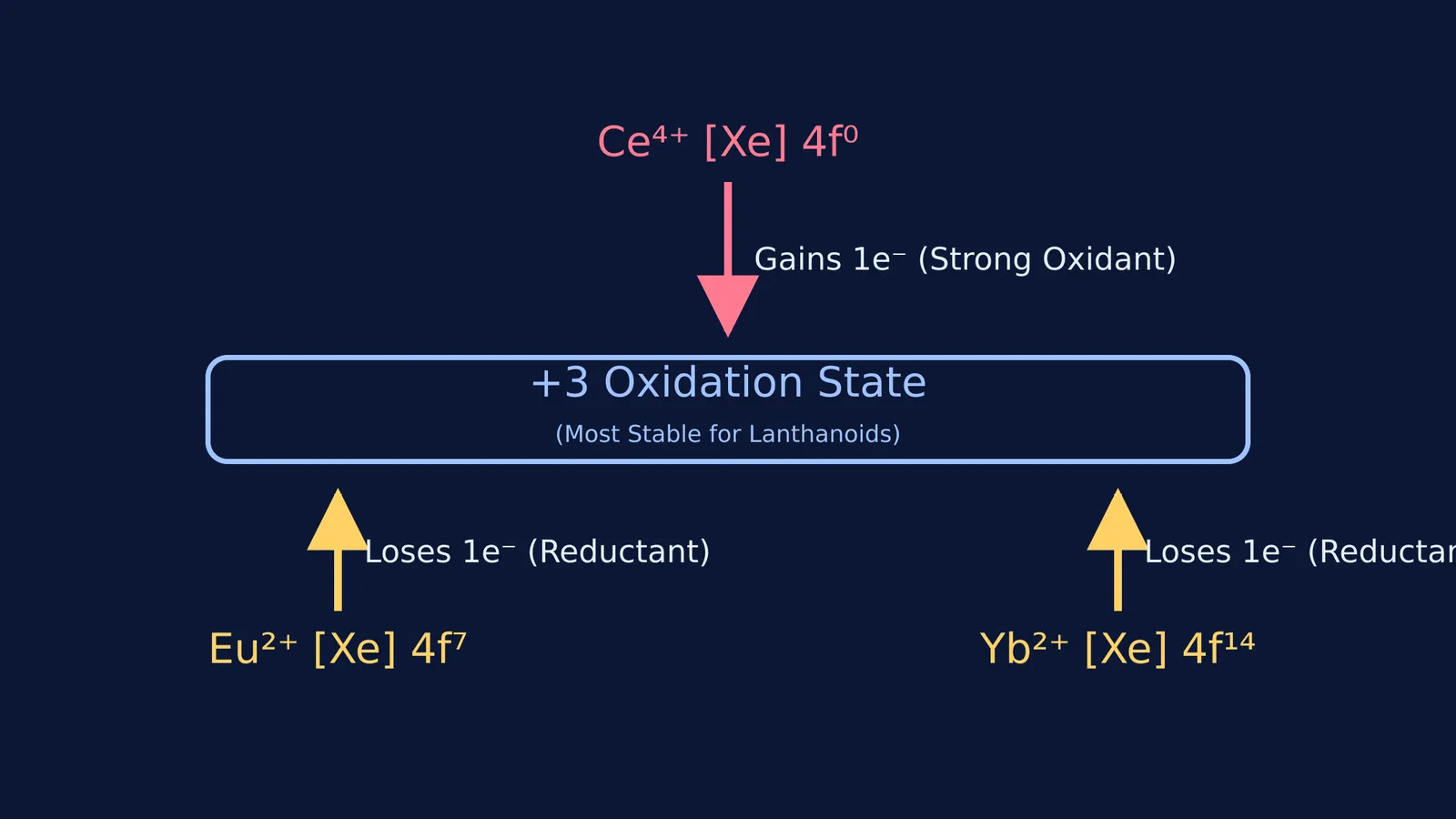
When these unusual states do form, they become highly reactive. Ions in the +4 oxidation state strongly want to gain an electron to return to the stable +3 state, while ions in the +2 state want to lose one electron. This inherent chemical drive to reach the universal +3 state explains their distinct behaviour as strong oxidising and reducing agents.
Why is Ce⁴⁺ a strong oxidising agent?
An oxidising agent takes electrons from another substance. Cerium (atomic number 58) has a neutral electron configuration of [Xe] 4f¹ 5d¹ 6s². When it loses four electrons to form Ce⁴⁺, it achieves the completely empty f-subshell configuration of [Xe] 4f⁰.
While this noble gas configuration allows Ce⁴⁺ to form, the thermodynamic "sink" for all lanthanoids remains the +3 state. Because it is highly favourable for Ce⁴⁺ to gain one electron and return to Ce³⁺, it acts as a strong oxidant.
The standard reduction potential (E°) for the Ce⁴⁺/Ce³⁺ couple is +1.72 V (Wikipedia). This large, positive value means the reduction reaction (Ce⁴⁺ + e⁻ → Ce³⁺) is highly spontaneous. It is such a reliable oxidant that Ce⁴⁺ solutions are widely used in volumetric analysis, a technique known as cerimetry.
Why are Eu²⁺ and Yb²⁺ strong reducing agents?
A reducing agent gives up electrons. Europium (atomic number 63) and Ytterbium (atomic number 70) form +2 ions because doing so grants them special electronic stability.
Europium loses its two 6s electrons to form Eu²⁺, which has a half-filled f-subshell: [Xe] 4f⁷. Ytterbium loses its two 6s electrons to form Yb²⁺, achieving a completely filled f-subshell: [Xe] 4f¹⁴.
Despite the extra stability of f⁷ and f¹⁴, both ions still "prefer" the universal +3 state in aqueous environments. To get there, they must lose an electron, which makes them strong reducing agents.
The standard reduction potential for the Eu³⁺/Eu²⁺ couple is −0.35 V, and for Yb³⁺/Yb²⁺ it is −1.05 V (Wikipedia). A negative standard reduction potential means that the reverse reaction (oxidation from +2 to +3) occurs readily, allowing these ions to reduce other species in solution.
How to predict reagent behaviour from E° values?
You can always tell whether an ion will act as an oxidant or a reductant by looking at its standard reduction potential.
A framework for predicting reactivity:
Identify the standard state: For lanthanoids, this is always +3.
Check the ion's current state: Is it above +3 (like +4) or below +3 (like +2)?
Look at the E° value:
A highly positive E° (e.g., Ce⁴⁺/Ce³⁺ at +1.72 V, per Wikipedia) means the ion strongly wants to be reduced. It will act as an oxidising agent.
A negative E° (e.g., Eu³⁺/Eu²⁺ at −0.35 V, per Wikipedia) means the ion resists reduction and prefers to be oxidised. It will act as a reducing agent.
If memorising these changes leaves you stuck on a blank page, you can trace the logic in the Fermi Concept Library. Fermi's AI tutor works out what you already know, builds a plan for the session, and teaches through it — writing on a board and checking understanding as it goes.
Related chemistry topics
To see how these principles apply across the periodic table, read about Oxidation states of transition metals: which are stable and why. You can also learn how to determine Oxidation numbers from structure: Fe3O4, S4O6²⁻ and CrO5 or review the rules for the Electron configuration of ions like Fe³⁺ and Cu⁺: which go first.


