

On this page
Paracetamol (acetaminophen) is N-(4-hydroxyphenyl)ethanamide: a benzene ring with an OH group and an NHCOCH₃ group opposite each other. You can make it from phenol in three steps that are all in the class 12 syllabus: nitrate the ring, reduce the nitro group, then acetylate the amine. This is a textbook route, not the way every factory does it. Industrial processes vary, for example starting from p-nitrochlorobenzene or making p-aminophenol directly. The value of the textbook route is that each step tests one idea you already know, and the last step asks a question students often miss: why does acetic anhydride react with the NH₂ and not the OH? How paracetamol acts in the body is a separate story, told in how paracetamol works against fever and pain. This post stays with the chemistry.
What are the three steps from phenol to paracetamol?
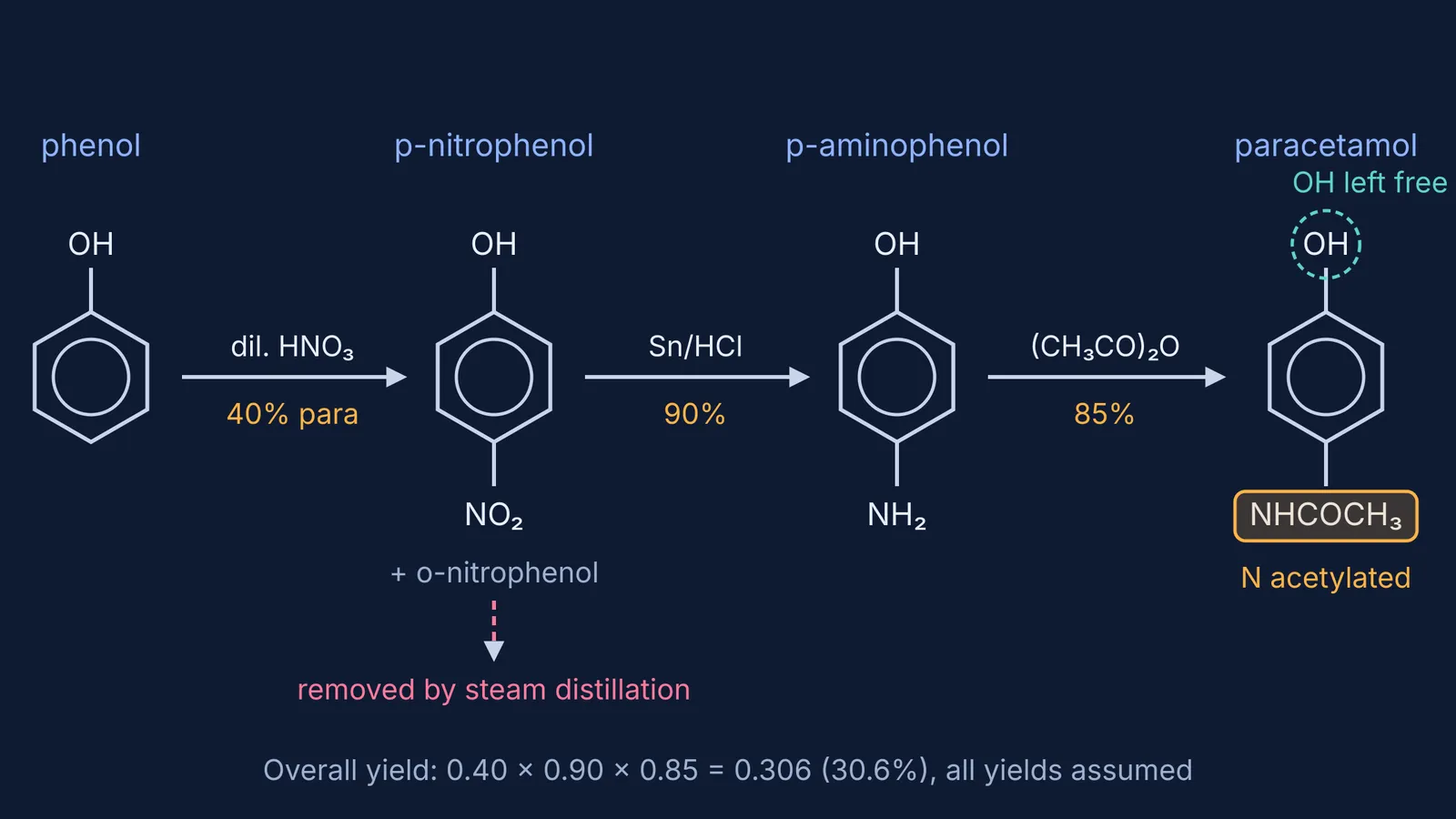
Nitration. C₆H₅OH + HNO₃ → HOC₆H₄NO₂ + H₂O (o- and p-nitrophenol)
Reduction. HOC₆H₄NO₂ + 6[H] → HOC₆H₄NH₂ + 2H₂O (p-aminophenol)
N-acetylation. HOC₆H₄NH₂ + (CH₃CO)₂O → HOC₆H₄NHCOCH₃ + CH₃COOH (paracetamol)
Check the last one: on the left there are 10 C, 13 H, 1 N and 4 O. On the right, paracetamol (C₈H₉NO₂) plus acetic acid (C₂H₄O₂) gives the same 10 C, 13 H, 1 N and 4 O.
The molar masses you need are phenol 94.11, p-nitrophenol 139.11, p-aminophenol 109.13 and paracetamol 151.16 g/mol.
Why does dilute HNO₃ give o- and p-nitrophenol, and how are they separated?
The OH group is a strong activating, ortho/para-directing group. Its lone pair feeds electron density into the ring, especially at the ortho and para positions. The ring is so activated that dilute nitric acid at room temperature is enough. Concentrated acid would go much further, towards 2,4,6-trinitrophenol (picric acid), and the nitric acid would also oxidise some of the phenol. That side of the story is covered in phenol nitration: nitrophenols and picric acid.
You get a mixture of the ortho and para isomers. The ratio depends on the conditions, so treat any yield for the para isomer as an assumption, not a fixed number.
Separation uses steam distillation. In o-nitrophenol, the OH and NO₂ groups are next to each other, so the H of the OH bonds to an O of the NO₂ inside the same molecule (intramolecular H-bonding). The molecules do not hold on to each other strongly, so the ortho isomer is volatile in steam. In p-nitrophenol the groups are too far apart for that. Instead, each molecule H-bonds to its neighbours (intermolecular H-bonding), so it is much less volatile and stays behind. The o-isomer distils over with the steam, and the p-isomer is left in the flask.
How is p-nitrophenol reduced to p-aminophenol?
The nitro group is reduced to an amino group, the same reaction you use to make aniline from nitrobenzene. Two common choices:
Sn and HCl (or Fe and HCl). With tin: HOC₆H₄NO₂ + 3Sn + 6HCl → HOC₆H₄NH₂ + 3SnCl₂ + 2H₂O. Each Sn gives two electrons, so three Sn supply the six electrons the nitro group needs. In the acid, the amine is actually present as its hydrochloride salt.
H₂ with a metal catalyst such as Pd or Ni, which gives water as the only by-product.
One work-up point: p-aminophenol is amphoteric (the NH₂ is basic and the phenolic OH is weakly acidic), so it is freed from its salt by careful neutralisation, not by adding a large excess of strong base.
Why does acetic anhydride acetylate the NH₂ and not the OH?
p-Aminophenol has two groups that could attack the anhydride: the NH₂ and the OH. Under mild conditions, the nitrogen wins. Here is why.
N is less electronegative than O. It holds its lone pair less tightly, so the lone pair is more available to attack the carbonyl carbon of the anhydride. Amines are better nucleophiles than neutral alcohols or phenols.
The phenolic O lone pair is tied up. It is delocalised into the ring, which makes it even less nucleophilic than the O of an ordinary alcohol.
Once N is acetylated, it stops reacting. The new amide N has its lone pair delocalised onto the C=O, so it does not react a second time. That is the same reason acetylation is used to tame aniline in why aniline is acetylated before nitration. In paracetamol, the acetyl group is not a temporary protecting group. It stays, because it is part of the target molecule.
This selectivity holds only under controlled conditions. With a large excess of acetic anhydride and heating, the OH can be acetylated too, giving the diacetyl product (4-acetamidophenyl acetate). So the reaction uses roughly one equivalent of anhydride and mild warming.
How much phenol do you need? A worked yield example
Question. You want to make 1.51 g of paracetamol. Assume the nitration gives 40% p-nitrophenol (based on phenol), the reduction 90% and the acetylation 85%. What mass of phenol must you start with?
Moles of paracetamol wanted. 1.51 g ÷ 151.16 g/mol = 0.0100 mol (to three significant figures).
Overall yield. Yields in a sequence multiply: 0.40 × 0.90 × 0.85 = 0.306, or 30.6%.
Moles of phenol needed. Every step is 1 : 1 in moles, so phenol needed = 0.0100 ÷ 0.306 = 0.0327 mol.
Mass of phenol. 0.0327 mol × 94.11 g/mol = 3.08 g.
So about 3.08 g of phenol gives 1.51 g of paracetamol under these assumptions. Notice how much is lost: about 69% of the phenol never becomes product, and most of that loss is in the first step, where the ortho isomer and side products take their share.
A common error is to add the losses (60% + 10% + 15% = 85% lost), which is wrong. Each yield applies to what survived the step before, so you multiply. If you want more multistep yield problems worked line by line, the Fermi Problem Library has a step-by-step solver that explains the reasoning.
Quick checklist
Phenol + dilute HNO₃ at room temperature gives o- and p-nitrophenol; the ratio depends on conditions.
Steam distillation removes o-nitrophenol (intramolecular H-bond, volatile); p-nitrophenol stays (intermolecular H-bonds).
Sn/HCl or H₂/catalyst reduces NO₂ to NH₂; neutralise carefully, since p-aminophenol is amphoteric.
Acetic anhydride acetylates N before O, because the amine N is the better nucleophile.
Excess anhydride with heat can also acetylate the OH; control the conditions.
Multistep yields multiply: 0.40 × 0.90 × 0.85 = 30.6% overall.


