On this page
Try to titrate an ammonium salt with sodium hydroxide and you get a mushy curve with no clean end point. NH₄⁺ is an acid, but a very weak one. In 1907 the Danish chemist S. P. L. Sørensen found a way round it: add formaldehyde first. Formaldehyde locks the ammonium nitrogen into a cage and hands its protons over in a form that phenolphthalein can see. This is the formol titration. It uses the same reaction you meet in our post on how formaldehyde and ammonia give urotropine, but as a tool for measuring nitrogen.
Why can't you titrate NH₄⁺ directly with NaOH?
The pKa of NH₄⁺ is 9.25 (from Kb of NH₃ = 1.8 × 10⁻⁵ at 25 °C). A good acid-base titration needs a steep jump in pH at the equivalence point, and the indicator's colour change must sit inside that jump.
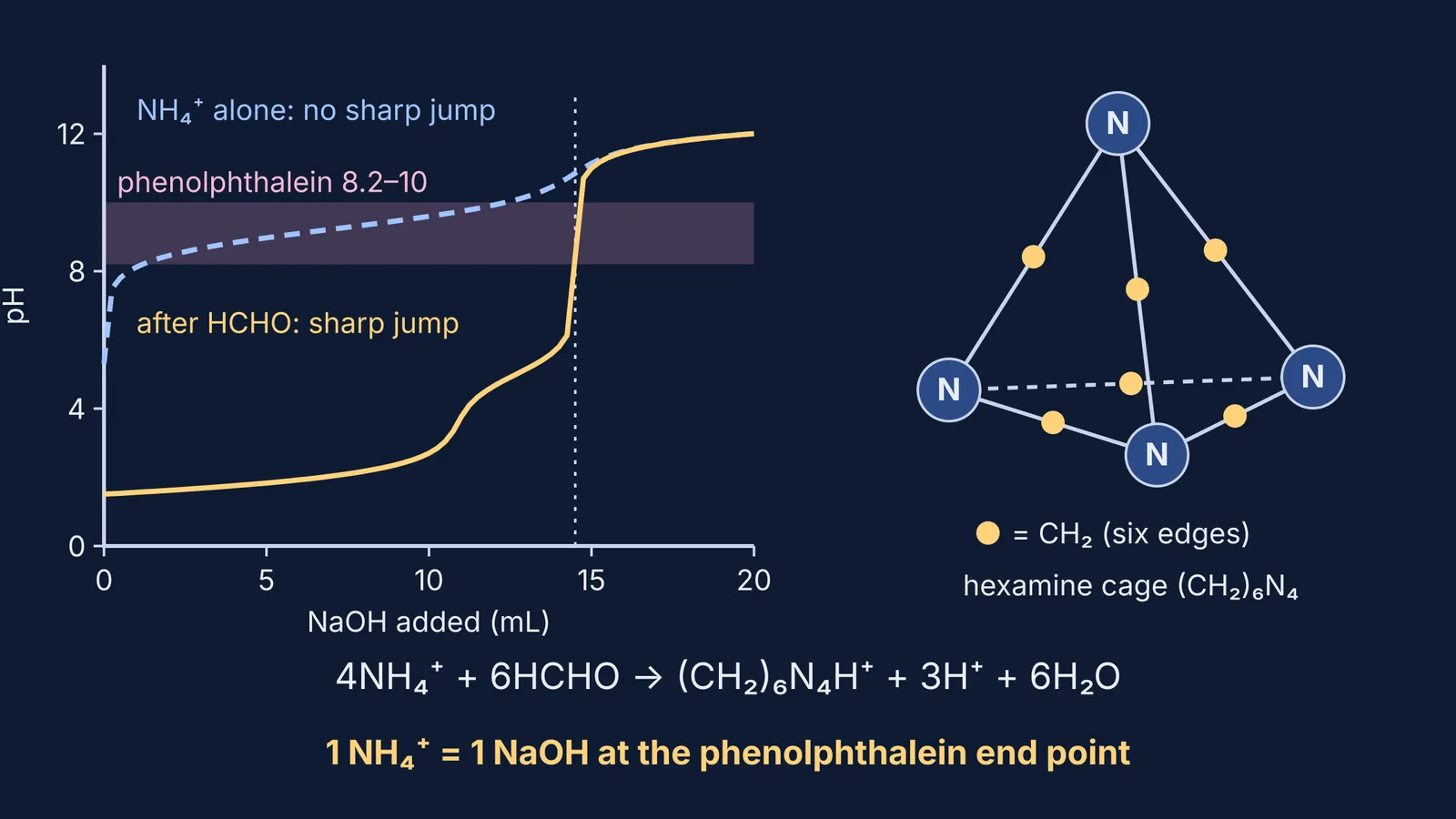
For NH₄⁺ there is no steep jump. At half-neutralisation the pH is already 9.25, right in the middle of phenolphthalein's range (about 8.2 to 10). The pH then creeps up through the buffer region and reaches only about 11 at the equivalence point. Phenolphthalein turns pink long before all the NH₄⁺ has reacted, and the colour deepens slowly instead of snapping. Our hero diagram shows this curve, computed for the worked example below.
How does formaldehyde make NH₄⁺ titratable?
Formaldehyde reacts with ammonium ions to form hexamethylenetetramine (hexamine, urotropine), the cage of four N atoms and six CH₂ bridges:
4NH₄⁺ + 6HCHO → (CH₂)₆N₄H⁺ + 3H⁺ + 6H₂O
Check it. Carbon: 6 = 6. Hydrogen: 16 + 12 = 28 on the left; 13 + 3 + 12 = 28 on the right. Nitrogen: 4 = 4. Oxygen: 6 = 6. Charge: +4 = +1 + 3.
Three of the four protons come out as free H⁺, a strong acid. The fourth stays on the cage as hexaminium, (CH₂)₆N₄H⁺. Hexamine is a very weak base, so its conjugate acid, hexaminium, is a much stronger acid than NH₄⁺, with a pKa near 5 (one chemistry lexicon gives 5.2). By the time the pH reaches phenolphthalein's range, that proton has been titrated too.
So many books write the overall reaction with free hexamine and 4H⁺:
4NH₄⁺ + 6HCHO → (CH₂)₆N₄ + 4H⁺ + 6H₂O
Both forms give the same count at a phenolphthalein end point: one NaOH for every NH₄⁺. The titration curve now looks like a strong acid's, with a sharp jump from about pH 6 to about 11 at the equivalence point.
Why must the formalin be neutralised first?
Commercial formalin (about 37 to 40% formaldehyde in water) slowly oxidises in air to formic acid, HCOOH. The ISO method for testing industrial formaldehyde, ISO 2225, reports its acidity as formic acid for exactly this reason. Formic acid would use up NaOH and make the titre too high.
So the formalin is titrated to a faint pink with dilute NaOH and phenolphthalein before it is used. A review of the method by Tur'yan in Reviews in Analytical Chemistry recommends a large excess of formaldehyde, neutralised to about pH 9, and titration to the phenolphthalein end point at about pH 9. Any free acid in the sample itself is also neutralised before the formalin goes in, so that only the acid released by formaldehyde is counted.
Formaldehyde is toxic and a carcinogen. This is a supervised lab method, never a home experiment; see our post on what formalin is and how it is used.
How does the formol titration work for amino acids?
This was Sørensen's original use, published in Biochemische Zeitschrift in 1907 (summary). He was following how enzymes break proteins into amino acids.
In water, an amino acid such as glycine is a zwitterion, ⁺H₃N–CH₂–COO⁻. The –COO⁻ end has already lost its proton. The –NH₃⁺ end holds its proton tightly (pKa about 9.6 for glycine), so, like NH₄⁺, it cannot be titrated sharply.
Formaldehyde adds to the small amount of free –NH₂ present, giving hydroxymethyl (methylol) derivatives: some –NH–CH₂OH and some –N(CH₂OH)₂. These are much weaker bases. As the free –NH₂ is used up, the NH₃⁺ equilibrium is pulled over and its proton is released at a pH that phenolphthalein can see. The product is a mixture, so do not draw one definite structure. What matters for the calculation is simpler: one NaOH per free amino group.
Worked example: fertiliser, urea and glycine
(a) Ammonium sulphate fertiliser. 1.00 g of fertiliser is dissolved and made up to 250 mL. A 25.0 mL aliquot, after neutralised formalin is added, needs 14.5 mL of 0.100 M NaOH to reach the phenolphthalein end point.
Mass in the aliquot = 1.00 × 25.0/250 = 0.100 g.
NaOH = 14.5 × 0.100 = 1.45 mmol, so NH₄⁺ = 1.45 mmol.
Nitrogen = 1.45 × 14.007 = 20.3 mg.
%N = 20.3 mg ÷ 100 mg × 100 = 20.3%.
Pure (NH₄)₂SO₄ is 28.014 ÷ 132.13 × 100 = 21.2% N. The Fertiliser (Control) Order, 1985 sets a minimum of 20.6% ammoniacal nitrogen for ammonium sulphate, so these teaching numbers would fall short. Note that the Order's own test for ammoniacal nitrogen is a distillation method, not the formol titration.
(b) Urea fertiliser. Run the same test on urea, NH₂CONH₂, and you get almost no titre. Urea contains 46.6% nitrogen, but none of it is NH₄⁺, and no acid is released. Kjeldahl digestion first converts organic nitrogen into ammonium sulphate, so it counts urea nitrogen; formol does not. The two methods measure different things, which is why formol never replaced Kjeldahl. Our post on the Kjeldahl and Dumas methods shows that route.
(c) Glycine. 75.0 mg of glycine (M = 75.07 g/mol) is dissolved in water, neutralised formalin is added, and the solution needs 10.0 mL of 0.100 M NaOH.
Glycine taken = 75.0 ÷ 75.07 = 0.999 mmol.
NaOH used = 10.0 × 0.100 = 1.00 mmol.
Recovery = 1.00 ÷ 0.999 ≈ 100%: one NaOH per amino group.
To see why the jump appears only after formaldehyde is added, try a weak-acid titration in the Fermi Simulation Lab, which has interactive simulations for ideas that are easier to see than read.
Where is the formol titration still used?
It is quick and needs only a burette, so it has been used to follow protein digestion and to estimate amino nitrogen in foods. Winemakers use a version of it to estimate the nitrogen yeast can use (overview). It is not a precision method: some amino acids do not give one NaOH per molecule, and tyrosine, for example, reads high.
Quick checklist
NH₄⁺ has pKa 9.25, too weak for a sharp end point with NaOH.
4NH₄⁺ + 6HCHO → (CH₂)₆N₄H⁺ + 3H⁺ + 6H₂O; hexaminium (pKa about 5) is titrated too.
Count: 1 NaOH per NH₄⁺ at the phenolphthalein end point.
Neutralise the formalin first; it contains formic acid.
Amino acids give methylol derivatives; count 1 NaOH per free –NH₂.
Formol measures NH₄⁺ only; Kjeldahl digests organic nitrogen first.