On this page
The textbook formulas SV = 168300/M and IV = 25400n/M only work when you already know the triglyceride. A food lab gets a bottle of groundnut oil with no formula on it. It measures both numbers by titration, and in both cases it does not titrate the fat directly. It adds a measured excess of reagent, titrates what is left over, and compares that with a blank flask that had no fat in it. Below are both methods, their formulas, and the algebra run backwards to get the mean molar mass and the C=C count.
If you need the definitions first, read saponification value and iodine value of fats, worked out.
Why are saponification and iodine values measured by back titration?
Neither reaction can be titrated directly.
Saponification is slow. Hydrolysing all three ester links of a triglyceride takes about an hour of boiling with alcoholic KOH. You cannot add alkali drop by drop and watch for an end point that takes an hour to arrive.
Addition of ICl to C=C is slow and has no end point of its own. The oil sits with the reagent in the dark for half an hour or more. Nothing changes colour when the last double bond reacts.
So both methods use the pattern from back titration calculations: add a known excess, let the reaction finish, titrate the leftover, and subtract.
Why does each method need a blank?
In purity problems you know how much reagent went in. Here you do not.
The FSSAI recipe for alcoholic KOH is "35 to 40 g of KOH" made up to a litre (FSSAI oils and fats manual, 2016, method 9). Its exact strength is not known, and it changes: the solution absorbs CO₂ from the air and darkens on standing.
Wijs solution, ICl in glacial acetic acid, is made to roughly 0.2 N. It is sensitive to light, moisture and temperature, and the manual warns that small temperature changes alter its titre.
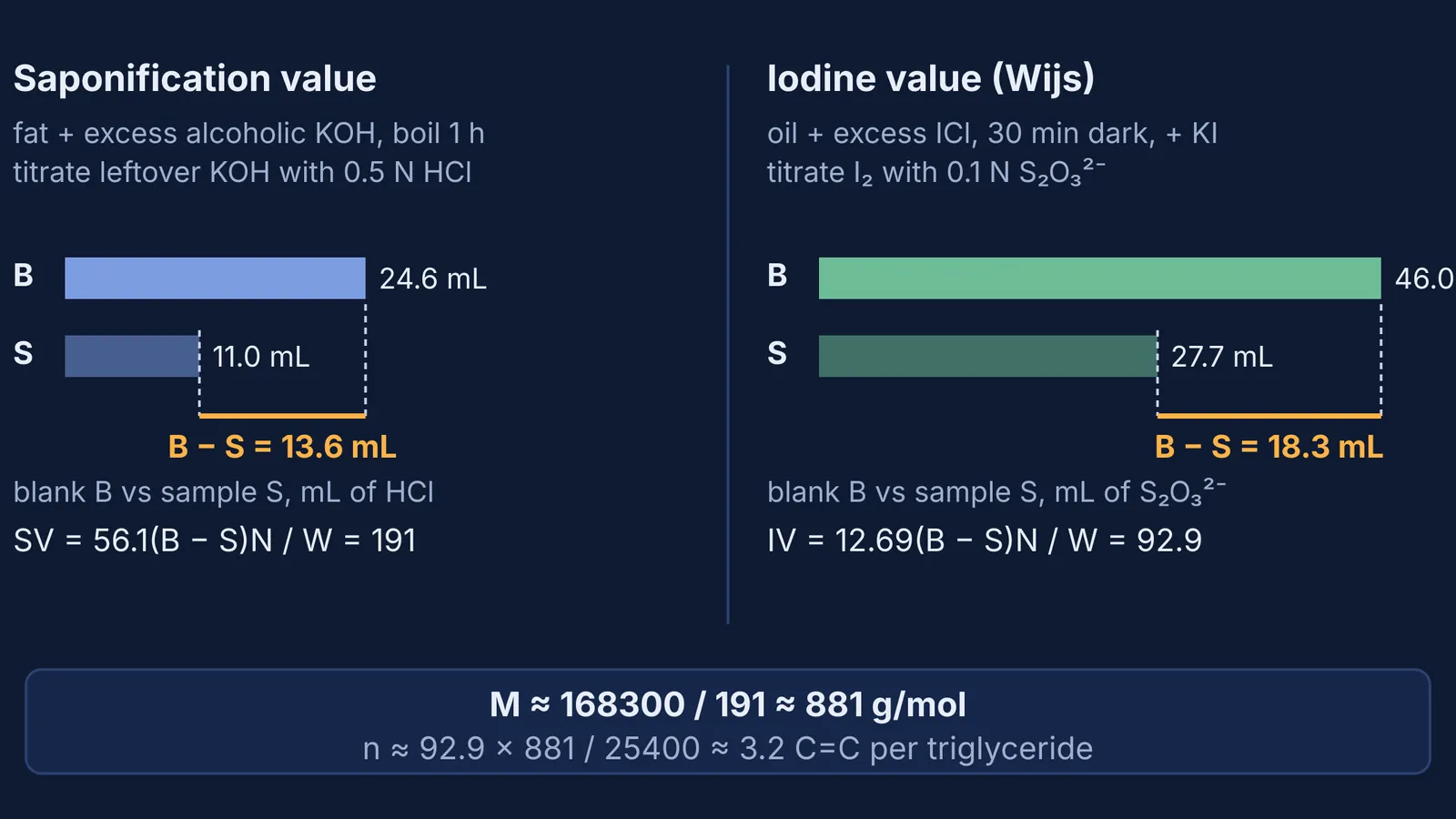
A blank flask gets the same pipetted volume of reagent, the same heating or the same time in the dark, and is titrated in the same way, but contains no fat. Its titre, B, tells you how much reagent was really delivered on that day. The sample titre, S, tells you how much was left after the fat reacted. The difference, B − S, is what the fat used. The nice consequence is that you never need to know the strength of the KOH or the Wijs solution. You only need the strength of the titrant.
How is saponification value measured in the lab?
The FSSAI method, from the same manual:
Weigh 1.5 to 2.0 g of dry, filtered oil into a 250 mL flask.
Pipette in 25 mL of alcoholic KOH. Set up a blank flask with 25 mL of KOH and no oil.
Fit both with condensers and boil gently until the solution is clear and no oily drops remain, usually within an hour.
Cool, rinse the condensers, and titrate the excess KOH in each flask with 0.5 N HCl using phenolphthalein.
Multiplying (B − S) by the normality N gives millimoles of KOH, multiplying by 56.1 gives milligrams, and dividing by the sample mass W gives mg per g:
SV = 56.1 × (B − S) × N / W
How is iodine value measured with Wijs reagent?
The FSSAI method:
Weigh the oil into a 500 mL stoppered flask with solvent. The 2016 manual uses carbon tetrachloride; the newer AOCS methods it also lists use cyclohexane with acetic acid instead.
Pipette in 25 mL of Wijs solution. The sample size is chosen so that a good excess of ICl is left over.
Keep the flask in the dark for 30 minutes (one hour for drying oils such as linseed), with a blank alongside.
Add 15 mL of 10% KI and 100 mL of water, then titrate with standard thiosulphate and starch.
The leftover ICl oxidises iodide: ICl + I⁻ → I₂ + Cl⁻. One ICl gives one I₂, which takes two thiosulphate ions: 2S₂O₃²⁻ + I₂ → S₄O₆²⁻ + 2I⁻. So (B − S) × N millimoles of thiosulphate correspond to half as many millimoles of ICl taken up by C=C bonds, reported as the same number of millimoles of I₂. Each millimole of I₂ is 253.8 mg, and the value is per 100 g of oil. Putting the factors together, 253.8 / 2 × 100 / 1000 = 12.69:
IV = 12.69 × (B − S) × N / W
Why ICl adds to C=C so much faster than iodine itself is explained in why ICl is more reactive than I₂.
Worked example: from titres to M and C=C
These are teaching numbers chosen to fall inside FSSAI's ranges for groundnut oil: saponification value 188 to 196 and iodine value 85 to 99 (FSSAI food product standards, chapter 2.2).
(a) Saponification value. 2.00 g of oil is refluxed with 25.0 mL of alcoholic KOH. The blank needs 24.6 mL and the sample 11.0 mL of 0.500 N HCl.
B − S = 24.6 − 11.0 = 13.6 mL.
KOH used = 13.6 × 0.500 = 6.80 mmol = 381 mg.
SV = 381 / 2.00 = 191 mg KOH per g (the formula gives 56.1 × 13.6 × 0.500 / 2.00 = 190.7).
(b) Iodine value. 0.250 g of the same oil is left with 25.0 mL of Wijs solution. The blank needs 46.0 mL and the sample 27.7 mL of 0.100 N thiosulphate.
B − S = 46.0 − 27.7 = 18.3 mL.
Thiosulphate = 18.3 × 0.100 = 1.83 mmol, so ICl taken up = 0.915 mmol, counted as 0.915 mmol I₂ = 232 mg.
IV = 232 mg per 0.250 g = 92.9 g per 100 g (the formula gives 12.69 × 18.3 × 0.100 / 0.250 = 92.9).
About 40% of the ICl was used and 60% was left over, so the reagent never ran short.
(c) Working backwards. Now use the textbook formulas the other way round.
Mean molar mass: M ≈ 168300 / 191 ≈ 881 g/mol.
Double bonds: n ≈ 92.9 × 881 / 25400 ≈ 3.2 C=C per triglyceride molecule.
So the average triglyceride has a molar mass close to triolein's and slightly more than three C=C, which fits an oil rich in oleic acid with some linoleic. Remember that M and n here are averages over a mixture. Free fatty acids also use KOH, so the SV of a real oil gives a mean value, not one molecule.
For more back titration problems, the Fermi Problem Library has a step-by-step solver that explains the reasoning at each subtraction.
Quick checklist
Both values are back titrations: excess reagent in, leftover titrated out.
The blank gets the same reagent and treatment with no fat; B − S is what the fat used.
You need the titrant's strength, not the strength of the KOH or the Wijs solution.
SV = 56.1 × (B − S) × N / W, titrating leftover KOH with HCl.
IV = 12.69 × (B − S) × N / W, using ICl + I⁻ → I₂ + Cl⁻ and thiosulphate.
Then M ≈ 168300 / SV and n ≈ IV × M / 25400.