On this page
Leave a tube of blood standing for an hour and the red cells slowly sink, leaving clear plasma at the top. The height of that clear layer is the erythrocyte sedimentation rate, or ESR, in millimetres per hour. For a physics student it is Stokes' law in a glass tube, with a result you can predict on paper. This post works out how far a single red cell should fall in an hour, and why cells that stick together in stacks fall many times faster.
This is a physics explainer, not medical advice. ESR results are interpreted by a doctor, together with the person's history and other tests.
How is the ESR test done?
The standard manual method is the Westergren method. A laboratory procedure published by Oman's Ministry of Health sets it out step by step:
Blood is mixed with sodium citrate, 4 parts blood to 1 part citrate, so that it cannot clot.
It is drawn up a vertical tube with a 200 mm scale and a 2.5 mm bore, kept still, upright, at 18 to 25 °C.
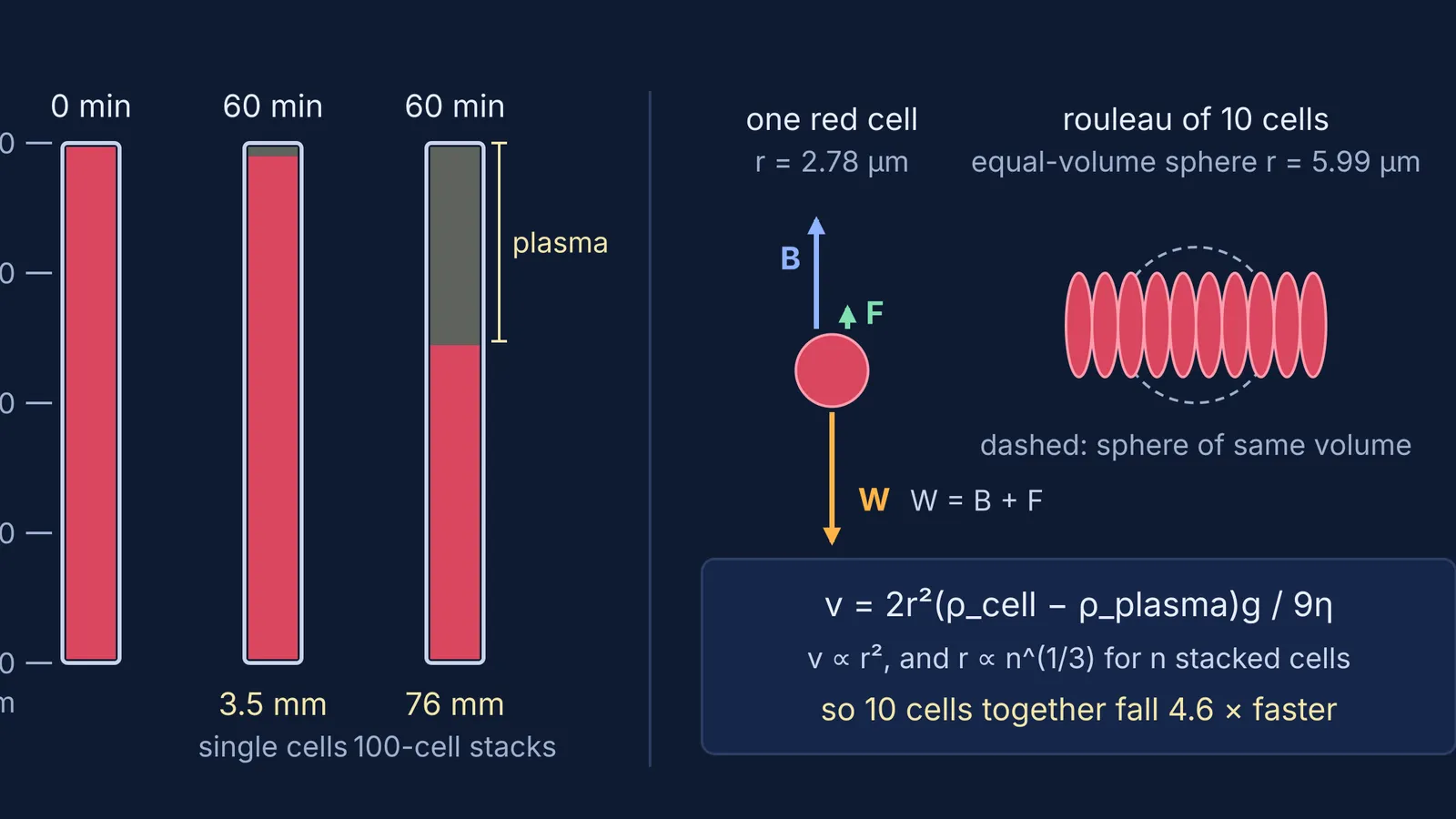
After exactly 60 minutes, the distance from the top of the plasma down to the top of the red cell column is read. That distance in mm is the ESR in mm/h.
The same document notes that ESR is a non-specific test: it does not point to any one disease. MedlinePlus, from the US National Library of Medicine, says the same and lists typical adult values in the Westergren method as under 15 mm/h for men under 50 and under 20 mm/h for women under 50, with higher limits at older ages. Labs set their own reference ranges, and only a doctor can say what a given result means for a patient.
Which forces act on a settling red cell?
Treat one red cell as a small sphere in plasma. Three forces act on it:
Weight W = ρ_cell V g, downwards.
Buoyancy B = ρ_plasma V g, upwards (Archimedes' principle).
Viscous drag F = 6πηrv, upwards, opposing the motion (Stokes' law).
The cell speeds up until the drag balances the net downward force: 6πηrv = (ρ_cell − ρ_plasma)Vg. With V = (4/3)πr³, this gives the terminal speed
v = 2r²(ρ_cell − ρ_plasma)g / 9η
The full derivation, and the conditions for Stokes' law, are in our derivation of terminal velocity for a sphere in a viscous fluid, so it is not repeated here. Keep one thing: v depends on r².
How far should one red cell fall in an hour?
You need three inputs. Each is a typical value, not an exact constant:
Cell volume. The normal mean red cell volume is about 79 to 95 fL (MedlinePlus, RBC indices). Take V = 90 fL = 90 × 10⁻¹⁸ m³.
Densities. Mean red cell density is about 1.094 kg/L (BioNumbers, Harvard Medical School). Plasma has a specific gravity of about 1.031 at 4 °C and 1.021 at 37 °C (Trudnowski and Rico, Clinical Chemistry, 1974). Take ρ_cell ≈ 1,095 kg/m³ and ρ_plasma ≈ 1,025 kg/m³, so Δρ ≈ 70 kg/m³.
Viscosity. Normal plasma viscosity is about 1.10 to 1.30 mPa s at 37 °C (Késmárky and colleagues, Clinical Hemorheology and Microcirculation, 2008). Take η = 1.2 mPa s = 1.2 × 10⁻³ Pa s.
Worked example: one cell as a sphere
Radius. A sphere of the same volume has r = (3V/4π)^(1/3) = (3 × 90 × 10⁻¹⁸ / 4π)^(1/3) = 2.78 × 10⁻⁶ m, or 2.78 µm.
Net downward force. W − B = ΔρVg = 70 × 90 × 10⁻¹⁸ × 9.81 = 6.18 × 10⁻¹⁴ N. That is about 6% of the cell's weight, so buoyancy cancels most of it.
Terminal speed. v = 2 × (2.78 × 10⁻⁶)² × 70 × 9.81 / (9 × 1.2 × 10⁻³) = 9.83 × 10⁻⁷ m/s, or about 0.98 µm/s.
Distance in one hour. 9.83 × 10⁻⁷ m/s × 3,600 s = 3.54 × 10⁻³ m, so about 3.5 mm.
Units check. m² × kg m⁻³ × m s⁻² ÷ (Pa s) = kg s⁻² ÷ (kg m⁻¹ s⁻¹) = m/s. Correct.
That lands inside the normal adult range quoted above. Two quick checks show that Stokes' law is safe to use here:
Reynolds number. Re = ρvd/η = 1,025 × 9.83 × 10⁻⁷ × 5.56 × 10⁻⁶ / 1.2 × 10⁻³ ≈ 5 × 10⁻⁶, far below 1, so the flow is smooth and Stokes' law applies.
Time to reach terminal speed. The time constant m/(6πηr) = 2r²ρ_cell/9η ≈ 1.6 × 10⁻⁶ s. The cell is at terminal speed within microseconds and spends the whole hour falling at constant speed.
Treat the 3.5 mm as an estimate. A real red cell is a biconcave disc, not a sphere, crowded cells slow one another, and plasma is a little thicker at room temperature than at 37 °C. The order of magnitude is the point: single cells settle only a few millimetres in an hour.
Why do stacked red cells fall faster?
Red cells normally stay apart. Some plasma proteins, mainly fibrinogen and globulins, make them stick face to face in stacks like coins. These stacks are called rouleaux (singular rouleau). The Oman procedure states that more fibrinogen and globulins mean more rouleaux and a higher sedimentation rate, while albumin slows it.
Now use the r² in Stokes' law. Treat a stack of n cells as one sphere with n times the volume, and the same density as one cell:
Volume grows n times, so radius grows n^(1/3) times.
Speed goes as r², so it grows n^(2/3) times.
For a stack of 10 cells, 10^(2/3) = 4.64, so the stack falls 4.64 × 3.54 ≈ 16 mm in an hour. For a stack of 100, 100^(2/3) = 21.5, giving about 76 mm.
This rouleau-as-a-sphere step is a scaling argument, not an exact model. A stack is a long cylinder, not a sphere, and stacks also link into networks. But it shows why stacking can multiply the settling speed several times.
How is this different from spinning blood in a centrifuge?
The same law is at work, but the driving acceleration is different. In the ESR tube it is g, so cells drift only millimetres in an hour. A centrifuge replaces g with ω²r, which can be thousands of times larger, so separation takes minutes. How spin speed sets that acceleration, and the order in which cells come out, is covered in how a centrifuge separates blood. For the same r² idea applied to fog and cloud droplets, see George Stokes and why tiny drops fall so slowly through air.
To practise terminal-velocity numericals, the Fermi Problem Library has a step-by-step solver that explains the reasoning.
What should you take into the exam?
Terminal speed: v = 2r²(ρ − σ)g/9η, where σ is the fluid's density.
v ∝ r²: double the radius and the speed goes up 4 times.
Equal-volume merging: n drops or cells combined give r × n^(1/3) and v × n^(2/3).
Convert fL to m³ (1 fL = 10⁻¹⁸ m³), µm to m and mPa s to Pa s before substituting.
Check Re is much less than 1 before using Stokes' law.