

On this page
When you drop a metal ball into a tall jar of honey, it does not accelerate forever. It speeds up initially, but soon settles into a steady, constant speed. This maximum speed is called its terminal velocity.
Understanding how to calculate this speed is a standard requirement in Fluid mechanics: pressure, buoyancy and Bernoulli mistakes to avoid and high school physics exams. By looking at the forces acting on the falling object, you can derive the exact formula for its final speed.
Why does a falling sphere reach terminal velocity?
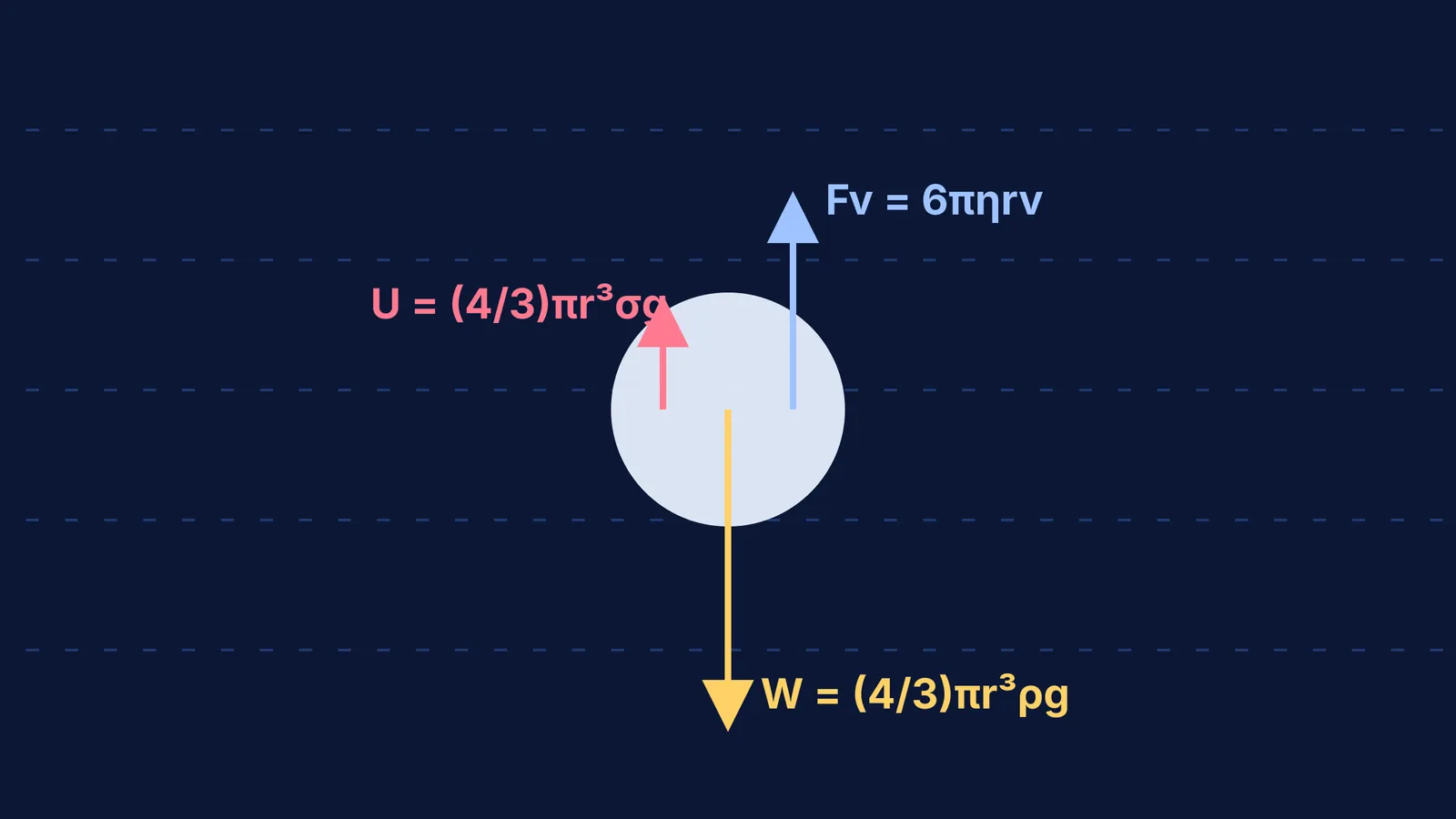
As an object falls through a fluid—whether it is a raindrop in the air or a ball bearing in oil—three distinct forces act upon it:
Weight (W): Gravity pulls the object downwards.
Upthrust or Buoyancy (U): The fluid pushes back up against the object, equal to the weight of the fluid displaced.
Viscous Drag (Fv): The friction of the fluid resists the object's motion.
According to Newton's laws, if there is a net force, the object accelerates. Initially, the downward weight is greater than the upward buoyancy and drag, so the sphere speeds up. However, the drag force is not constant. As established by George Gabriel Stokes in 1851, the viscous drag on a small, slow-moving sphere is directly proportional to its velocity. As the sphere falls faster, the drag force grows stronger.
Eventually, the upward forces (drag plus buoyancy) grow large enough to perfectly balance the downward weight. At this point, the net force is zero, the acceleration drops to zero, and the sphere continues to fall at a constant speed. That constant speed is its terminal velocity.
What is the formula for terminal velocity in a viscous fluid?
For a sphere falling through a viscous fluid, the terminal velocity (v) is given by the formula:
v = 2r²(ρ - σ)g / 9η
Here is what each symbol represents:
r is the radius of the sphere.
ρ (rho) is the density of the material making up the sphere.
σ (sigma) is the density of the viscous fluid.
g is the acceleration due to gravity.
η (eta) is the coefficient of viscosity of the fluid.
How do you derive the terminal velocity of a sphere?
To derive the formula, we set the net force to zero and solve for the velocity.
Step 1: Write down the downward force. The only downward force is the weight of the sphere. Mass is volume multiplied by density, and the volume of a sphere is (4/3)πr³. Weight, W = (4/3)πr³ρg
Step 2: Write down the upward forces. The first upward force is the upthrust. By Archimedes' principle, this equals the weight of the displaced fluid. Upthrust, U = (4/3)πr³σg
The second upward force is the viscous drag. By Stokes' Law, for a sphere of radius r moving at speed v in a fluid of viscosity η, the drag is: Viscous Drag, Fv = 6πηrv
Step 3: Balance the forces. At terminal velocity, the sphere does not accelerate, meaning the downward forces equal the upward forces: W = U + Fv
Substitute the expressions we found: (4/3)πr³ρg = (4/3)πr³σg + 6πηrv
Step 4: Solve for v. First, rearrange the equation to isolate the drag term: 6πηrv = (4/3)πr³ρg - (4/3)πr³σg
Factor out the common terms on the right side: 6πηrv = (4/3)πr³(ρ - σ)g
Now, divide both sides by 6πηr to solve for v: v = [(4/3)πr³(ρ - σ)g] / [6πηr]
Simplify the fraction and cancel one power of r: v = 2r²(ρ - σ)g / 9η
This final expression gives you the terminal velocity. If you need to revise other mechanics concepts that build on these force-balancing principles, see our guide on Five JEE mechanics mistakes and the habits that fix them.
A three-step checklist for terminal velocity problems
When you face a numerical problem involving terminal velocity, follow these steps to avoid careless errors:
Check your units: Ensure the radius is in metres, densities in kg/m³, and viscosity in pascal-seconds (Pa·s). Exam questions often give the radius in millimetres and viscosity in poise, which require conversion.
Identify the missing variable: You might be given the terminal velocity and asked to find the fluid's viscosity, rather than the other way around. Rearrange the formula before plugging in numbers.
Remember the squared radius: A common mistake is forgetting to square the radius. Because v depends on r², doubling the radius of the sphere quadruples its terminal velocity.
If you want to test this logic on real exam questions, the Fermi Problem Library has worked problems with a step-by-step solver that explains the reasoning rather than printing an answer. For a broader review of the physics behind drag and buoyancy, the Fermi Concept Library contains every concept in physics, chemistry, biology, mathematics and computing, each with its own lesson and its place in the map.


