On this page
When you lose marks in mechanics, it rarely feels like a physics problem. It feels like a slip. But the same slips come back test after test, and each one has a habit that fixes it. Here are five, with short worked examples. We use g = 10 m/s² throughout.
Why does the free-body diagram matter so much?
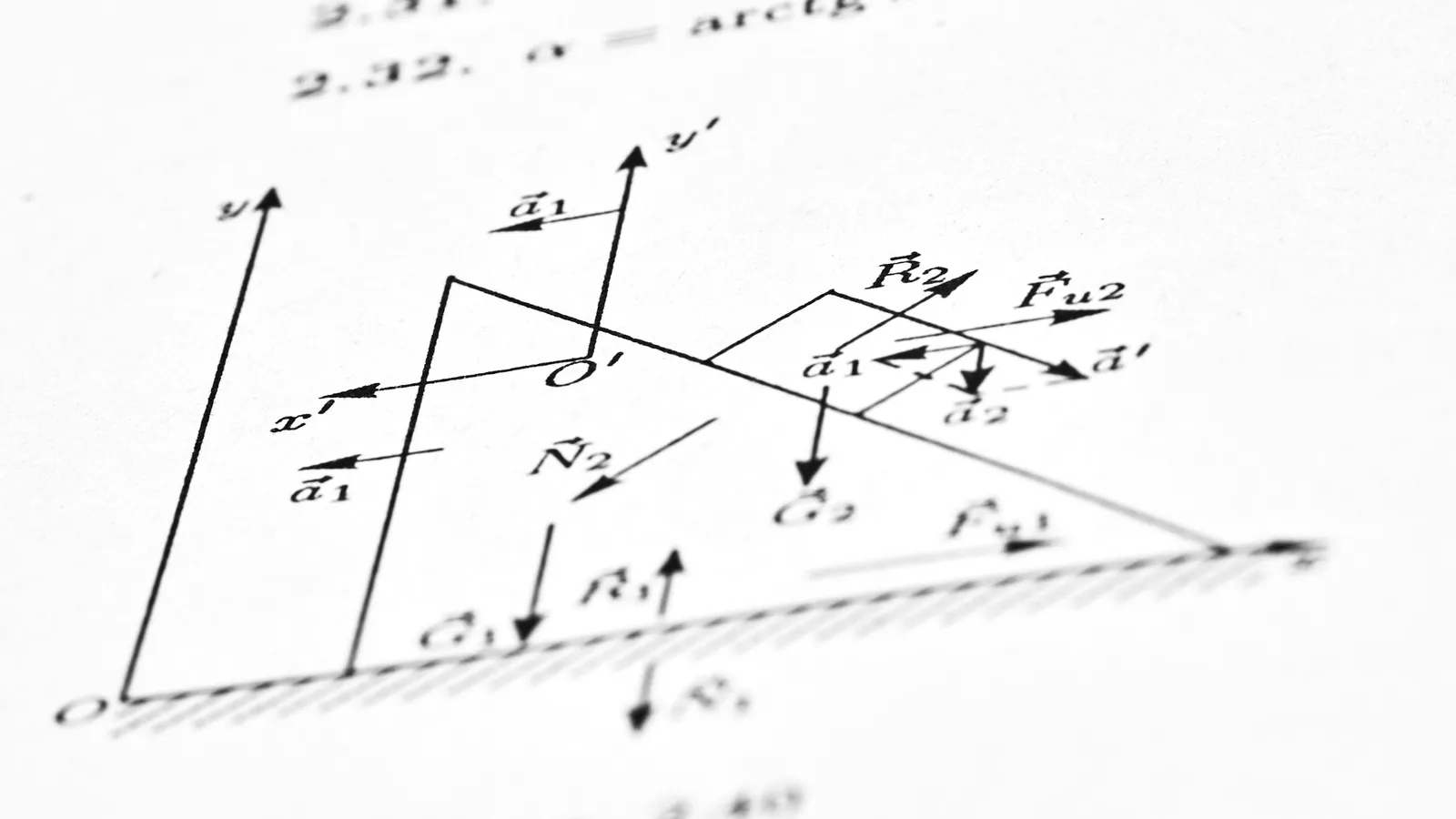
In a two-year study, Rosengrant, Van Heuvelen and Etkina (2009) found that students who drew free-body diagrams correctly were significantly more successful at getting the right answer. High-achieving students also used the diagram to evaluate their work, while low-achieving students used it only as an aid while solving. So the diagram is not decoration; it is also your checking tool.
Mistake 1: the wrong normal force on an incline
A block slides down a rough incline at 37° (sin 37° = 0.6, cos 37° = 0.8) with coefficient of friction 0.5. Find its acceleration.
Forces on the block: weight mg, normal force N, and friction μN up the slope. Nothing else.
Perpendicular to the slope there is no acceleration, so N = mg cos 37° = 0.8 mg.
Along the slope: ma = mg sin 37° − μN, so a = 10(0.6 − 0.5 × 0.8) = 2 m/s².
The common slip is writing N = mg out of habit, which gives a = 10(0.6 − 0.5) = 1 m/s². That wrong answer is often one of the options. The fix: get N from the perpendicular equation every time, never from memory.
The other classic error is adding a "force of motion" pointing down the slope. If you cannot name the object that exerts a force, it is not a force. Our piece on David Hestenes and the Force Concept Inventory covers this and other common misconceptions about force.
Mistake 2: switching sign conventions halfway
A ball is thrown upward at 20 m/s from the top of a 25 m tower. When does it hit the ground?
Take upward as positive and the launch point as the origin. The ground is then at −25 m and the acceleration is −10 m/s²:
−25 = 20t − 5t², so t² − 4t − 5 = 0, which gives t = 5 s. The other root, −1 s, is not physical.
If you write the displacement as +25 while keeping g negative, you get t² − 4t + 5 = 0, which has no real roots. Treat that as an alarm. The fix: write "up = +" at the top of your working and give every vector its sign from that line, including displacement.
Mistake 3: mixing frames
A 5 kg box rests on the floor of a lift accelerating upward at 2 m/s². How hard does the floor push?
Ground frame: N − mg = ma, so N = 5(10 + 2) = 60 N. No pseudo force.
Lift frame: the box is at rest, so add a pseudo force ma downward: N = mg + ma = 60 N.
Both are fine. The error is mixing them, for example writing N − mg = ma and also adding a pseudo force, which double-counts and gives 70 N. The fix: name your frame in words before you write any equation. Pseudo forces belong only in the accelerating frame.
Mistake 4: guessing the tension
Two masses, 3 kg and 2 kg, hang over a light frictionless pulley. Find the acceleration and the tension.
Draw two separate diagrams. For the 3 kg block, moving down: 30 − T = 3a. For the 2 kg block, moving up: T − 20 = 2a. Adding them: 10 = 5a, so a = 2 m/s², and T = 20 + 2 × 2 = 24 N.
Students often assume the tension equals the weight of one block, 20 N or 30 N. It must lie between the two weights, or neither block could accelerate the way it does. The fix: one diagram per body, one equation per diagram.
Mistake 5: never checking the answer
Before you mark an option, run three quick checks:
Dimensions: does the answer have the right dimensions? Our guide to dimensional analysis shows how in 30 seconds.
Limiting cases: set μ = 0, θ = 0 or one mass to zero. In the pulley example, making the 2 kg mass zero should give a = g and T = 0, and the formulas a = (m₁ − m₂)g/(m₁ + m₂) and T = 2m₁m₂g/(m₁ + m₂) do.
Size: an acceleration bigger than g for a block sliding freely on an incline means something is wrong.
All of these habits start with the picture. Our post on drawing the diagram first has more examples.
When a method goes wrong and you cannot see why, the Fermi Problem Library has worked problems with a step-by-step solver that explains the reasoning rather than printing an answer. For frames and inclines that are easier to see than to read, try the Fermi Simulation Lab.
Next step: take your last mechanics test, find each wrong answer, and label it with one of the five mistakes above.