On this page
Make a prediction first. A tube of blood, mixed with an anticoagulant so it cannot clot, spins for a few minutes. Red blood cells, white blood cells with platelets, and plasma separate out. Which ends up at the bottom, and what changes if you spin twice as fast? Write your answer down before reading on.
What layers form when blood is centrifuged?
The OpenStax *Anatomy and Physiology* textbook gives the answer plainly: "Because the heaviest elements in blood are the erythrocytes, these settle at the very bottom of the hematocrit tube" (OpenStax, An overview of blood). The same section gives the proportions:
Red blood cells make up about 45% of a normal blood sample; this share is the haematocrit.
The buffy coat, a thin pale band of white blood cells and platelets, normally makes up less than 1% of the sample.
Plasma sits on top and is about 92% water.
The textbook lists typical haematocrit ranges of 37 to 47% for women and 42 to 52% for men. To follow plasma after it leaves the blood vessels, read our explainer on lymph, plasma and tissue fluid.
Why do red blood cells sink to the bottom of the tube?
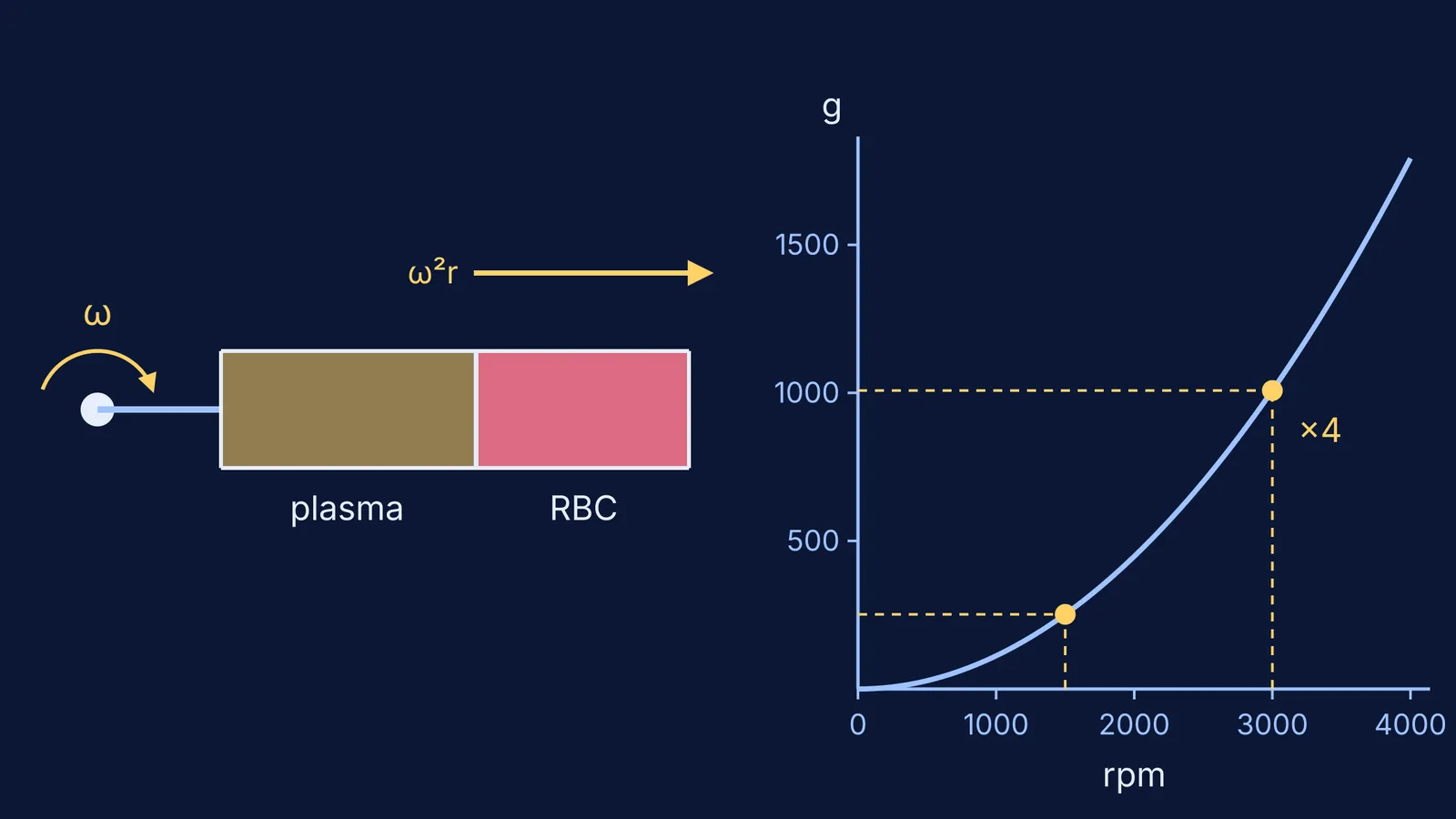
Stokes' law gives the settling speed of a small sphere as v = (2/9)(ρp − ρf)gR²/μ, where ρp and ρf are the particle and fluid densities, R is the radius and μ is the viscosity (Stokes' law). In a centrifuge, g is replaced by the much larger acceleration of the spin, ω²r, which is why spin speed matters.
Read the formula as two predictions:
Density difference: a cell denser than plasma moves outward, and the bigger the difference, the faster it goes. A particle with the same density as the fluid does not settle at all.
Size: speed grows with R², so a cell twice as wide settles four times as fast.
Here is the twist. A 2019 review in *Biomicrofluidics* lists red blood cells as 6 to 8 µm across, platelets as 2 to 3 µm and white blood cells as 7 to 30 µm depending on type (Biomicrofluidics review, Table II). Some white cells are bigger than red cells, yet finish above them: size changes how fast a cell moves, while the heaviest cells, the red cells, end at the bottom. Stokes' law describes one sphere in open fluid, so treat it as a guide to the trend, not an exact rate for crowded red cells. Our terminal velocity simulation shows the R² effect with falling balls.
How does spin speed change the g-force?
Labs describe a spin by its relative centrifugal force (RCF): the force as a multiple of gravity, written in g. The FAO's notes on centrifugation give RCF = 11.2 × r × (rpm/1000)², with r the radius in centimetres (FAO, Notes on centrifugation).
Worked example for a rotor with r = 10 cm:
1,500 rpm: 11.2 × 10 × 1.5² = 252 g
3,000 rpm: 11.2 × 10 × 3² = 1,008 g
6,000 rpm: 11.2 × 10 × 6² = 4,032 g
Each doubling of rpm multiplies the force by four, because rpm is squared. Radius matters too: at the same rpm, a rotor with r = 20 cm gives twice the force of one with r = 10 cm.
Faster is not always better. In a 2014 review of platelet-rich plasma preparation, Rachita Dhurat and M. S. Sukesh describe a two-step method: a gentler soft spin first, to separate the red cells while keeping platelets in the plasma, then a hard spin to pack the platelets into a pellet (Dhurat and Sukesh, Journal of Cutaneous and Aesthetic Surgery). Their protocol used 900 g for 5 minutes, then 1,000 g for 10 minutes, and they cite research in which 3,000 g for 20 minutes reduced platelet viability. The right speed depends on which layer you want.
How can you test spin speed and density yourself?
In a simulation or on paper, predict before every run:
Order: predict bottom to top for red cells, buffy coat and plasma, then check against the tube.
Speed: double the rpm. Predict the new g-force (four times, from the FAO formula) and whether the final order changes (it should not; only the time to get there changes).
Density: make a particle exactly as dense as the fluid. Predict its settling speed (zero).
Size: halve a particle's radius. Predict its new speed (one quarter, from Stokes' law).
Explain: for every wrong prediction, write down which term in the formula you ignored.
The same predict-then-test habit works for floating and sinking, as in our buoyancy and density simulation. The Fermi Simulation Lab has interactive simulations for ideas that are easier to see than to read, so you can check a prediction against something moving. If the formula itself is the sticking point, the Fermi Concept Library has a lesson for each concept in physics, chemistry and biology.
Next time you see a haematocrit on a blood report, you will know what it measures: the share of the sample that is red cells.