On this page
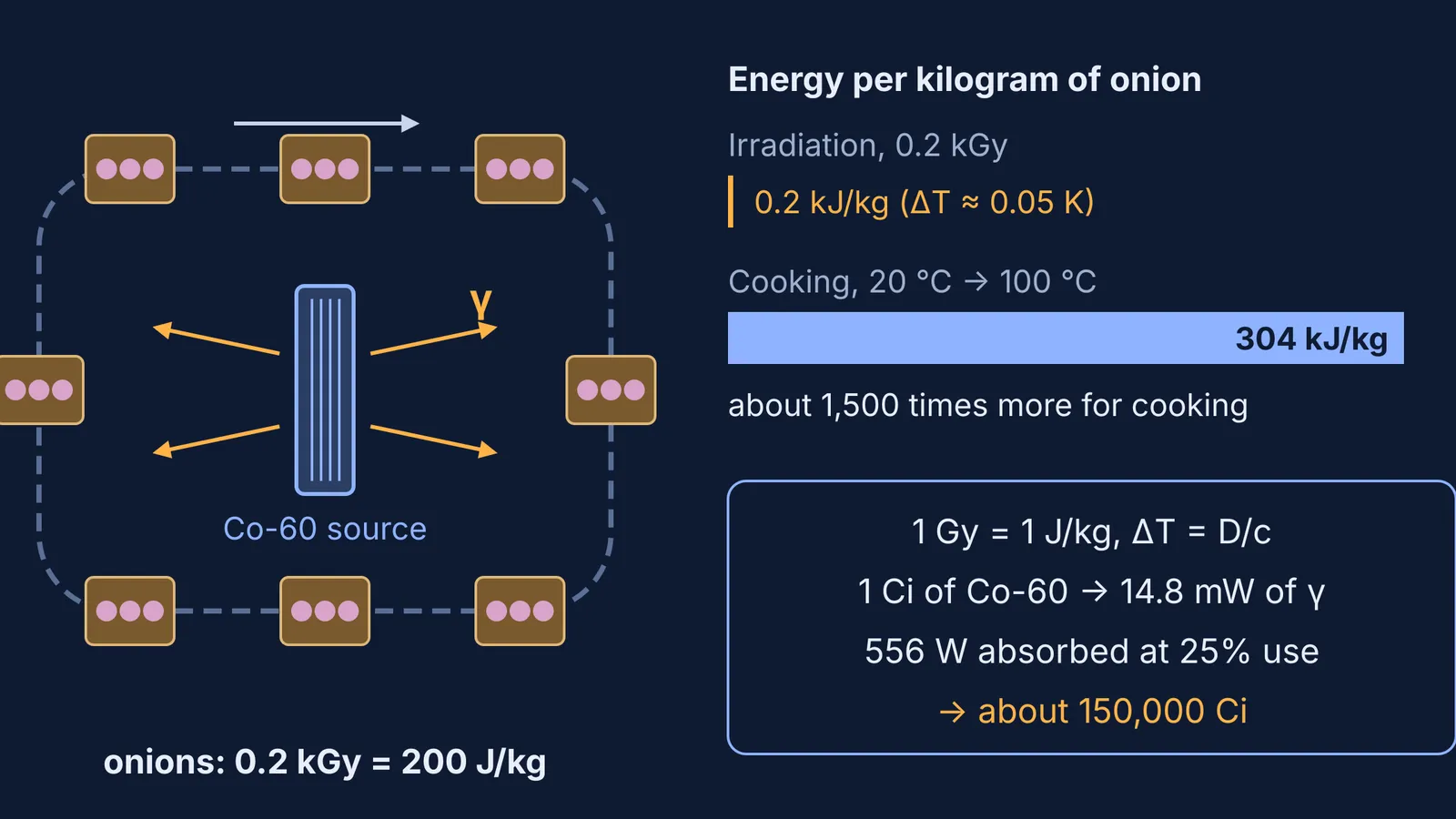
Onions stored after harvest start to sprout, and sprouted onions lose weight and value. One way to stop this is to pass the crates past a cobalt-60 source for a short time. The dose that does it is tiny in energy terms: it would warm the onions by about 0.05 K. This post works out why so little energy is enough, how big the radioactive source has to be, and what "absorbed dose" really measures.
What does a dose in kGy mean for food?
Absorbed dose is the energy deposited per kilogram of material. The unit is the gray: 1 Gy = 1 J/kg, so 1 kGy = 1,000 J/kg. The unit and its namesake are covered in Louis Harold Gray and the unit of radiation dose; here we use it.
Keep three units apart:
Gray (Gy): energy absorbed per kilogram. This is what food regulations specify.
Sievert (Sv): dose weighted for biological risk to people. It is not used for food processing doses.
Becquerel (Bq) and curie (Ci): activity, the number of decays per second in the source. 1 Ci = 3.7 × 10¹⁰ Bq.
In India the permitted doses are set by FSSAI. Its regulation 2.13 on radiation processing of food lists a minimum and maximum dose for each class of food and purpose. Three rows used below:
Bulbs and tubers (onion, potato), to inhibit sprouting: 0.02 to 0.2 kGy.
Fresh fruits, insect disinfestation: 0.2 to 1.0 kGy.
Spices and dry herbs, microbial decontamination: 6.0 to 14.0 kGy.
How much does irradiation heat the food?
If all the absorbed energy turns into heat, the temperature rise is ΔT = Q/(mc), and Q/m is just the dose D. So:
ΔT = D/c
where c is the specific heat capacity in J/(kg K). Fresh produce is mostly water, so its c is a little below water's 4,186 J/(kg K). We use round illustrative values: about 3,800 J/(kg K) for onion, 3,700 for mango and 1,500 for dry spice.
Worked example: warming an onion, a mango and a spice
Onion at the maximum sprouting dose. D = 0.2 kGy = 200 J/kg. ΔT = 200/3,800 = 0.053 K. At the 0.02 kGy minimum it is 0.005 K.
Mango at the maximum disinfestation dose. D = 1.0 kGy = 1,000 J/kg. ΔT = 1,000/3,700 = 0.27 K.
Spice at the maximum decontamination dose. D = 14 kGy = 14,000 J/kg. ΔT = 14,000/1,500 = 9.3 K. This is the only case where you would notice warming at all.
Compare with cooking. Heating the onion by 80 K (from 20 °C to 100 °C) takes Q/m = 3,800 × 80 = 304,000 J/kg = 304 kJ/kg.
Ratio. 304,000/200 = 1,520. Cooking puts in about 1,500 times more energy per kilogram than the largest sprout-inhibition dose.
Units check: J/kg divided by J/(kg K) gives K, as it should.
So irradiation does not work by heat. The energy arrives as single high-energy photons. Each gamma ray knocks electrons out of atoms along its path, and the damage that matters is to DNA in the growing tissue of the onion's bud, or in insects and microbes. A few broken DNA strands can stop a cell dividing, even though the total energy is far too small to warm anything.
How big a cobalt-60 source does an irradiation plant need?
Each cobalt-60 decay sends out two gamma rays, of 1.173 MeV and 1.332 MeV. That is 2.505 MeV of gamma energy per decay.
Power from one curie. P = 3.7 × 10¹⁰ decays/s × 2.505 × 10⁶ eV × 1.602 × 10⁻¹⁹ J/eV = 0.0148 W, or 14.8 mW per curie.
Power the onions must absorb. Take a plant treating 10 tonnes an hour at 0.2 kGy. The mass flow is 10,000/3,600 = 2.78 kg/s. Absorbed power = 2.78 × 200 = 556 W.
Allow for waste. Much of the gamma energy goes into the walls, the conveyor and the air. If only 25% reaches the product (a round illustrative figure; real plants differ), the source must emit 556/0.25 = 2,222 W.
Source size. 2,222/0.0148 = about 150,000 Ci, or about 5,500 TBq.
Gamma rays reach through a whole crate of onions, which is why cobalt-60 is used rather than an alpha or beta source; alpha, beta and gamma penetration explains why. Cobalt-60 has a half-life of 5.27 years, so every year the source keeps 2^(−1/5.27) = 0.877 of its activity and loses 12.3%. Operators add fresh pencils of cobalt-60 to keep the dose rate up. For the activity side of this sum, A = λN, see activity in becquerel and curie.
India has run such plants for decades. According to an FSSAI guidance note on irradiated food, a facility called KRUSHAK was set up at Lasalgaon near Nashik in 2002 for agricultural produce, and was upgraded in 2006 for quarantine treatment of mangoes for export.
Does irradiation make food radioactive?
The regulator answers this directly. FSSAI's guidance note says gamma rays, X-rays and electrons prescribed for radiation processing of food "do not induce any radioactivity in foods", and that the food never comes in contact with the radioactive material.
The physics behind the energy rules is simple. To make a nucleus radioactive, a photon must knock a neutron or proton out of it, and that needs a minimum energy. Among the main elements in food, the lowest threshold is for deuterium (heavy hydrogen), about 2.2 MeV; for carbon, nitrogen and oxygen it is above 10 MeV. Cobalt-60's 1.17 and 1.33 MeV gammas are below all of these. Machine sources can be made more energetic, so the Codex standard caps X-rays at 5 MeV and electron beams at 10 MeV, partly to keep any induced activity negligible, as summarised by Hong Kong's Centre for Food Safety.
This post makes no claims about nutrition or health effects; those are for the food regulators. If you want to check the unit work yourself on more problems like these, the Fermi Problem Library has a step-by-step solver that explains the reasoning.
Quick checklist
1 Gy = 1 J/kg; FSSAI sets doses in kGy per food class and purpose.
Heating: ΔT = D/c. Onion at 0.2 kGy warms by about 0.05 K.
Cooking needs about 1,500 times more energy per kilogram.
Irradiation works by breaking DNA, not by heat.
One curie of Co-60 emits 14.8 mW of gamma power.
Co-60 loses 12.3% of its activity a year.
Gray, sievert and becquerel measure three different things.