

On this page
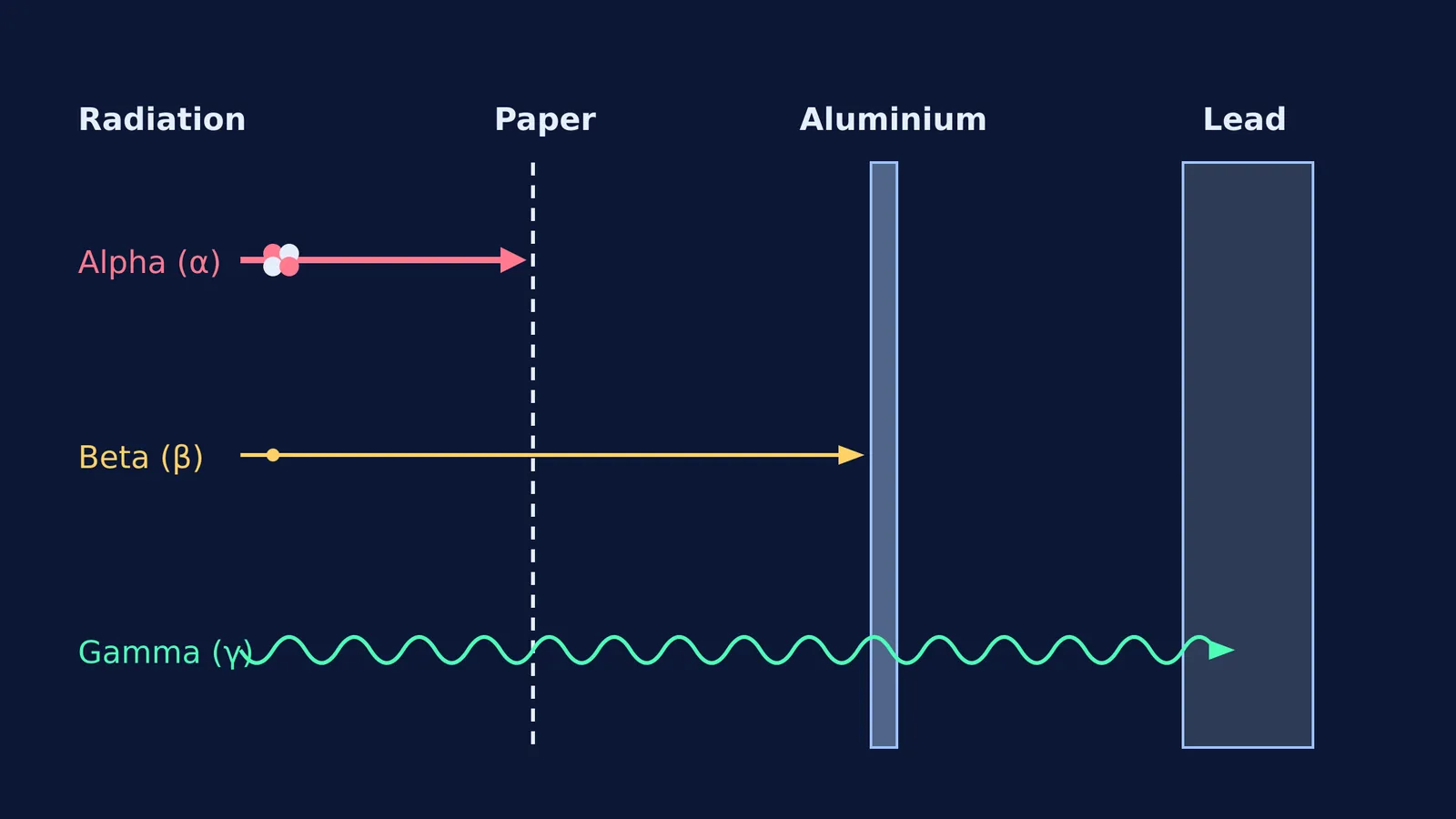
When testing the penetration of radioactive sources, you usually set up a Geiger-Müller tube and place different barriers in the path of the beam. The classic experiment tests a sheet of paper, a thin sheet of aluminium, and a thick block of lead.
Why does one particle stop immediately while another sails through solid metal? The answer lies in mass and charge. By looking at how heavy a particle is and how strongly it pulls on surrounding electrons, you can predict exactly which barrier will stop it.
Why does alpha radiation stop at paper?
An alpha particle is a helium nucleus, made of two protons and two neutrons. Because it carries a positive charge of +2 and is relatively heavy, it interacts violently with the atoms it passes.
As it moves, its strong positive charge tears electrons away from nearby atoms, ionizing them. Every time it does this, it loses some of its own kinetic energy. Because it is so bulky and interacts so heavily, it comes to a halt very quickly. According to the US Environmental Protection Agency (EPA), an alpha particle is easily stopped by a single sheet of paper or the dead outer layer of human skin (1).
How much aluminium stops a beta particle?
A beta particle is a high-speed electron (or positron) ejected from the nucleus. It carries a charge of -1 and is vastly smaller than an alpha particle.
Because of its tiny mass and smaller charge, a beta particle does not interact as frequently or as strongly with the atoms in its path. It can slip straight through a sheet of paper. However, it still has a charge, so it eventually loses energy through collisions and electromagnetic interactions. The US Nuclear Regulatory Commission (NRC) notes that beta particles are stopped by a thin sheet of metal, such as aluminium, or a block of wood (2). In most lab setups, a 3 to 5 mm sheet of aluminium does the job.
Why do gamma rays require inches of lead?
Unlike alpha and beta particles, gamma radiation is not a physical particle with mass. It is a high-energy photon, essentially a weightless packet of pure electromagnetic energy with zero charge.
Having no charge and no mass means a gamma ray does not push or pull on the electrons of the atoms it passes. It only stops if it scores a direct hit on a nucleus or interacts via specific quantum effects. Because the space between atomic nuclei is mostly empty, a gamma ray can travel enormous distances. To attenuate gamma radiation, you need materials with very densely packed nuclei. The NRC states that blocking gamma rays effectively requires several inches of a dense material like lead, or several feet of concrete (2).
If you find it hard to picture how these particles interact with atomic lattices, the Fermi Simulation Lab provides interactive simulations for the ideas that are easier to see than to read. You can change the barrier material and thickness to watch how probability and density govern which particles get through.
How do you solve exam questions on shielding?
When you encounter a question asking you to identify a radiation source from a penetration experiment, or to count alpha and beta decays in a radioactive decay series, use this checklist to build your reasoning:
Did it stop at paper? If yes, it is massive and highly charged (Alpha, +2 charge).
Did it pass through paper but stop at a thin metal sheet? If yes, it is light with a single charge (Beta, -1 charge).
Did it pass through paper and aluminium, requiring lead? If yes, it is a massless, uncharged electromagnetic wave (Gamma, 0 charge).
Understanding this relationship between charge, mass and penetration also helps explain safety rules in the lab. Alpha emitters are relatively safe outside the body but highly dangerous if swallowed, while gamma emitters are an external hazard from across the room. Whenever you study nuclear reactions, such as finding the recoil of the daughter nucleus in alpha decay, remembering the massive, bulldozing nature of the alpha particle makes the conservation of momentum intuitive.


