On this page
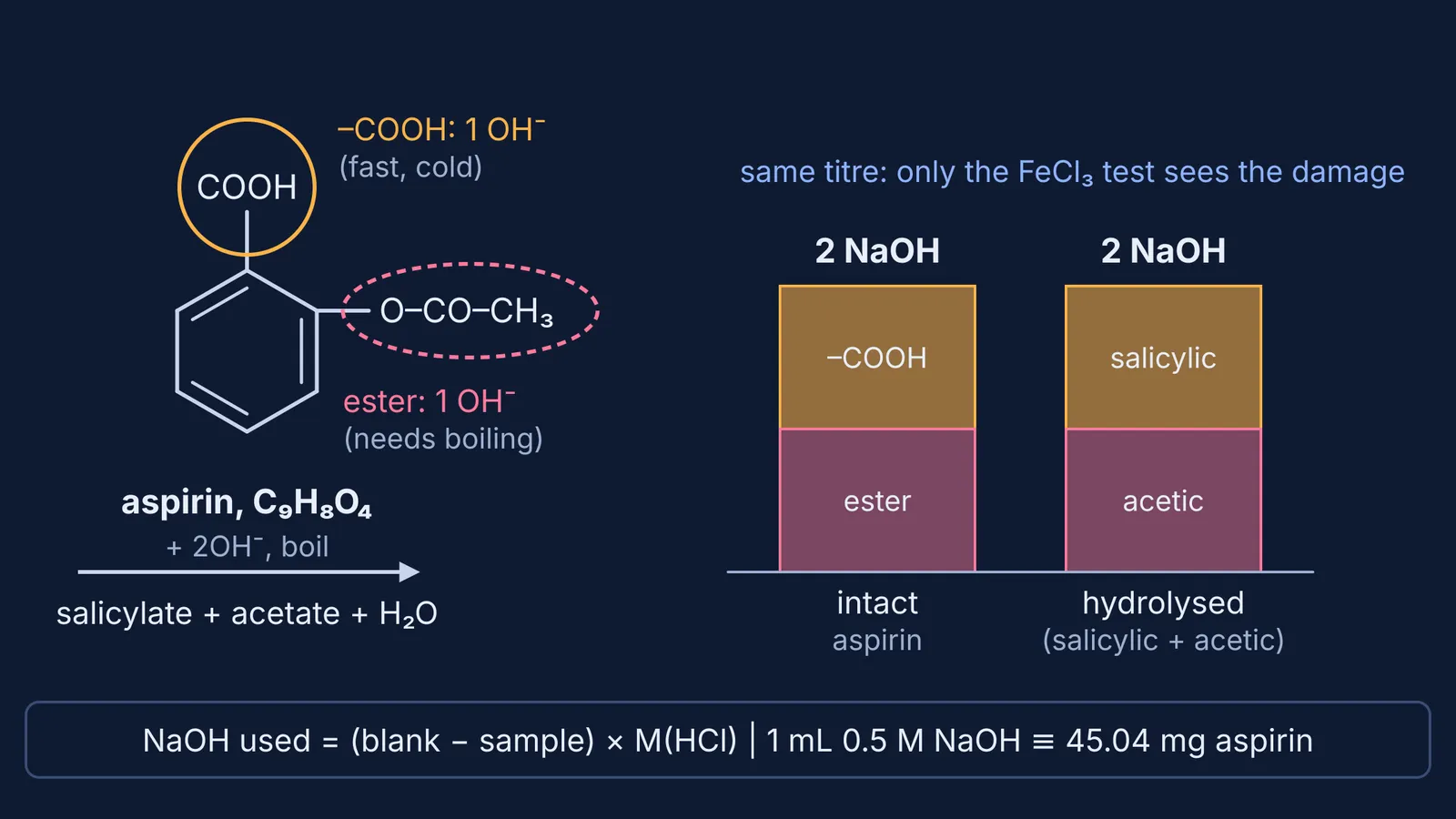
Aspirin has two acidic sites that alkali can attack: a free –COOH and an ester. A quick titration in cold ethanol sees only the first. The classic pharmacopoeia assay for aspirin tablets boils the powder with a measured excess of NaOH so that both react, then titrates what is left. That one change turns a 1 : 1 calculation into a 1 : 2 one, and it also creates a blind spot that a separate test has to cover. This post covers the analytical chemistry only.
What groups in aspirin react with NaOH?
Aspirin is 2-acetoxybenzoic acid, C₉H₈O₄ (M = 180.16 g/mol). How it is made and purified is in preparing aspirin from salicylic acid. Here we need only its two reactive groups:
The carboxylic acid, –COOH. It is a normal acid (pKa about 3.5) and is neutralised by OH⁻ at once, even in the cold.
The ester, CH₃COO–Ar. OH⁻ hydrolyses it, but slowly in the cold; heat drives it to completion.
Boiling with excess alkali does both jobs:
CH₃COO–C₆H₄–COOH + 3OH⁻ → ⁻O–C₆H₄–COO⁻ + CH₃COO⁻ + 2H₂O
That is the state of the hot, strongly alkaline flask. At the end point the phenoxide takes its proton back, so the net reaction counted is:
CH₃COO–C₆H₄–COOH + 2OH⁻ → HO–C₆H₄–COO⁻ + CH₃COO⁻ + H₂O
Check it: C₉H₈O₄ + 2OH⁻ has 9 C, 10 H, 6 O and charge 2−. The products C₇H₅O₃⁻ + C₂H₃O₂⁻ + H₂O have 9 C, 10 H, 6 O and charge 2−. It balances.
Why does the count stop at 2 NaOH and not 3?
Salicylate also has a phenolic –OH. It does not count, because of where the end point sits.
The salicylate phenol has a pKa of about 13. It only loses its proton in strong alkali.
The British Pharmacopoeia tablet method uses phenol red, which changes colour at about pH 6.8–8.4. The USP method for bulk aspirin uses phenolphthalein, which changes at about pH 8.2–10.
At pH 8 to 10, every carboxylic acid (salicylic and acetic, pKa about 3 and 4.8) is fully ionised, and the phenol is almost fully protonated.
Any OH⁻ the phenol took during boiling is handed back as the HCl lowers the pH. The titration counts two protons per molecule: one from –COOH and one from the acetic acid made by hydrolysis.
How is the pharmacopoeia assay done?
The British Pharmacopoeia 2013 monograph for aspirin tablets gives the classic procedure:
Weigh and powder 20 tablets.
Take powder containing about 0.5 g of aspirin and add 30 mL of 0.5 M NaOH.
Boil gently for 10 minutes.
Titrate the excess alkali with 0.5 M HCl, with phenol red as indicator.
Repeat the whole operation without the sample. This is the blank.
The USP monograph for aspirin as a bulk substance uses the same idea: 50.0 mL of 0.5 N NaOH, 10 minutes of gentle boiling, phenolphthalein, back-titration with acid and a blank. For tablets, the USP aspirin tablets monograph now uses liquid chromatography (HPLC) instead. Treat the titration as the classic method, and check the current Indian Pharmacopoeia or BP edition for the official procedure.
The blank matters because NaOH picks up CO₂ from air. Running the same steps without aspirin gives the NaOH really delivered, and the difference between the titres is what the aspirin used. The general logic of back titration, with chalk and MgO examples, is in back titration calculations.
Worked example: how much aspirin is in the powder?
A batch of tablets is labelled so that the powder should contain 90.0% aspirin by mass. These are teaching numbers.
0.500 g of the powder is boiled with 30.0 mL of 0.500 M NaOH for 10 minutes. The excess needs 20.0 mL of 0.500 M HCl. The blank needs 29.9 mL.
NaOH used by the sample. (29.9 − 20.0) mL × 0.500 M = 9.9 × 0.500 = 4.95 mmol.
Moles of aspirin. Each molecule uses 2 OH⁻, so n = 4.95 / 2 = 2.475 mmol.
Mass of aspirin. 2.475 mmol × 180.16 mg/mmol = 446 mg.
Percent in the powder. 446 / 500 × 100 = 89.2%.
Percent of the label claim. 89.2 / 90.0 × 100 = 99.1%.
The BP monograph sets the tablet content at 95.0 to 105.0% of the stated amount, so on these numbers the batch is within limits. (The USP tablets monograph uses a wider 90.0 to 110.0%, measured by HPLC.)
Check there was enough alkali: 15.0 mmol was added and 4.95 mmol used, so about two thirds is left to titrate.
Where does the factor 45.04 mg come from?
Both pharmacopoeias say that each mL of 0.5 M NaOH is equivalent to 45.04 mg of C₉H₈O₄. Derive it: 1 mL of 0.5 M NaOH is 0.5 mmol of OH⁻. That reacts with 0.5 / 2 = 0.25 mmol of aspirin, which is 0.25 × 180.16 = 45.04 mg. With the factor, the whole calculation is one line: 9.9 mL × 45.04 mg/mL = 446 mg.
Can the titration detect aspirin that has broken down?
This is the trap that makes the method interesting. Aspirin slowly hydrolyses in moist air:
C₉H₈O₄ + H₂O → C₇H₆O₃ (salicylic acid) + CH₃COOH
Now count the NaOH for the products. Salicylic acid has one –COOH (1 OH⁻) and acetic acid has one (1 OH⁻). The phenol does not count at the end point, as before. Total: 2 OH⁻, exactly what the intact aspirin molecule would have used.
So a partly hydrolysed sample gives the same titre as a fresh one, as long as the acetic acid stays in the powder. The back titration measures aspirin plus its breakdown products and cannot tell them apart. (If some acetic acid escapes as vapour, the titre falls a little, but that is not a clean measure of the damage either.)
That is why the monograph has a separate limit test for free salicylic acid. A free phenol gives a violet colour with iron(III), while the acetylated phenol in aspirin does not. The BP tablet monograph compares that violet colour against a standard and sets a limit of 3.0% salicylic acid. This is the same FeCl₃ idea used to check purity after you prepare aspirin, turned into a quantitative limit.
How do exam questions test this?
Before you calculate, ask three things:
Is the titration direct (cold, 1 : 1, –COOH only) or after boiling with excess alkali (1 : 2)?
Which titre is the blank, and which is the sample? NaOH used = blank − sample.
Is the question asking for percent of the powder or percent of the label claim?
If the ratio or the blank keeps catching you out, the Fermi Problem Library has back-titration problems with a step-by-step solver that explains the reasoning at each stage.
Quick checklist
Aspirin has a –COOH and an ester; boiling with excess NaOH reacts both.
At a phenol red or phenolphthalein end point, 1 aspirin = 2 NaOH. The phenol (pKa about 13) is not counted.
NaOH used = (blank − sample) × M(HCl).
1 mL of 0.5 M NaOH ≡ 0.5 × 180.16 / 2 = 45.04 mg of aspirin.
Hydrolysed aspirin still uses 2 NaOH, so a separate iron(III) test sets the salicylic acid limit.