

On this page
Synthesising aspirin (acetylsalicylic acid) is a classic laboratory experiment that demonstrates esterification and purification techniques. In this reaction, the phenolic hydroxyl group of salicylic acid is acetylated using acetic anhydride.
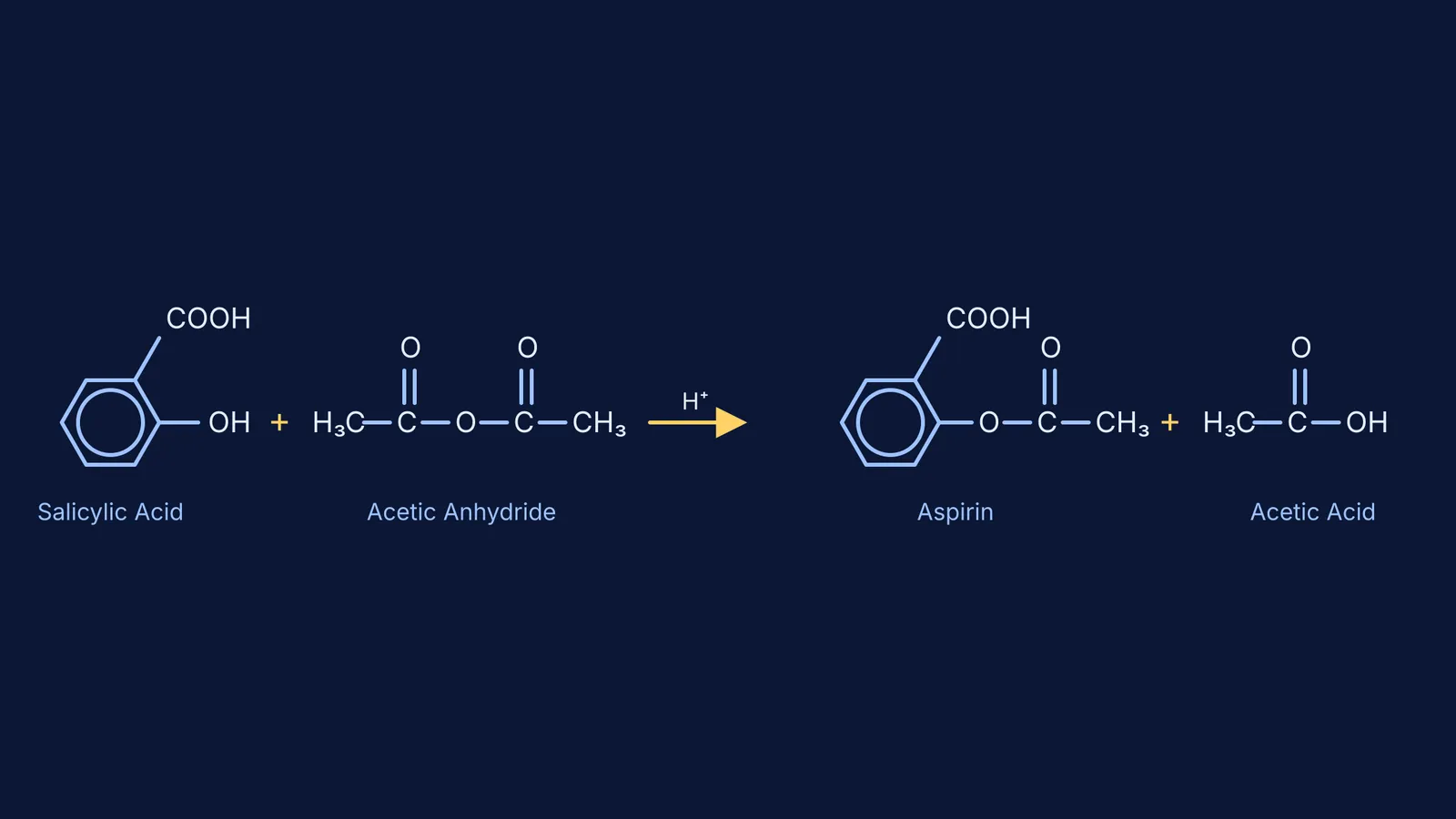
What is the chemical equation for aspirin synthesis?
The preparation of aspirin is an O-acetylation reaction. The starting material, salicylic acid, contains both a carboxylic acid group (-COOH) and a phenol group (-OH). In this synthesis, only the phenol group reacts.
Salicylic acid reacts with acetic anhydride in the presence of an acid catalyst to produce aspirin and acetic acid. Acetic anhydride is preferred over acetic acid because it is much more reactive, which drives the reaction to completion and results in a higher yield. Acetic anhydride acts as the acylating agent, supplying the acetyl group that replaces the hydrogen atom of the phenolic hydroxyl group.
If you are reviewing esterification mechanisms for your exams, the Fermi Concept Library breaks down nucleophilic acyl substitution step by step. You can also compare this process to standard Fischer esterification: mechanism and how to push the equilibrium, where a weaker carboxylic acid is used instead of an anhydride.
Why do we use an acid catalyst?
The reaction requires a strong acid—typically 85% phosphoric acid (H₃PO₄) or concentrated sulfuric acid (H₂SO₄) according to LibreTexts.
The catalyst works by protonating one of the carbonyl oxygens on the acetic anhydride. This protonation draws electron density away from the carbonyl carbon, making it a stronger electrophile. The weakly nucleophilic phenol group of salicylic acid can then attack this carbon much more easily, speeding up the reaction significantly. Without the acid catalyst, the uncatalysed reaction would be far too slow to be practical in a typical laboratory timeframe. Once the tetrahedral intermediate forms, a proton transfer occurs, and the leaving group (an acetate ion) departs. The final deprotonation restores the acid catalyst, confirming its true catalytic role.
How is aspirin separated and purified?
Once the reaction is complete (usually after 10 to 15 minutes of heating at 70–80°C per standard procedures), the mixture contains aspirin, acetic acid, unreacted starting materials, and the catalyst. Isolating the pure product requires a carefully controlled sequence.
Quenching the anhydride: A small amount of water is added to the warm mixture. This reacts exothermically with any excess acetic anhydride, safely decomposing it into acetic acid. This step is critical to ensure that no reactive anhydride remains during the subsequent purification stages.
Precipitation: The flask is cooled in an ice bath. Because aspirin has very low solubility in cold water, it precipitates out as a white solid. If crystals are slow to form, gently scratching the inside of the flask with a glass rod provides a rough surface for nucleation, encouraging the solid to crystallise out of the supersaturated solution.
Recrystallisation: The crude solid often contains unreacted salicylic acid and other trace impurities. To purify it, the solid is dissolved in a minimal volume of warm ethanol, followed by the addition of warm distilled water. As this solvent pair cools slowly to room temperature, pure aspirin forms well-defined needle-like crystals, while the impurities remain dissolved in the mother liquor.
If you are stuck on stoichiometric calculations for this experiment—such as finding the limiting reactant or theoretical yield—the Fermi Problem Library can guide you through the mole ratios with its step-by-step solver. Salicylic acid is typically the limiting reactant, while acetic anhydride is supplied in excess to push the reaction forward.
How to test the purity of aspirin?
After filtering and drying the final crystals, you must verify that the recrystallisation successfully removed the starting materials.
Melting point: Pure aspirin has a sharp melting point of 136°C. If the sample melts at a lower temperature or across a broad range (e.g., 125–130°C), it indicates the presence of impurities, most commonly residual salicylic acid or moisture. The melting point depression occurs because impurities disrupt the regular crystal lattice of the solid.
Ferric chloride test: Adding a few drops of 1% iron(III) chloride (FeCl₃) solution tests for unreacted salicylic acid. The Fe³⁺ ion forms a highly coloured purple or violet complex with phenols. Because pure aspirin has an ester group instead of a free phenol group, a pure sample will not change colour. If the solution turns purple, the aspirin needs to be recrystallised again.


