On this page
Walk through a dairy, a pharmaceutical plant or a power station and many of the temperature readings on the control screens come from the same small part: a coil or film of platinum called a Pt100. The physics is Class 12 current electricity. The engineering lesson is about something your textbook usually ignores: the resistance of the connecting wires.
What is a Pt100 and why is it made of platinum?
A Pt100 is a platinum resistance thermometer whose resistance is exactly 100 Ω at 0 °C. "Pt" is platinum, and "100" is that resistance. A Pt1000 is the same idea with 1000 Ω.
Platinum resists corrosion, changes resistance smoothly and repeatably, and can be made very pure. You already know the general rule R = R₀(1 + αΔT) for metals from temperature coefficient of resistance and its worked examples.
The industrial standard is IEC 60751. It fixes the average coefficient between 0 °C and 100 °C at 0.00385 per kelvin. That is lower than the value for very pure platinum, about 0.003926 per kelvin (reference-grade figure in this platinum RTD note). Industrial sensors are made from platinum that is deliberately not quite pure, so that every manufacturer's sensor follows the same curve and can be swapped without recalibration.
How do you calculate Pt100 resistance at a given temperature?
Above 0 °C the standard uses the Callendar–Van Dusen equation:
R(T) = R₀(1 + AT + BT²)
with R₀ = 100 Ω, A = 3.9083 × 10⁻³ °C⁻¹ and B = −5.775 × 10⁻⁷ °C⁻². These coefficients are listed in Texas Instruments' basic guide to RTD measurements, which quotes IEC 60751. (Below 0 °C a third term with a coefficient C is added; you will not need it here.)
At 100 °C:
R = 100(1 + 0.39083 − 0.005775) = 138.51 Ω
So the resistance rises by 38.51 Ω over 100 K, an average of 0.385 Ω per kelvin. That is where α = 0.00385 comes from. The small negative B term bends the curve slightly. Between 0 and 100 °C the curve sits above the straight line joining its ends by at most 0.14 Ω, at 50 °C.
Worked example: a Pt100 at body temperature in a bridge
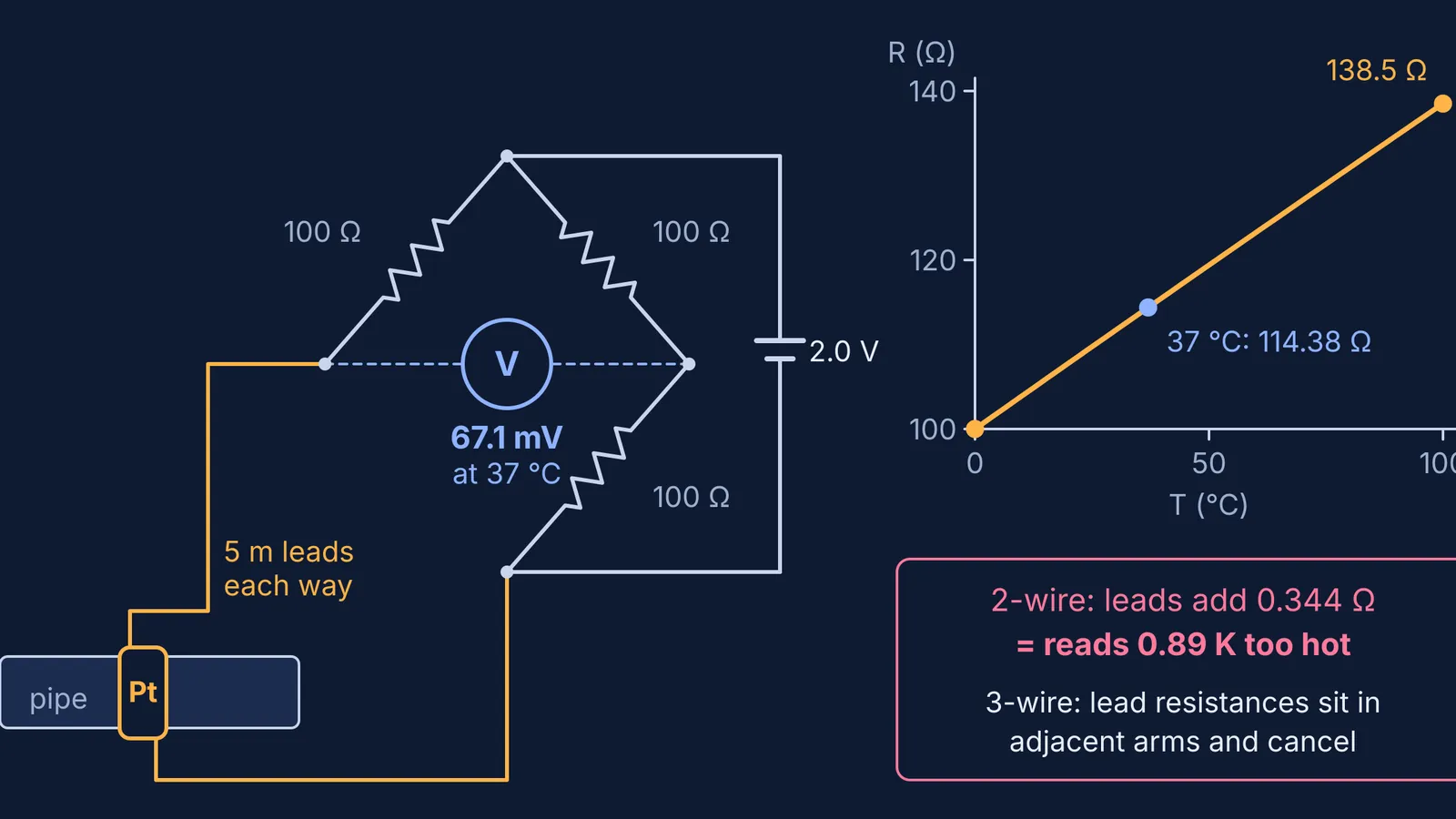
A Pt100 sits in a water bath at 37.0 °C. It forms one arm of a Wheatstone bridge whose other three arms are 100 Ω each, with a 2.0 V supply.
Find the resistance. R = 100(1 + 3.9083 × 10⁻³ × 37 − 5.775 × 10⁻⁷ × 37²) = 100(1 + 0.144607 − 0.000791) = 114.38 Ω.
Compare with the straight line. Using R = 100(1 + 0.00385 × 37) gives 114.24 Ω. If you turned the true 114.38 Ω back into a temperature with the straight-line formula, you would get (114.38 − 100)/0.385 = 37.35 °C. The straight line reads about 0.35 K too high at 37 °C, which is why instruments use the full equation.
Find the bridge output. The Pt100 side of the bridge is a divider: the voltage across the 100 Ω in series with it is 2.0 × 100/(100 + 114.38) = 0.9329 V. The fixed side divides equally: 1.0000 V. The difference is 67.1 mV. At 0 °C the bridge is balanced and reads zero.
Check linearity. At 100 °C the same bridge gives 161.4 mV, not 100/37 × 67.1 = 181 mV. An unbalanced bridge's output is not exactly proportional to the resistance change, so the meter must correct for that too. If you want to see how the null and the off-balance swing behave, try the Wheatstone bridge simulation.
Check self-heating. A typical meter drives about 1 mA through the sensor. The power is I²R = (1 × 10⁻³)² × 114.38 = 0.11 mW. That is small, but it is why the current is kept around a milliampere: more current would warm the platinum above the water it is measuring.
Check the tolerance. A Class A sensor may be off by ±(0.15 + 0.002|T|) K, which the same TI guide lists. At 37 °C that is ±(0.15 + 0.074) = ±0.22 K.
Why does a 2-wire Pt100 read too hot?
Here is the trap. The sensor sits in a pipe, and the meter sits in a panel 5 m away. With a 2-wire connection, the current flows out along one copper lead, through the platinum and back along the other. The meter sees the platinum and both leads in series.
Take leads of 0.5 mm² copper, with resistivity 1.72 × 10⁻⁸ Ω m:
One lead: R = ρL/A = 1.72 × 10⁻⁸ × 5/(0.5 × 10⁻⁶) = 0.172 Ω.
Both leads: 0.344 Ω.
The meter now sees 114.38 + 0.344 = 114.73 Ω. Solving the Callendar–Van Dusen equation for that resistance gives 37.89 °C.
The reading is 0.89 K too hot, four times the Class A tolerance, and nothing about the sensor is faulty. A Pt100 changes by only about 0.39 Ω per kelvin, so a few tenths of an ohm in the wiring look like nearly a degree.
How do 3-wire and 4-wire connections fix it?
In a 3-wire Pt100, a third lead is attached to one end of the platinum. In a bridge, one lead goes in series with the Pt100 arm and an identical lead goes in series with the neighbouring arm. The third lead carries the detector connection, which takes no current at balance. Because the two equal lead resistances sit in adjacent arms, they appear on both sides of the balance condition and cancel. This works as long as the leads match, which is why 3-wire cable is sold as matched sets. 3-wire is the usual choice in industry.
A 4-wire connection is used for the most accurate work. Two wires carry the current and two separate wires measure the voltage across the platinum alone. It is the same idea as subtracting lead resistance on a meter, covered in how to use a multimeter for resistance and continuity.
How is a Pt100 different from a thermistor?
A Pt100's resistance rises with temperature (positive coefficient). The common NTC thermistor in a digital fever thermometer falls as it warms.
A Pt100 changes by about 0.4% per kelvin. A thermistor changes by several per cent per kelvin, so it is more sensitive but much less linear.
A Pt100 works over a range of hundreds of degrees. A thermistor suits a narrow band, such as around body temperature.
If the bridge arithmetic or the lead error still feels slippery, the Fermi Problem Library has a step-by-step solver that explains the reasoning behind each line of a circuit problem.
Quick checklist
Pt100: platinum, 100 Ω at 0 °C, about 138.5 Ω at 100 °C.
Average slope 0.385 Ω/K; the industrial α is 0.00385 per kelvin, a little lower than very pure platinum.
Use R = R₀(1 + AT + BT²) above 0 °C; at 37 °C, R = 114.38 Ω.
An unbalanced bridge's output is not exactly linear in temperature.
Two 5 m leads of 0.5 mm² copper add 0.344 Ω, which reads as 0.89 K too hot.
3-wire connections cancel matched leads; 4-wire connections remove them.
Pt100s rise with temperature; NTC thermistors fall.