On this page
Put a small foam bead between an ultrasonic speaker and a flat plate, switch on a 40 kHz tone, and the bead stays in the air with nothing touching it. Add more beads and they line up in a column, each one about 4.3 mm above the next. You cannot hear any of it, because 40 kHz is far above the range of human hearing. This post works out why the beads float, why they sit where they do, and how loud the sound has to be.
How does an acoustic levitator work?
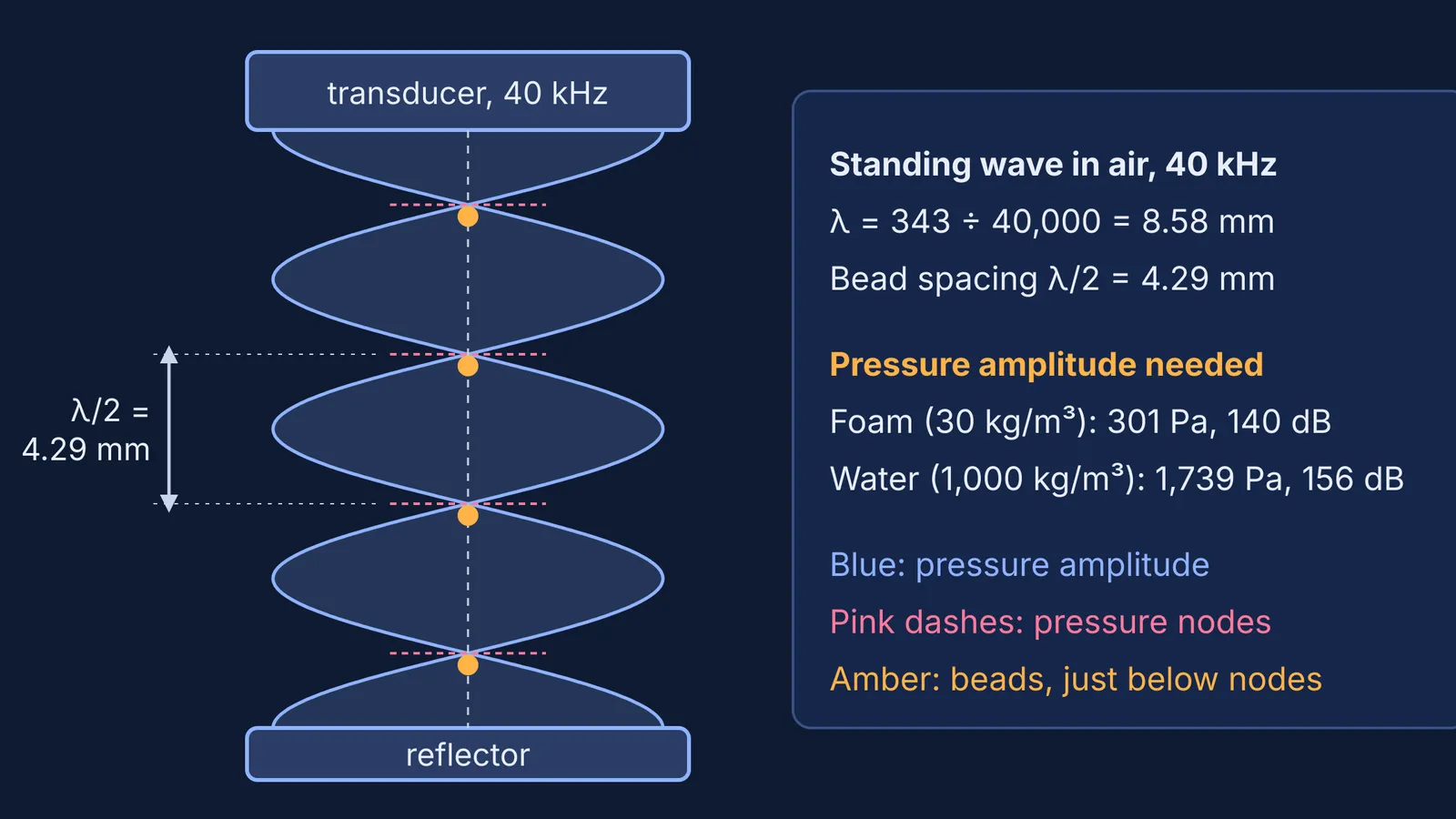
A transducer at the top vibrates at 40 kHz and sends sound down to a reflector. The reflected wave runs back up through the incoming one, and if the gap is a whole number of half-wavelengths the two form a standing wave. The pressure swings strongly at some heights (antinodes) and hardly at all at others (nodes). The node spacing of λ/2 is the same result you use for strings and pipes in standing waves in strings and pipes, so it is not derived again here.
The new part is the force. Over one cycle, the pressure on the bead pushes down for half the time and up for the other half, so the first-order force averages to zero. What survives is a small second-order, time-averaged effect called the acoustic radiation force. It is not the sound "kicking" the bead upward on every cycle. It is a steady push that comes from the squares of pressure and air velocity, which do not average to zero.
Why do beads sit at the pressure nodes?
For a small, hard, dense sphere in air, the radiation force pushes the bead away from pressure antinodes and towards pressure nodes. At a pressure node the air does not compress much, but it rushes back and forth fastest (a velocity antinode). A dense bead that cannot keep up with that oscillating air is drawn into the node.
Gravity shifts the picture slightly. At the node itself the force is zero, so a bead resting exactly there would fall. It drops a little below the node until the upward radiation force equals its weight. The trapped beads therefore sit just under each node.
Compare this with Kundt's tube, where powder lying on the tube floor piles up at displacement nodes, the places where the air barely moves. That is the opposite position, and the mechanism is different: the powder is shaken off where the air moves most and settles where it is still. In a levitator the bead is held in mid-air, where the air moves most.
How strong is the acoustic radiation force?
For a sphere much smaller than the wavelength, in a standing wave whose pressure amplitude at the antinodes is p₀, the force along the axis has size
F = (5/8) V k p₀² sin(2kz) / (ρc²)
where z is the distance from the nearest pressure node, V is the bead's volume, k = 2π/λ, ρ is the density of air and c the speed of sound. The force always points towards the node. Its largest value, at sin(2kz) = 1, is Fmax = 5Vkp₀²/(8ρc²). This is the standard small-particle result (Gor'kov's theory). Research papers write it as F = 4πa³kEΦ sin(2kz), with acoustic energy density E = p₀²/(4ρc²) and contrast factor Φ; see for example Barnkob, Augustsson, Laurell and Bruus (2012). For a rigid sphere much denser than the fluid, Φ = 1/3 + 1/2 = 5/6, which gives the 5/8 above.
Notice that Fmax grows with V, and so does the bead's weight, ρ(bead) V g. Set them equal and V cancels:
p₀² = 8ρc²ρ(bead) g / (5k)
So, as long as the bead is much smaller than λ, the sound pressure needed does not depend on the bead's size. It depends only on the bead's density.
Worked example: how loud must the sound be to lift a foam bead?
Take a 40 kHz levitator in air at about 20 °C, with c = 343 m/s and ρ = 1.2 kg/m³. Use an expanded polystyrene bead of density 30 kg/m³. Standard EPS grades run from about 11 to 38 kg/m³ (see this EPS geofoam density table), so 30 kg/m³ is a round illustrative value.
Wavelength. λ = c/f = 343 ÷ 40,000 = 8.58 × 10⁻³ m = 8.58 mm.
Bead spacing. Nodes are λ/2 apart, so the beads hang 4.29 mm apart.
Wave number. k = 2π/λ = 2π ÷ 8.575 × 10⁻³ = 733 m⁻¹.
Pressure needed. p₀² = 8 × 1.2 × 343² × 30 × 9.81 ÷ (5 × 733) = 9.07 × 10⁴ Pa², so p₀ = 301 Pa.
Check the units. (kg/m³)(m²/s²)(kg/m³)(m/s²) ÷ m⁻¹ = kg²/(m² s⁴) = Pa². Good.
Sound pressure level. The rms pressure is 301 ÷ √2 = 213 Pa. SPL = 20 log₁₀(213 ÷ 20 × 10⁻⁶) = 140.5 dB.
A water drop instead. Replace 30 with 1,000 kg/m³. p₀ rises by √(1000/30) = 5.77 times, to 1,739 Pa, or 155.8 dB.
So a column of foam beads needs about 140 dB and water drops about 156 dB. Real levitators run above the minimum. At twice the minimum pressure (6 dB more), Fmax is four times the weight, and the bead settles where sin(2kz) = 1/4, only 0.17 mm below the node. At exactly the minimum it would sit λ/8 = 1.07 mm below, on the edge of falling out.
What limits the size of a levitated bead?
The formula assumes a radius much smaller than λ. As a bead approaches half a wavelength (about 4 mm across at 40 kHz) it spans a whole node-to-antinode region, the simple formula stops working, and it no longer fits between neighbouring traps. That is why levitator demos use beads of a millimetre or two.
Liquids add another problem. A water drop is not rigid: the radiation force squashes it into a flattened shape, and at high amplitude it wobbles or breaks up. The 1,739 Pa figure is for a rigid sphere, so treat it as an estimate for a drop. For a completely different way of floating a drop, on a cushion of its own vapour, see why water drops dance on a hot tawa.
One more caution. 140 dB at 40 kHz is inaudible, but inaudible is not the same as harmless, and high-power ultrasonic equipment needs proper design and shielding. This post is about the physics, not a build guide.
If standing waves are still hard to picture, the Simulation Lab has interactive simulations for ideas that are easier to see than read.
Quick checklist
A levitator needs a standing wave: transducer plus reflector, gap a whole number of λ/2.
The lifting force is a time-averaged, second-order radiation force, proportional to p₀².
Small dense beads go to pressure nodes and hang slightly below them.
At 40 kHz, λ = 8.58 mm and the beads are 4.29 mm apart.
The pressure needed depends on the bead's density, not its size: about 301 Pa (140 dB) for foam, 1,739 Pa (156 dB) for water.
Use peak pressure in the force formula and rms pressure for decibels.