

On this page
Sound is invisible. In 1866 the German physicist August Kundt found a way to make one draw itself. He sprinkled a fine powder along a glass tube, made the air inside ring at a single pitch, and watched the powder gather into evenly spaced heaps. The gaps between those heaps are a ruler for the wavelength of sound.
Who was August Kundt?
Kundt (1839-1894) taught at Zurich, Strassburg and finally Berlin, where he succeeded Helmholtz; Wilhelm Röntgen was one of his Zurich students (August Kundt, Wikipedia).
His tube paper appeared in Annalen der Physik in 1866 under a title that translates roughly as "On a new kind of acoustic dust figures and their use to determine the speed of sound in solids and gases" (Crossref record, volume 203, pages 497-523).
How does Kundt's tube measure the speed of sound?
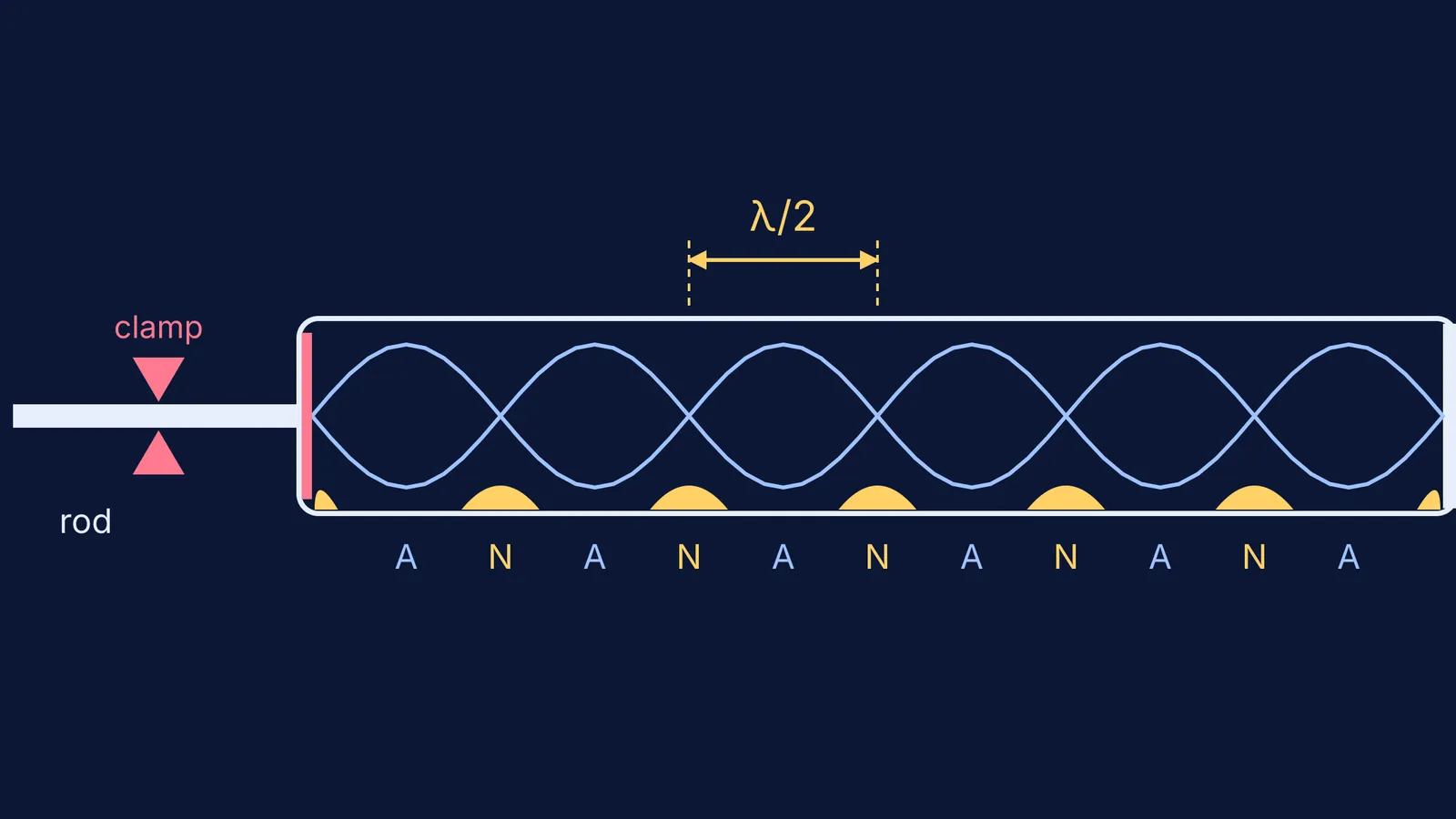
Kundt's tube is a transparent horizontal pipe holding a small amount of fine powder such as cork dust, talc or lycopodium, with a sound source at one end and a movable piston at the other (Kundt's tube, Wikipedia). You slide the piston to adjust the length of the air column until it resonates. Then a standing wave forms: some points (nodes) hardly move, and others (antinodes) swing back and forth hard.
The moving air at the antinodes sweeps the powder away, and the powder settles in heaps at the nodes, where the air is still. Neighbouring nodes are half a wavelength apart, so the heap spacing d gives the wavelength directly: λ = 2d (HyperPhysics lab notes on Kundt's tube).
The last step is the wave equation, v = fλ. If you know the frequency f of the source, the speed of sound in the gas is v = 2fd. The same notes advise measuring across as many heaps as possible to get a good average, because the centre of a single heap is hard to pin down. Divide that length by the number of gaps between the heaps.
If the standing-wave picture still feels shaky, our posts on standing waves in strings and pipes and on displacement and pressure waves in sound build it up step by step. The Fermi Simulation Lab has interactive simulations for ideas that are easier to see than to read.
How did the same tube measure sound in a metal rod?
Kundt's sound source was a metal rod clamped at its centre, projecting into the tube. Rubbing the rod lengthwise with rosined leather made it vibrate at its fundamental frequency (Kundt's tube, Wikipedia).
A small disc on the rod's end passes the vibration to the air. The clamp holds the middle still, so it is a node, and the free ends are antinodes. For the rod's fundamental, the wavelength in the metal is twice the rod's length, λ = 2L (HyperPhysics).
The rod and the air vibrate at the same frequency, so v(rod) / v(air) = L / d. You do not need the frequency at all, only the rod length and the heap spacing.
By filling the tube with other gases and partly pumping it out, Kundt also worked out sound speeds in different gases and at different pressures. Ten years later he and Emil Warburg published a study of the specific heat of mercury vapour (Crossref record, 1876), and their result showed that mercury vapour is a monatomic gas (August Kundt, Wikipedia).
Worked example: from dust heaps to metres per second
Take a brass rod 1.00 m long, clamped at its centre. Reference tables list sound in brass at about 4,700 m/s and in air at 20 °C at 343 m/s (physics.info speed of sound table). Here is what the tube would show.
Wavelength in the rod: λ = 2L = 2.00 m.
Frequency: f = v / λ = 4,700 / 2.00 = 2,350 Hz.
Wavelength in air: λ = 343 / 2,350 = 0.146 m.
Heap spacing: d = λ / 2 = 7.30 cm.
Run it backwards as Kundt did. Suppose you measure 80.3 cm across 11 gaps: d = 7.30 cm, and v(rod) = v(air) × L / d = 343 × 100 / 7.30 ≈ 4,700 m/s.
Now swap the gas and keep the same 2,350 Hz rod. Using the same table, the heap spacing d = v / 2f becomes:
carbon dioxide (259 m/s): about 5.5 cm
air (343 m/s): about 7.3 cm
helium (965 m/s): about 20.5 cm
The heaps stretch out in light gases and crowd together in heavy ones. If you want to know why, read our post on Newton's formula and Laplace's correction.
If you keep getting a factor of two wrong, the Fermi Problem Library has worked problems with a step-by-step solver that explains the reasoning rather than printing an answer.
Next time you meet a Kundt's tube problem, sketch the heaps first. Once you can see the nodes, the formula follows.


