On this page
Anyone who makes dosas or chapatis knows the "tawa test". You sprinkle a few drops of water onto the pan to check if it is ready. If the water spreads, bubbles and evaporates instantly, the pan is hot. But if the drops bead up like tiny glass marbles and dart across the surface, the pan is exceptionally hot.
Why does water take longer to boil away on a hotter pan? The answer is a fascinating phenomenon in thermal physics known as the Leidenfrost effect, named after Johann Gottlob Leidenfrost, the German doctor who first described it in 1756.
What is the Leidenfrost effect?
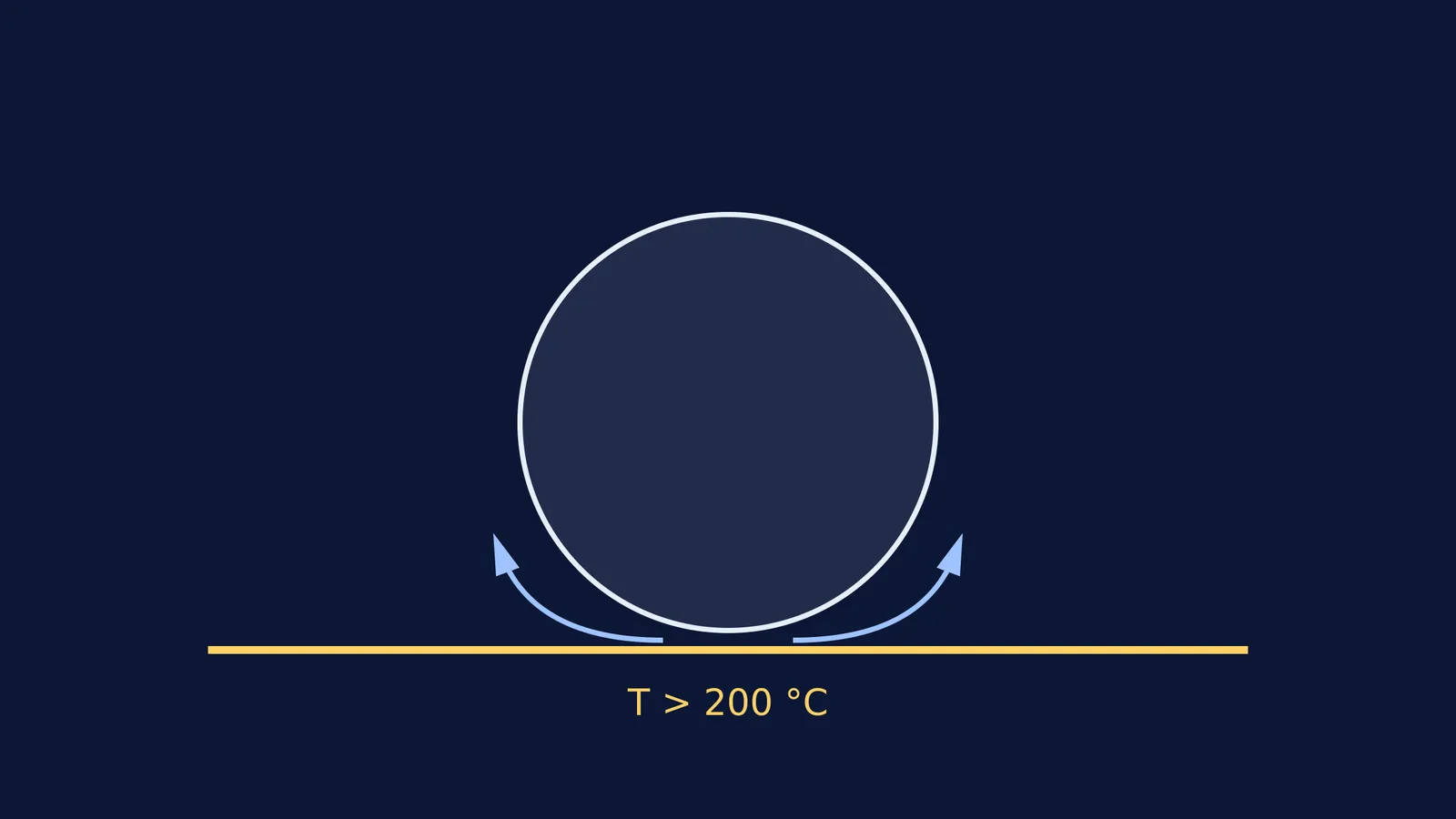
When a liquid touches a surface that is significantly hotter than its boiling point, it does not simply boil faster. Instead, the very bottom of the droplet flashes into steam the instant it makes contact with the metal.
For water on a smooth metal pan, this transition—called the Leidenfrost point—typically happens at around 200 °C. Because steam is a much poorer conductor of heat than liquid water, this thin layer of vapour acts as a physical cushion and a powerful thermal insulator.
The water droplet is entirely suspended on this steam layer, preventing the bulk of the liquid from directly touching the hot metal. Without the high friction of the pan to hold it back, the droplet skates and dances across the surface on its own vapour.
Why does the water not boil away immediately?
The insulation provided by the steam is incredibly effective, leading to a counter-intuitive result: heating the pan further makes the water last longer.
At 168 °C, which is well above the boiling point but below the Leidenfrost point, a water drop will vigorously boil and disappear almost immediately (Wikipedia). However, at 202 °C, the insulating vapour cushion allows the drop to survive for 152 seconds, even though the pan is much hotter.
Recent research published in *Physical Review Letters* (Harvey, Méndez Harper and Burton, 2021) explored exactly how these levitating layers break down. The scientists found that as the surface cools, the vapour layer gradually thins out. Once the layer drops to a critical minimum thickness of 10 to 20 micrometres, it collapses. The steam cushion fails, allowing the liquid to touch the pan and boil away violently.
A physics lab in your kitchen
The Leidenfrost effect is not just a kitchen curiosity. The exact same physics dictates how industrial cooling systems work, how nuclear reactors are safely quenched, and why liquid nitrogen scoots across the floor at room temperature without instantly turning to gas.
The next time you are preparing a hot tawa, take a moment to watch the droplets. You are watching a levitating liquid balanced perfectly on its own escaping gas.
Try the Leidenfrost test at home
You can safely observe the different phases of boiling and heat transfer by doing this simple kitchen experiment.
Place a dry stainless steel or cast iron pan on the stove over medium heat. Do not use a non-stick Teflon pan, as heating them empty can damage the chemical coating.
Every 30 seconds, dip your fingers in water and flick a tiny amount onto the pan.
Below 100 °C: The water will simply sit on the metal and slowly evaporate into the air.
Nucleate boiling (100 °C to 150 °C): Once the pan passes the boiling point, the drops will sizzle loudly, bubble aggressively, and vanish in a couple of seconds. Heat is transferring directly from the metal to the water.
The Leidenfrost point (~200 °C): The sound will suddenly change. The drops will no longer sizzle loudly. Instead, they will form perfect spheres and glide effortlessly around the pan, propelled by tiny jets of steam.
The collapse: Turn off the heat and watch the drop closely as the pan cools. Eventually, the steam layer will shrink below 20 micrometres and collapse, causing the drop to instantly boil away.
If you are studying heat transfer and phase changes for school, testing predictions interactively is one of the best ways to build a strong physical intuition. You can explore physical models and run your own virtual experiments in Fermi's Simulation Lab.
To connect this concept with other everyday thermal physics, you can also explore why a glass of cold water gets wet outside and why metal feels colder than wood at the same temperature.