On this page
Phenol decolourises bromine water and gives a white precipitate of 2,4,6-tribromophenol. The same reaction, done with a measured amount of bromine, is the classic way to find how much phenol a sample contains. It is often called Koppeschaar's method, or the bromate–bromide titration. The awkward part is that bromine itself is too volatile to keep as a standard solution, so the method makes its bromine inside the flask and counts what is left with iodine and thiosulphate.
Why not titrate phenol with bromine water directly?
Bromine water loses Br₂ to the air every time the bottle is opened, so its concentration drifts. Phenol also reacts in three steps, and the white precipitate makes a direct end point hard to see.
The fix has two parts:
Make the bromine in the flask from potassium bromate, KBrO₃, which is a stable solid you can weigh accurately, plus excess KBr and acid.
Add the bromine in excess and measure the leftover, not the bromine used. This is a back titration.
Why phenol takes three bromines in the first place, and why positions 2, 4 and 6 react, is explained in bromination of phenol with bromine water. Here we only use the result.
How does bromate and bromide make bromine?
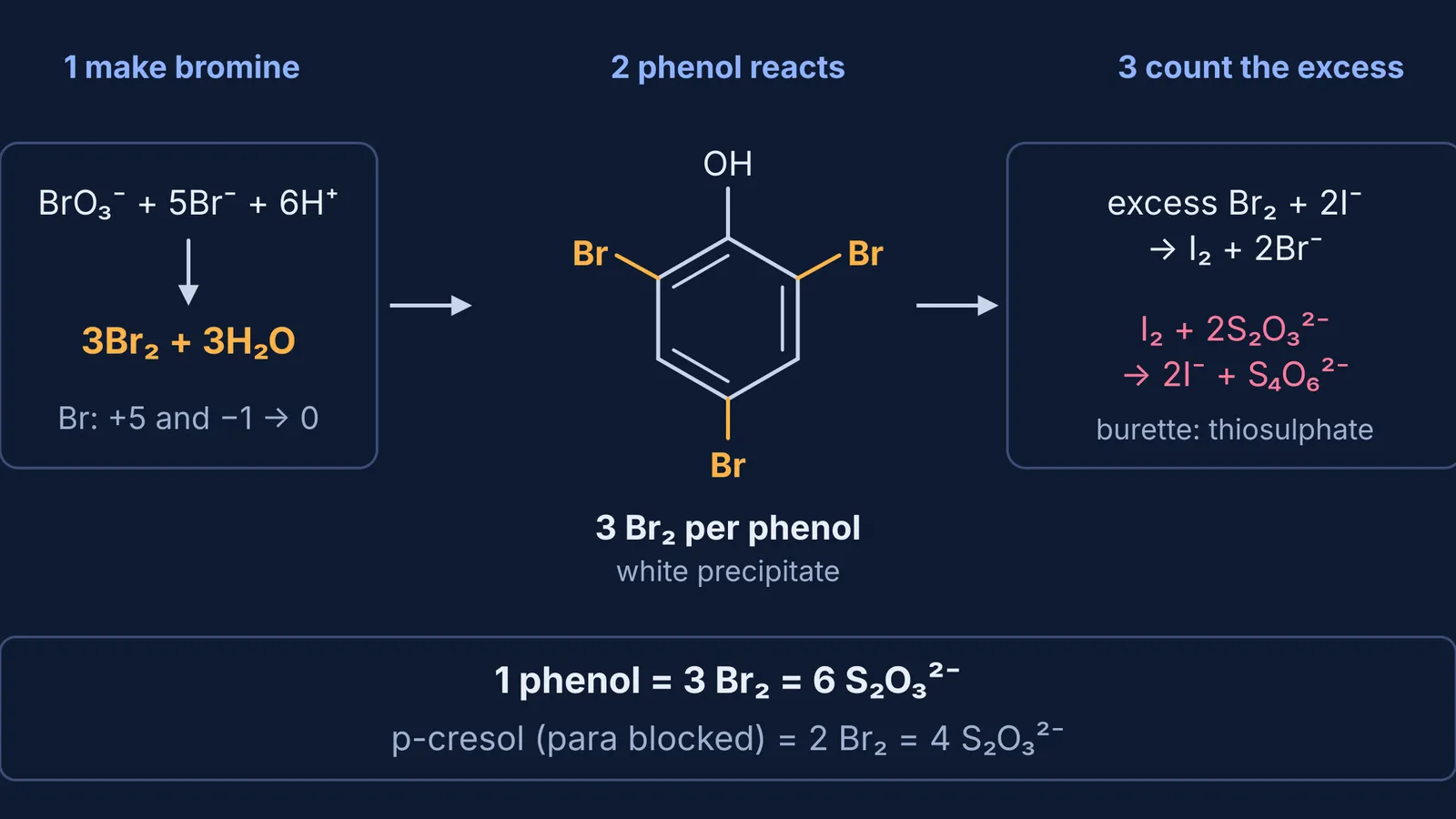
In acid, bromate (Br at +5) oxidises bromide (Br at −1), and both end up as Br₂ (Br at 0):
BrO₃⁻ + 5Br⁻ + 6H⁺ → 3Br₂ + 3H₂O
Check it: 6 Br, 3 O and 6 H on each side, and charge −1 − 5 + 6 = 0 on the left, 0 on the right. Electrons: one Br falls by 5, five Br rise by 1 each. Balanced.
This kind of reaction, where one element in two oxidation states meets in the middle, is called comproportionation. You may have met the iodine version, IO₃⁻ + 5I⁻ + 6H⁺ → 3I₂ + 3H₂O, in measuring iodine in iodised salt. The bromine version works the same way: 1 BrO₃⁻ gives 3 Br₂.
How do you get from bromine to thiosulphate?
Three reactions follow in the flask:
Phenol takes its bromine. C₆H₅OH + 3Br₂ → C₆H₂Br₃OH + 3HBr
The leftover bromine is swapped for iodine. KI is added: Br₂ + 2I⁻ → I₂ + 2Br⁻. Iodine is far less volatile in iodide solution, so nothing is lost from here on.
The iodine is titrated. I₂ + 2S₂O₃²⁻ → 2I⁻ + S₄O₆²⁻, with starch near the end. The thiosulphate step itself is covered in iodometric and iodimetric titrations.
Put the ratios together:
1 Br₂ = 1 I₂ = 2 S₂O₃²⁻
1 BrO₃⁻ = 3 Br₂ = 6 S₂O₃²⁻
1 phenol = 3 Br₂ = 6 S₂O₃²⁻
So the n-factor for phenol in this titration is 6, the same as for bromate. That is why the USP phenol monograph states that each mL of 0.1 N bromine is equivalent to 1.569 mg of phenol: 94.11 g/mol ÷ 6 ÷ 10 = 1.569 mg.
The same monograph shows how carefully it is done: the solution goes into a stoppered iodine flask, the flask is shaken repeatedly for 30 minutes and left for 15, KI is added quickly while guarding against escaping bromine vapour, and a blank is run alongside.
Worked example: how pure is a crude phenol sample?
These are teaching numbers.
0.200 g of crude phenol is dissolved and made up to 250 mL. A 25.0 mL aliquot is placed in an iodine flask with 25.0 mL of 0.0200 M KBrO₃, excess KBr and HCl. After standing, KI is added. The liberated iodine needs 18.0 mL of 0.100 M thiosulphate. A blank (no phenol) needs 30.0 mL.
Bromine made. KBrO₃ = 25.0 × 0.0200 = 0.500 mmol, so Br₂ = 3 × 0.500 = 1.50 mmol. Check with the blank: 30.0 × 0.100 = 3.00 mmol thiosulphate = 1.50 mmol Br₂. They agree.
Bromine left. 18.0 × 0.100 = 1.80 mmol thiosulphate, so Br₂ left = 1.80 / 2 = 0.900 mmol.
Bromine used by phenol. 1.50 − 0.900 = 0.600 mmol.
Phenol in the aliquot. 0.600 / 3 = 0.200 mmol. Mass = 0.200 × 94.11 = 18.8 mg.
Phenol in the sample. The aliquot is one tenth of 250 mL, so 188 mg.
Purity. 188 / 200 × 100 = 94.1%.
The shortcut: (blank − sample) titre × M(thiosulphate) / 6 = mmol phenol. (30.0 − 18.0) × 0.100 / 6 = 0.200 mmol.
What changes for p-cresol or other phenols?
The 1 : 3 ratio is not a law of phenols. It is set by the number of free ortho and para positions, which is exactly the prediction rule from the bromination post.
p-Cresol (4-methylphenol, M = 108.14 g/mol) has its para position blocked by CH₃. Only positions 2 and 6 react, so 1 p-cresol = 2 Br₂ = 4 S₂O₃²⁻.
Suppose a 25.0 mL aliquot contains 20.0 mg of pure p-cresol and is run under the same conditions:
p-Cresol = 20.0 / 108.14 = 0.185 mmol.
Br₂ used = 2 × 0.185 = 0.370 mmol. Br₂ left = 1.50 − 0.370 = 1.13 mmol.
Titre = 2 × 1.13 / 0.100 = 22.6 mL.
Correct working: (30.0 − 22.6) × 0.100 / 4 = 0.185 mmol, which is 20.0 mg, 100%.
Wrong working with the phenol factor of 6: 0.123 mmol, which is 13.3 mg, 66.7%.
A pure sample appears two thirds pure, because the bromine ratio is 3 : 2. Before you calculate, always count the free ortho and para positions.
The method also has limits. Phenols with strongly electron-withdrawing groups, such as nitrophenols, brominate slowly or incompletely, so the method has to be checked for each compound rather than assumed.
Why does a fourth bromine not spoil the count?
With excess bromine, tribromophenol can take up one more bromine to form 2,4,4,6-tetrabromocyclohexa-2,5-dienone, C₆H₂Br₄O, a yellowish solid. You might think this uses an extra Br₂ and breaks the 1 : 3 ratio.
It does not, because this compound is itself an oxidising agent. When KI is added it gives the bromine back as iodine:
C₆H₂Br₄O + 2I⁻ + H⁺ → C₆H₂Br₃OH + Br⁻ + I₂
Check it: 6 C, 3 H, 4 Br, 1 O and charge −1 on each side. The extra bromine ends up as iodine and is titrated with the leftover Br₂, so the count per phenol stays at 3 Br₂. Some procedures, including the USP one, add a little chloroform before titrating. It dissolves the precipitate and helps release any iodine trapped in it, which sharpens the end point.
For practice chaining mole ratios through several reactions, the Fermi Problem Library has a step-by-step solver that explains the reasoning at each link of the chain.
Quick checklist
BrO₃⁻ + 5Br⁻ + 6H⁺ → 3Br₂ + 3H₂O makes a known amount of bromine in the flask.
Excess Br₂ is turned into I₂ with KI, then titrated with thiosulphate.
1 phenol = 3 Br₂ = 6 S₂O₃²⁻; 1 mL of 0.1 N bromine ≡ 1.569 mg phenol.
mmol phenol = (blank − sample) × M(thiosulphate) / 6.
Count free ortho and para positions: p-cresol uses 2 Br₂, so divide by 4.
The tetrabromo dienone returns its extra bromine as iodine, so the count holds.
Phenol is toxic and is absorbed through the skin; this is a laboratory method only.