On this page
Class 10 science tells you that oils "become rancid" when they are oxidised. A food lab cannot work with a smell, so it uses a number. For early oxidation that number is the peroxide value: how much hydroperoxide the oil has built up, measured with potassium iodide and sodium thiosulphate. FSSAI caps it at 10 milliequivalents per kg for refined oils. This post shows what the test measures, how to calculate it, and why a low value does not always mean the oil is fresh.
What does the peroxide value of an oil measure?
Oxygen attacks the fatty-acid chains of a triglyceride at the CH₂ groups next to a C=C double bond. A free-radical chain reaction adds O₂ there and leaves an –OOH group on the chain. The products are hydroperoxides, written ROOH. They are the first products of oxidation, and at this stage the oil often still smells normal.
Hydroperoxides are oxidising agents, just as H₂O₂ is, because both contain a weak O–O bond. That is what the test uses. The peroxide value (PV) is the amount of this oxidising "peroxide oxygen" in 1 kg of oil, reported in milliequivalents per kg (meq/kg). FSSAI's regulations call the same quantity "milliequivalents of active oxygen per kg".
For the background on rancidity, antioxidants and nitrogen-flushed packets, see corrosion and rancidity for Class 10. This post picks up where that one stops: putting a number on it.
How is peroxide value measured with KI and thiosulphate?
The FSSAI manual for oils and fats (FSSAI, 2016, method 38.1) gives the procedure, based on AOAC method 965.33:
Weigh 5 g of oil into a 250 mL stoppered flask.
Dissolve it in 30 mL of acetic acid and chloroform mixed 3 : 2.
Add 0.5 mL of freshly made saturated KI solution.
Stand for one minute in the dark, shaking now and then, then add about 30 mL of water.
Titrate the iodine with sodium thiosulphate until the yellow almost goes, add starch, and continue until the blue colour disappears.
Run a blank with everything except the oil.
In the acid, each hydroperoxide oxidises iodide to iodine:
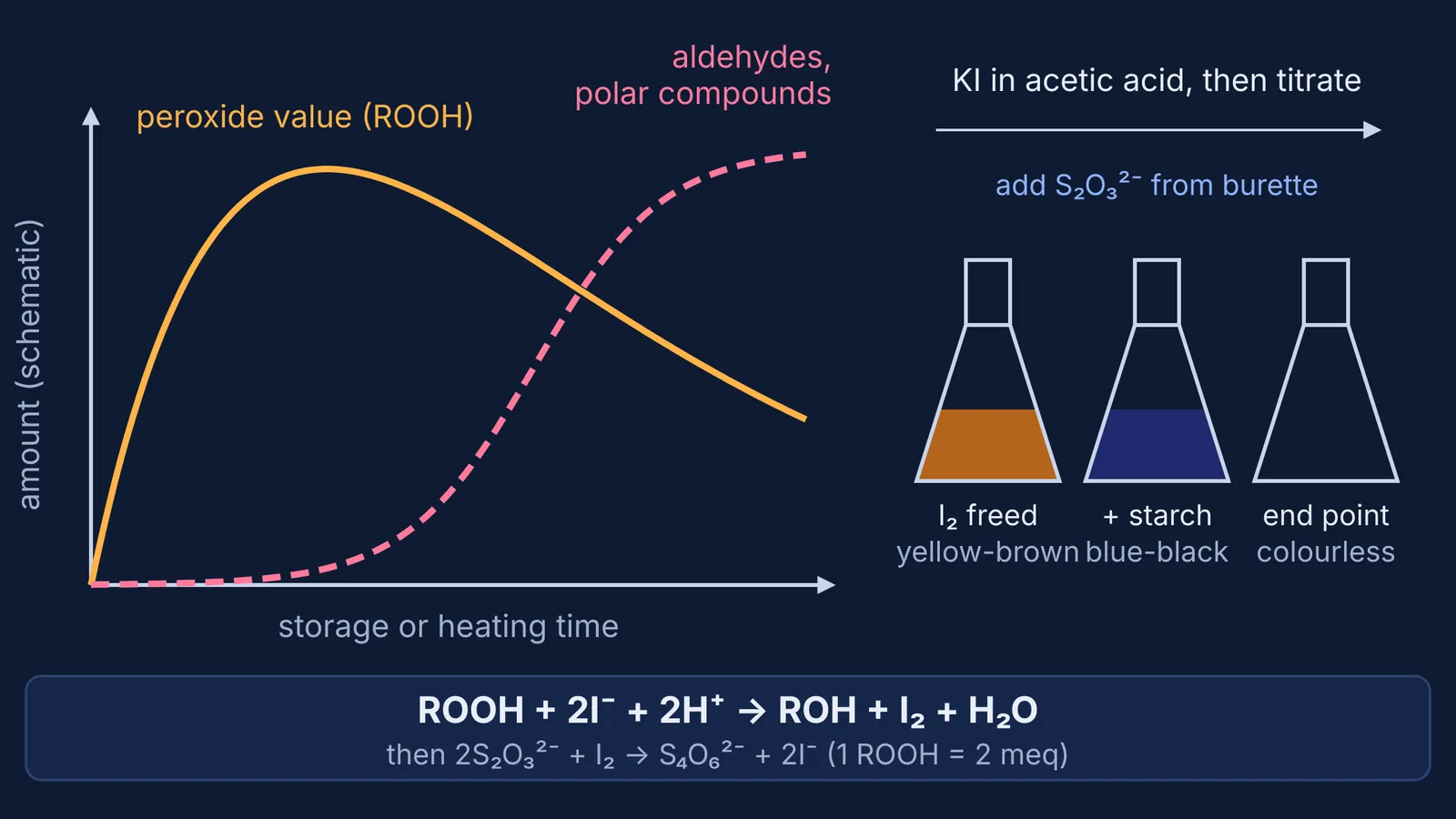
ROOH + 2I⁻ + 2H⁺ → ROH + I₂ + H₂O
The iodine is then titrated: 2S₂O₃²⁻ + I₂ → S₄O₆²⁻ + 2I⁻. So one ROOH gives one I₂, which takes two thiosulphate ions. A hydroperoxide therefore counts as 2 equivalents, exactly like H₂O₂, and thiosulphate counts as 1. If you need the thiosulphate step in more detail, see iodometric vs iodimetric titrations.
Why the dark, the one minute and the blank?
Iodide is also oxidised slowly by oxygen from the air, faster in light and acid: 4I⁻ + O₂ + 4H⁺ → 2I₂ + 2H₂O. That iodine has nothing to do with the oil. The short, timed contact in the dark keeps it small, and the blank measures what is left so you can subtract it. The FSSAI method says the blank must be under 0.1 mL of 0.1 N thiosulphate. A larger blank means the KI or the solvent is already contaminated.
How do you calculate peroxide value? A worked example
The formula follows from the units. Titre (mL) × normality (meq/mL) gives milliequivalents of iodine, and therefore of peroxide oxygen. Dividing by the sample mass in grams and multiplying by 1000 turns it into meq per kg:
PV = (S − B) × N × 1000 / W
Here S is the sample titre, B the blank titre, N the normality of thiosulphate and W the mass of oil in grams.
Question. 5.00 g of stored groundnut oil is tested as above with 0.0100 N sodium thiosulphate. The sample needs 6.0 mL and the blank 0.1 mL. Find the PV, the hydroperoxide content in mmol/kg and the active oxygen in mg/kg.
Blank-corrected titre. 6.0 − 0.1 = 5.9 mL.
Equivalents. 5.9 mL × 0.0100 meq/mL = 0.059 meq of iodine, so 0.059 meq of peroxide oxygen.
Per kg. 0.059 × 1000 / 5.00 = 11.8 meq/kg. That is the peroxide value.
Convert to moles. Each ROOH is 2 equivalents, so 11.8 / 2 = 5.9 mmol of ROOH per kg.
Convert to mass of active oxygen. 1 meq of oxygen is half a millimole of O atoms, or 8 mg. So 11.8 × 8 ≈ 94 mg of active oxygen per kg.
A note on the titrant. The FSSAI method starts with 0.1 N thiosulphate and repeats with 0.01 N if the titre is below 0.5 mL. Here 0.1 N would need only about 0.6 mL, which is hard to read precisely, so the example uses 0.01 N to keep the numbers clear. The answer is the same.
The Fermi Problem Library has more titration problems like this, with a step-by-step solver that explains the reasoning behind each conversion.
What is the FSSAI limit for peroxide value?
Regulation 2.2.8 of the FSSAI food product standards sets these limits, among others (FSSAI, chapter 2.2, version 2, 2023):
Refined oils: up to 10 meq of active oxygen per kg (olive oil has its own limits).
Cold pressed and virgin oils: up to 15 meq/kg.
Other expelled edible oils and fats: up to 10 meq/kg.
So the oil in the example, at 11.8 meq/kg, would be over the limit if it were a refined or ordinary expelled oil, but under the 15 meq/kg limit if it were sold as cold pressed. The same reading can pass or fail depending on the category, which is why the label matters. The FSSAI manual adds a rough guide: fresh oils usually test well below 10 meq/kg, and a rancid taste often starts to show above about 20 meq/kg (FSSAI, 2016). These are quality limits, not health thresholds.
Why can a low peroxide value still mean old or abused oil?
Hydroperoxides do not last. They break down, quickly when heated, into aldehydes, ketones and other secondary products. Those are what you actually smell in rancid oil, and they do not oxidise iodide in this test.
So PV rises during storage, peaks and then falls as breakdown overtakes formation. Oil that has been used for deep frying several times can show a modest PV while its total polar compounds keep climbing. That is why FSSAI regulates used frying oil by polar compounds (the 25% limit), not by peroxide value; see why reusing frying oil is harmful. Labs that need the full picture pair PV with a test for secondary products.
One more contrast. Rancidity also has a hydrolytic form, where water splits off free fatty acids from the ester links. That is measured by the acid value, not the peroxide value. PV sees oxidation only.
Quick checklist
PV measures hydroperoxides, the first products of oil oxidation.
ROOH + 2I⁻ + 2H⁺ → ROH + I₂ + H₂O; the iodine is titrated with thiosulphate.
PV = (S − B) × N × 1000 / W, in meq per kg.
1 mmol ROOH = 2 meq; 1 meq of active oxygen = 8 mg O.
The blank and the minute in the dark correct for iodide oxidised by air.
FSSAI: refined oils up to 10 meq/kg, cold pressed and virgin oils up to 15.
PV rises then falls, so a low PV alone does not prove oil is fresh.