On this page
You fried pakoras on Sunday and there is half a kadhai of oil left. The catch is that oil is not the same once it has been used for frying, and every reheat takes it further from what you bought.
What happens to oil when you heat it again and again?
Most cooking oil is made of triglycerides: three fatty acid chains joined to a glycerol backbone by ester bonds. A review in the British Journal of Nutrition by Carmen Dobarganes and Gloria Márquez-Ruiz describes three sets of reactions in the frying pan (Dobarganes and Márquez-Ruiz, 2015):
Hydrolysis: water from the food breaks ester bonds, releasing free fatty acids, monoglycerides and diglycerides. It is the same reaction as in acid and base hydrolysis of esters.
Oxidation: oxygen from the air attacks unsaturated fatty acid chains through free-radical chain reactions, giving oxidised triglycerides plus volatile aldehydes and ketones.
Thermal alteration: heat joins triglyceride molecules into dimers and larger polymers.
Nearly all of these new compounds are more polar than the original triglycerides, so they are measured together as total polar compounds (TPC) by adsorption chromatography (Dobarganes and Márquez-Ruiz, 2015). TPC is a rough measure of how much of the oil frying has changed.
Every time you fry, the polar fraction grows. Stored oil also oxidises slowly, the process behind rancidity in Class 10 chemistry.
What is FSSAI's limit on total polar compounds?
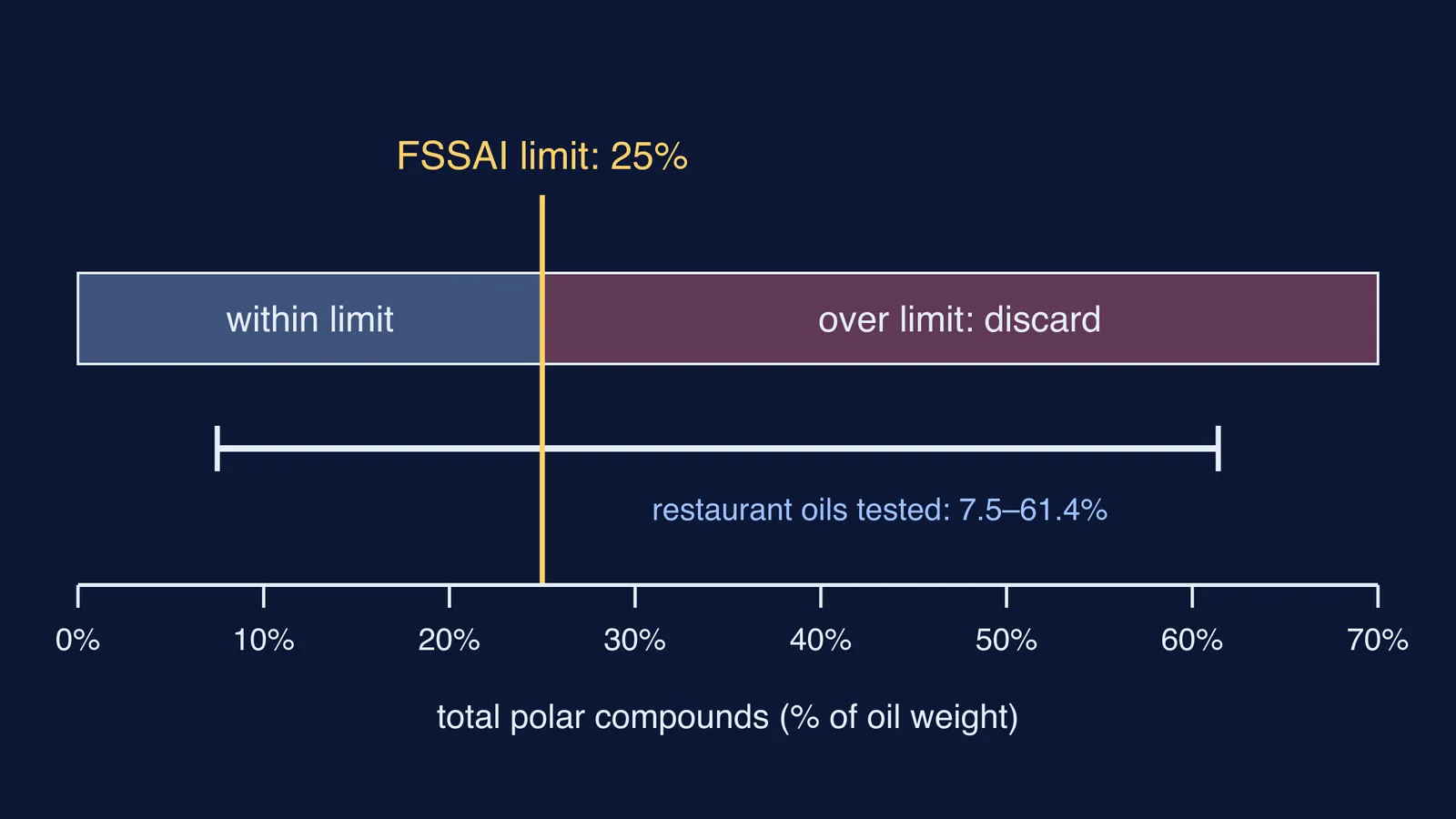
The Food Safety and Standards Authority of India (FSSAI) says vegetable oil with more than 25% total polar compounds shall not be used (FSSAI, RUCO).
FSSAI's guidance note on used cooking oil calls oil past this limit unsafe for human consumption and tells large food businesses to treat it as waste (FSSAI guidance note 06/2018). The same note tells food businesses not to use the same oil more than three times, and says using it once is ideal.
Dobarganes and Márquez-Ruiz write that the most common limit in many countries' regulations and guidelines is also 25% polar compounds by oil weight, and that at that level polymers alone make up 12-15% of the oil (Dobarganes and Márquez-Ruiz, 2015). They add that fast-food outlet oils often far exceed it, some reaching about 60%; one study they cite found 7.5% to 61.4% in restaurant and outlet oils.
Why is reused cooking oil bad for you?
FSSAI's guidance note says reports have linked these compounds to hypertension, atherosclerosis, Alzheimer's disease and liver disease (FSSAI guidance note 06/2018).
The British Journal of Nutrition review is more cautious. Heavily used oil is harder to digest because the gut's fat-digesting enzyme breaks down the polymers poorly, it says, but studies in people have so far not found a direct link between used frying oil and health problems (Dobarganes and Márquez-Ruiz, 2015). It does describe one Spanish study linking heavily degraded home cooking oil with a higher risk of high blood pressure.
Either way, you cannot see TPC by eye, and FSSAI's advice for households is to avoid frying in the same oil again. If someone in your family has a heart, liver or digestive condition, ask a doctor or registered dietitian about fried food.
How do you know when frying oil should be thrown away?
The 25% figure needs a testing instrument to measure, so FSSAI also gives signs you can see in your own kitchen (FSSAI guidance note 06/2018). Throw the oil away if:
blue-grey smoke rises from it
tough foam forms on the surface
it has turned dark and murky
its consistency has changed
For why oils smoke at all, see what the smoke point of an oil means.
What should you do with leftover frying oil at home?
This plan follows FSSAI's advice for households (FSSAI guidance note 06/2018):
Cool and strain: once the oil is fully cool, filter it through a fine sieve or muslin cloth to remove bits of food.
Store it separately: never in the fresh-oil bottle.
Cook with it, do not fry with it: FSSAI says once-fried oil may be used for curry, not for frying again.
Finish it in a day or two: used oil deteriorates faster than fresh oil, so do not store it for long.
Check before each use: any one of the four signs above means it goes.
Dispose of it safely: never pour it down the sink or drain. Mix small amounts with sand, sawdust, an old cloth, paper towels or food scraps, then put it in the dustbin.
For example, oil from Sunday's puris goes into Monday's dal tadka and Tuesday's sabzi; anything left by Wednesday goes in the bin, not back in the kadhai.
If you are studying ester hydrolysis or free-radical reactions, the Fermi Concept Library gives each chemistry concept its own lesson and its place in the map.