On this page
You put the kadhai on high flame, get distracted for a minute, and come back to a thin blue haze, a sharp smell and watering eyes. That haze means the oil has passed its smoke point. Here is the chemistry behind it, and what to do when you see it.
What is the smoke point of cooking oil?
The smoke point is "the minimum temperature at which oil releases a thin continuous stream of smoke", according to a 2025 study of virgin olive oils in Foods. The same paper calls it the mark of "the onset of thermal degradation in edible oils".
Labs heat oil in an open cup. The standard AOCS method Cc 9a-48 records three temperatures: when the sample smokes, flashes and burns. Smoke comes first, so it is your early warning.
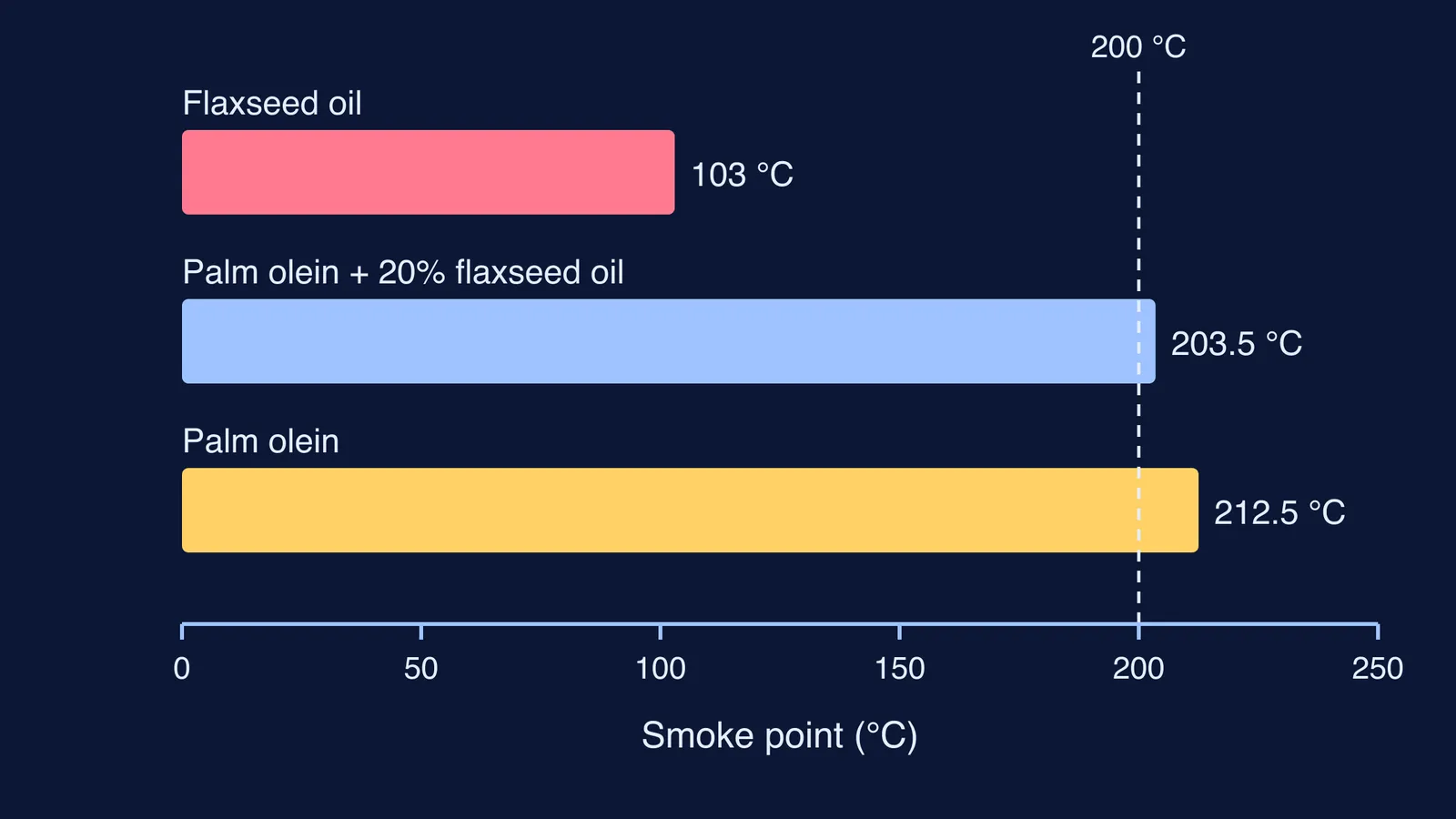
Smoke points vary a lot from oil to oil. In a 2021 study in the Journal of Food Science and Technology, flaxseed oil smoked at 103 °C while palm olein reached about 212 °C, and the authors judged flaxseed oil "not suitable for cooking involving heat".
What sets the number? The Foods study of 48 virgin olive oils found that free fatty acid content was the main factor, with a strong inverse relationship: more free fatty acids, lower smoke point. Refining removes most free fatty acids, so refined oils have "higher and more consistent smoke points than virgin oils", the same paper notes.
What happens to oil past its smoke point?
Past the smoke point, oil is undergoing thermal decomposition: heat breaks big molecules into smaller, volatile ones. It is the same idea as the thermal decomposition of salts in your Class 10 textbook, only with a fat molecule instead of calcium carbonate.
A 2022 review, Origin and Fate of Acrolein in Foods, describes two routes. During heating, water attacks the ester bonds of triglycerides and releases glycerol and fatty acids; the glycerol can then lose water to form acrolein, a small aldehyde with an acrid smell. The second route, the peroxidation of polyunsaturated fatty acids, is documented as the main source of acrolein, the review says.
Acrolein matters because you breathe it. The US agency ATSDR says in its ToxFAQs on acrolein that air containing acrolein "may cause eye irritation and watering" and irritation of the nose and throat. Its advice is to avoid cooking at high temperatures, such as those for deep frying, when possible.
Oxidation of fats is also behind rancidity, the slower spoilage of oil stored in air at room temperature.
Why does reused oil smoke sooner?
Every frying session adds breakdown products. The Foods paper notes that during deep frying the smoke point generally falls as free fatty acids from hydrolysis build up. So the oil left over from Diwali puris is likely to smoke at a lower temperature the next time, even on the same flame.
India's food regulator sets a limit for businesses. FSSAI has fixed total polar compounds at 25%, "beyond which the vegetable oil shall not be used", and says the toxicity of these compounds is associated with diseases including hypertension and liver disease, according to its RUCO page. You cannot measure polar compounds at home, but oil that smokes sooner than it used to is showing that breakdown.
What should you do when oil starts smoking?
Use this four-step check every time you heat oil:
Watch, do not walk away. UK fire service guidance from Buckinghamshire Fire and Rescue says: "Do not leave cooking unattended".
Smoke means too hot. The same guidance says: "If oil starts to smoke, it is too hot. Turn off the heat and leave it to cool". Opening a window or switching on the chimney also helps clear the smoke.
Never add water. Water on hot oil makes it "bubble up, overflow and ignite", the fire service warns.
If it catches fire, turn off the heat only if it is safe to do so, leave the building closing the doors behind you, and call the fire service. Our explainer on how fire extinguishers work shows why oil fires need a different extinguisher from paper or wood fires.
How do you explain smoke point in an exam answer?
If a question asks why oil should not be overheated, a strong answer has three parts:
Define: the smoke point is the lowest temperature at which oil gives off a continuous stream of smoke.
Explain: beyond it, triglycerides break down; glycerol is dehydrated and polyunsaturated fatty acids oxidise, giving acrolein, an irritant.
Apply: reused oil has more free fatty acids, so it smokes at a lower temperature.
Some science is easier to see than to read. The Fermi Simulation Lab has interactive simulations for those ideas. If esters and hydrolysis are still shaky, the Fermi Concept Library gives each chemistry concept its own lesson.
Next time the kadhai hazes, you will know: decomposition has begun, so turn off the flame.