

On this page
Ester hydrolysis questions in Class 12, JEE Main and NEET-UG come down to three things: which catalyst, which way the equilibrium goes, and which bond breaks.
What is the difference between acid and base hydrolysis of esters?
The Wikipedia entry on ester hydrolysis sets out the contrast. Acid hydrolysis is the reverse of Fischer esterification, and acid is needed only in catalytic amounts. Alkaline hydrolysis, or saponification, needs a base such as sodium hydroxide in stoichiometric amounts, and it is not an equilibrium reaction: it proceeds to completion.
Acid (H+, water): catalytic acid, reversible, products are carboxylic acid plus alcohol, pushed forward by excess water.
Base (OH-, water): one full equivalent of hydroxide is used up, effectively irreversible, products are a carboxylate salt plus alcohol; you add acid afterwards to get the free carboxylic acid.
Same in both: the nucleophile attacks the carbonyl carbon, a tetrahedral intermediate forms, and the bond between the acyl carbon and the alkoxy oxygen breaks.
How does acid hydrolysis of an ester work?
The LibreTexts chapter on the chemistry of esters/21%3A_Carboxylic_Acid_Derivatives-_Nucleophilic_Acyl_Substitution_Reactions/21.06%3A_Chemistry_of_Esters) says the steps are exactly those of Fischer esterification, run in reverse. For ethyl acetate:
H+ protonates the carbonyl oxygen, making the carbonyl carbon more electrophilic.
Water attacks the carbonyl carbon; a tetrahedral intermediate forms.
A proton moves from the oxygen that came from water to the -OC2H5 oxygen.
Ethanol leaves, and the C=O re-forms.
Losing H+ from the carbonyl oxygen gives acetic acid and returns the catalyst.
Every step can run backwards, so you get an equilibrium; a large excess of water pushes it forward. Our walk-through of the Fischer esterification mechanism and how to push its equilibrium is the same story read the other way. Because water is in such excess, the rate law of acid hydrolysis looks first order, which is why it appears in pseudo first-order reactions with ester hydrolysis and sugar inversion.
Why does base hydrolysis go to completion?
In saponification, hydroxide attacks the carbonyl carbon to give a tetrahedral intermediate, which then expels an alkoxide ion, as described in the ester hydrolysis entry. At that moment you have a carboxylic acid next to an alkoxide, a strong base, and the proton jumps across.
The numbers show how lopsided that jump is. Acetic acid has a pKa of about 4.76 in water, according to the acetic acid entry. Ethanol has a pKa of about 15.9, according to the ethanol entry.
Worked estimate: for CH3COOH + C2H5O- giving CH3COO- + C2H5OH, K is about 10^(15.9 - 4.76), roughly 10^11. The carboxylate is resonance-stabilised and negatively charged, so neither ethanol nor ethoxide can attack it to rebuild the ester. The reverse path is closed, so the reaction runs to completion and uses up one hydroxide per ester.
This is the same chemistry that turns fats into soap, which you can follow into Class 10 in how soaps clean through micelles.
Where does the labelled oxygen end up?
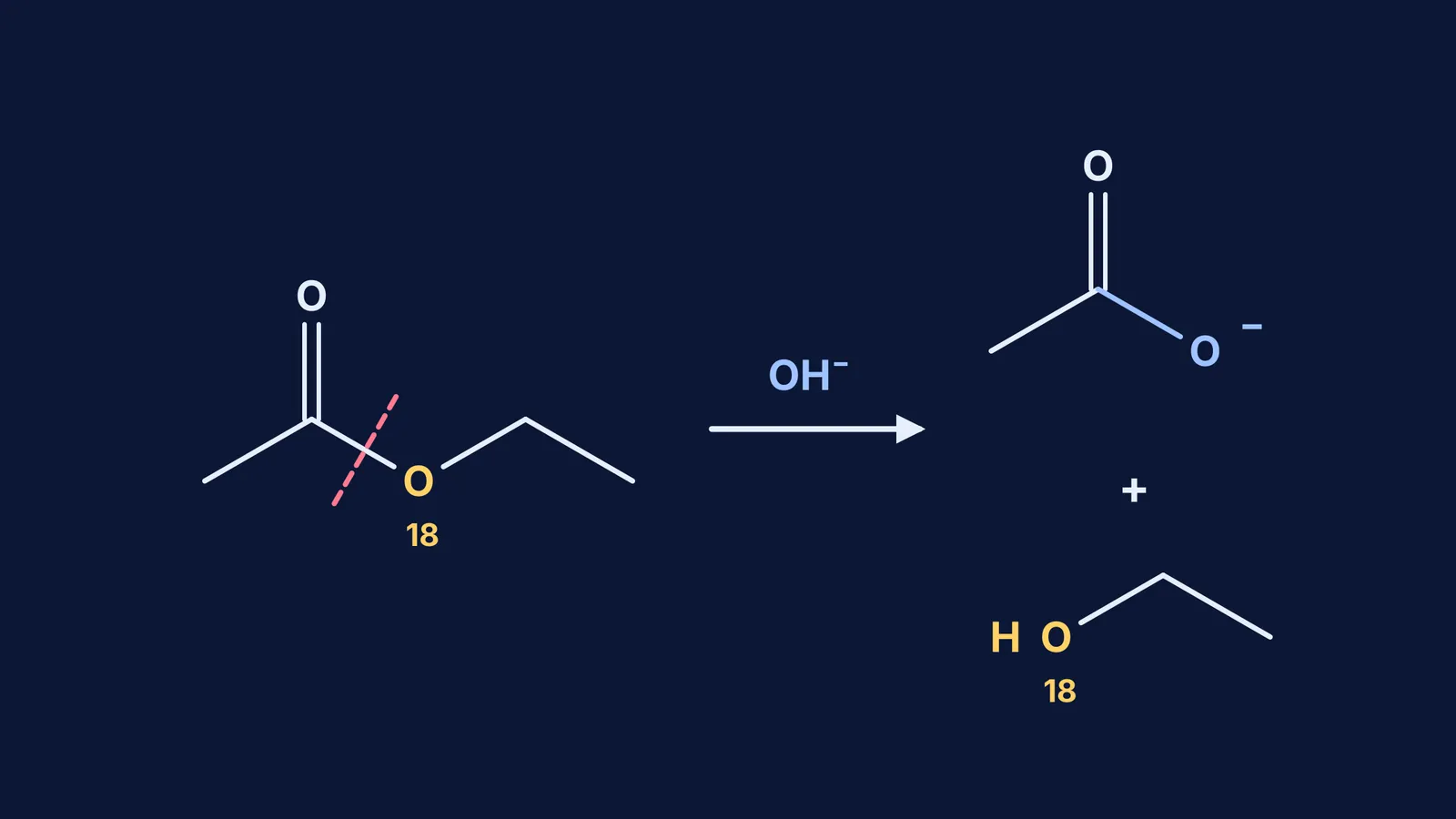
Chemists were already studying which bond breaks by 1934, when M. Polanyi and A. L. Szabo published On the mechanism of hydrolysis: the alkaline saponifications of amyl acetate in Transactions of the Faraday Society. Oxygen-18 labelling shows the answer. A textbook version of this kind of experiment, discussed in a Pearson problem on D. N. Kursanov's work, puts 18O on the alkoxy oxygen of an ethyl ester. After hydrolysis with hydroxide, the label is found in the ethanol, not the carboxylate. That shows the acyl C-O bond breaks, not the alkyl C-O bond.
Use this three-question method on any labelled-oxygen problem:
Where is the label now? On the C=O oxygen, the alkoxy oxygen, or the water.
Which bond breaks? For ordinary esters in both acid and base, it is the bond between the carbonyl carbon and the alkoxy oxygen.
Who keeps which oxygen? The alcohol leaves with the alkoxy oxygen. The acid or carboxylate keeps the carbonyl oxygen and gains the oxygen from the water or hydroxide.
Worked example 1: CH3CO-18O-C2H5 with NaOH. The label is on the alkoxy oxygen, so you get C2H5-18OH and unlabelled CH3COO- Na+.
Worked example 2: CH3COOC2H5 in H2(18O) with dilute H2SO4. The oxygen from water ends up bonded to the acyl carbon, so the label appears in acetic acid and the ethanol is unlabelled.
Picking the alkyl-oxygen bond by mistake puts the label in the wrong product. To check your bond-breaking logic step by step, the Fermi Problem Library has worked problems with a step-by-step solver that explains the reasoning rather than printing an answer.
What should you revise before the exam?
Write both mechanisms from memory and mark the step that makes base hydrolysis one-way.
Explain, using the pKa gap, why acid is a catalyst but base is a reagent.
Solve one labelled-ester and one labelled-water problem without notes.
If carbonyl reactivity or acid-base strength still feels shaky, the Fermi Concept Library gives every concept in chemistry its own lesson and its place in the map, so you can patch the gap before attempting more problems.


