On this page
Many metro viaducts and bridge piers stand on piles: long columns of concrete or steel pushed deep into the ground. One old way to push them in is a drop hammer. A crane lifts a heavy block and lets it fall onto the top of the pile, again and again, and each blow drives the pile a few millimetres further. It is a collision problem followed by a work–energy problem, and it explains a design choice that surprises most students: to drive a pile further, you should make the hammer heavier, not drop it from higher.
What happens when a drop hammer hits a pile?
Split each blow into three stages.
The fall. The hammer, mass M, falls a height h. Energy is conserved, so it hits at v = √(2gh).
The impact. For a few milliseconds the hammer and pile (mass m) push hard on each other. These internal forces are huge compared with gravity and the soil's grip over such a short time, so momentum is conserved during the impact. Kinetic energy is not. Some of it goes into heat, sound, and crushing the cushion and the pile head.
The set. Hammer and pile then move down together and slow to a stop against the soil. The distance they move is called the set per blow. Here the work–energy theorem applies, with gravity helping and the soil resisting.
The mistake to avoid is using energy conservation straight from the release point to the end of the set. The impact in the middle loses energy, so you must switch to momentum for that stage.
How much of the hammer's energy reaches the pile?
Treat the impact as perfectly inelastic: hammer and pile move off together at speed V.
Momentum: Mv = (M + m)V, so V = Mv/(M + m).
Kinetic energy just after: ½(M + m)V² = ½Mv² × M/(M + m).
So the fraction of the hammer's energy that is kept is M/(M + m). The rest, m/(M + m), is lost at impact. This is the same result as in the fraction of kinetic energy lost in a perfectly inelastic collision, which derives it in general. The pile driver simply puts it to work.
The fraction depends only on the masses, not on how fast the hammer hits. A hammer much heavier than the pile keeps nearly all of its energy. A hammer much lighter than the pile wastes most of it.
How do you find the soil resistance from the set?
After impact the combined mass (M + m) has kinetic energy K and moves down a distance s before stopping. Gravity does positive work (M + m)gs, and the average soil resistance R does negative work Rs. The final kinetic energy is zero, so:
0 − K = (M + m)gs − Rs, which gives R = K/s + (M + m)g.
The (M + m)g term is easy to forget. It is small for a set of a few millimetres, but it is not zero.
Worked example: heavy hammer against light hammer
All values here are illustrative round numbers, chosen to be realistic in size, not taken from any named project. Take g = 9.81 m/s².
The pile is a square concrete pile 0.4 m × 0.4 m and 12 m long. With concrete at 2,400 kg/m³ its mass is m = 0.4 × 0.4 × 12 × 2,400 = 4,608 kg.
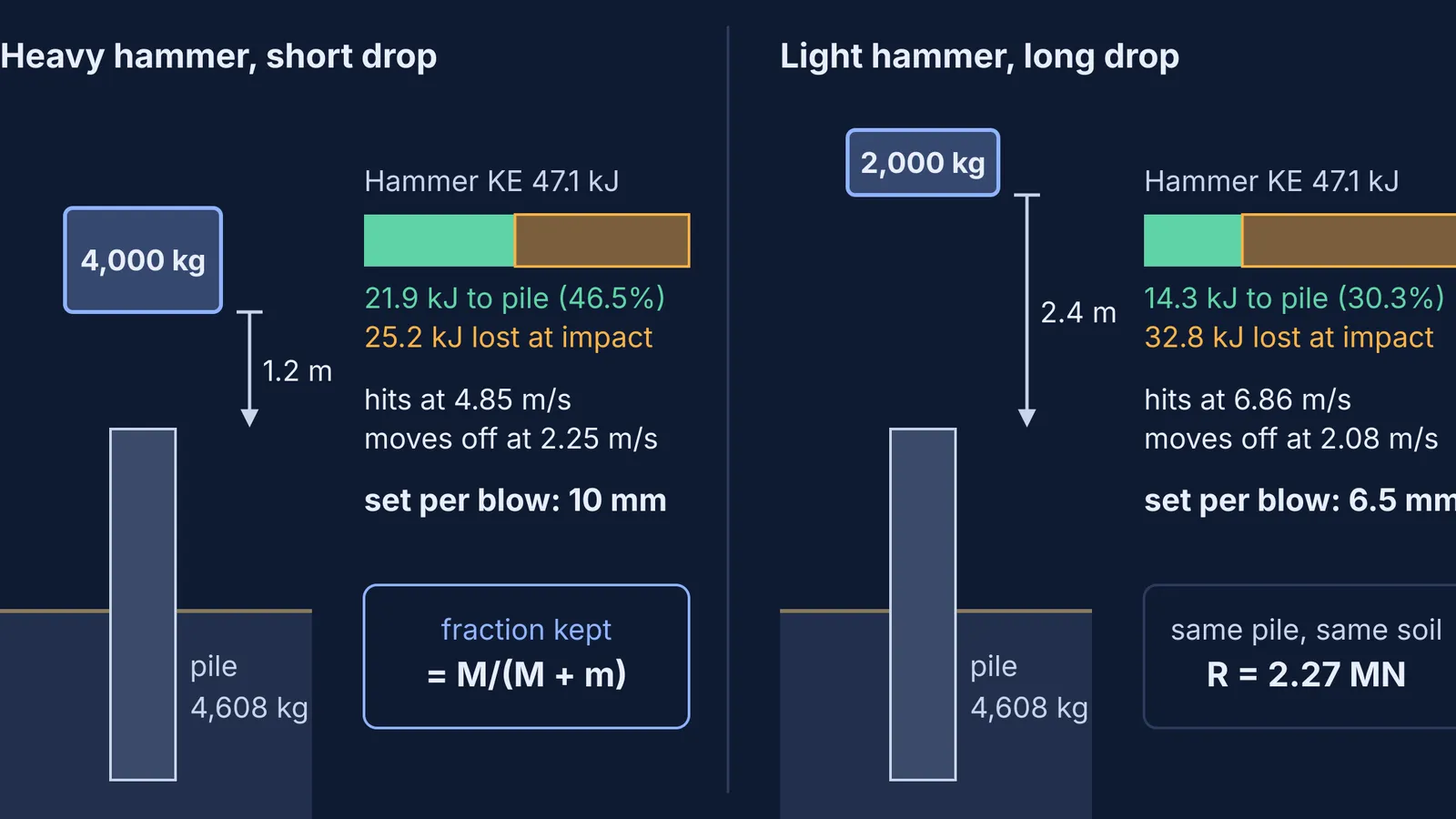
Rig A: a 4,000 kg hammer falling 1.2 m.
Impact speed: v = √(2 × 9.81 × 1.2) = 4.85 m/s.
Hammer energy: ½ × 4,000 × 4.85² = Mgh = 4,000 × 9.81 × 1.2 = 47.1 kJ.
Speed just after impact: V = 4,000 × 4.85 ÷ 8,608 = 2.25 m/s.
Energy kept: ½ × 8,608 × 2.25² = 21.9 kJ. That is 4,000/8,608 = 46.5%. The other 25.2 kJ is lost at impact.
Suppose the pile sinks s = 10 mm per blow. Then R = 21,900 ÷ 0.010 + 8,608 × 9.81 = 2.19 MN + 0.084 MN = 2.27 MN. That is about the weight of 232 tonnes.
Check the units: J ÷ m = N, and kg × m/s² = N, so R is a force, as it should be.
Rig B: a 2,000 kg hammer falling 2.4 m. Same 47.1 kJ, because Mgh = 2,000 × 9.81 × 2.4 is the same product.
Impact speed: v = √(2 × 9.81 × 2.4) = 6.86 m/s. It hits faster.
Speed after impact: V = 2,000 × 6.86 ÷ 6,608 = 2.08 m/s.
Energy kept: 2,000/6,608 = 30.3%, which is 14.3 kJ. The other 32.8 kJ is lost.
Against the same soil, the set is s = 14,300 ÷ (2.27 MN − 6,608 × 9.81 N) = 6.5 mm.
Same energy per blow, but the light hammer drives the pile only about two-thirds as far. Over hundreds of blows that is a large difference in time and fuel. The energy it wastes goes into the pile head and cushion instead, which is why a fast, light blow is also harder on the pile. Hence the lesson: heavy hammer, short drop.
What if the blow is not perfectly inelastic?
Real blows bounce a little. If the coefficient of restitution between hammer and pile is e, the kinetic energy left after impact (hammer and pile together) is a fraction (M + e²m)/(M + m) of the hammer's energy. With e = 0.4, an illustrative value, rig A keeps (4,000 + 0.16 × 4,608)/8,608 = 55.0% instead of 46.5%. Setting e = 0 gives back M/(M + m), and e = 1 gives 100%, as an elastic collision should. Restitution itself is covered in collisions and momentum: elastic, inelastic and restitution.
You can watch kinetic energy disappear in a sticking collision, and survive in a bouncing one, in the Simulation Lab. The post on testing elastic and inelastic collisions in a simulation suggests what to try.
Is the soil resistance the load the pile can carry?
No. The 2.27 MN is the resistance while the pile is being driven fast. It is not the safe working load. Engineers divide the ultimate capacity by a factor of safety, and they do not trust a driving formula alone, because real soil, cushions and wave effects in a long pile are far more complicated than this model. In India, load tests on piles follow IS 2911 Part 4, Load test on piles: a trial pile is loaded and its settlement measured. Treat the perfectly inelastic calculation as a model that shows the trend, not as a design method.
For more two-stage problems like this one, the Fermi Problem Library has a step-by-step solver that explains the reasoning at each stage.
Quick checklist
Fall: v = √(2gh). Impact: momentum conserved. Set: work–energy theorem.
Fraction of energy kept in a sticking blow: M/(M + m).
Soil resistance: R = K/s + (M + m)g.
For the same energy per blow, the heavier hammer drives the pile further.
With restitution e, the kept fraction rises to (M + e²m)/(M + m).
Driving resistance is not the safe load; load tests confirm capacity.