

On this page
A common collision mistake in Class 11 and JEE practice is conserving kinetic energy when only momentum is conserved. A good way to make the rule stick is to collide two carts in a simulation, write a prediction first, and check it against the screen. Here are three predictions, with the numbers worked out.
What is the difference between elastic and inelastic collisions?
The definitions below come from OpenStax University Physics, section 9.4, a free university textbook.
Momentum: "A closed system always conserves momentum; it might also conserve kinetic energy, but very often it doesn't."
Elastic collision: the objects bounce apart at the same relative speed at which they approached, and the total kinetic energy of the system is conserved.
Inelastic collision: momentum stays constant but kinetic energy decreases.
Perfectly inelastic collision: the objects stick together, which gives the maximum loss of kinetic energy.
How do you set up a collision simulation?
Any simulation where you set masses, velocities and bounciness will do. PhET's free Collision Lab from the University of Colorado is one option. Its 2012 teacher tips by Trish Loeblein, Mike Dubson and Mindy Gratny point out a few things worth knowing before you start:
Turn off the reflecting borders. Ball-ball collisions conserve momentum; ball-wall collisions do not, so walls will confuse your test.
Elasticity is a number between 0 and 1. At 1 the collision is perfectly elastic and kinetic energy is conserved.
The kinetic energy display shows how much mechanical energy each collision removes.
Pause and Step let you look at the moment just before and just after impact.
The guide also notes that students may be surprised to see kinetic energy fall when elasticity is below 100%. That surprise shows you exactly where your idea was wrong.
Prediction 1: is momentum conserved in every collision?
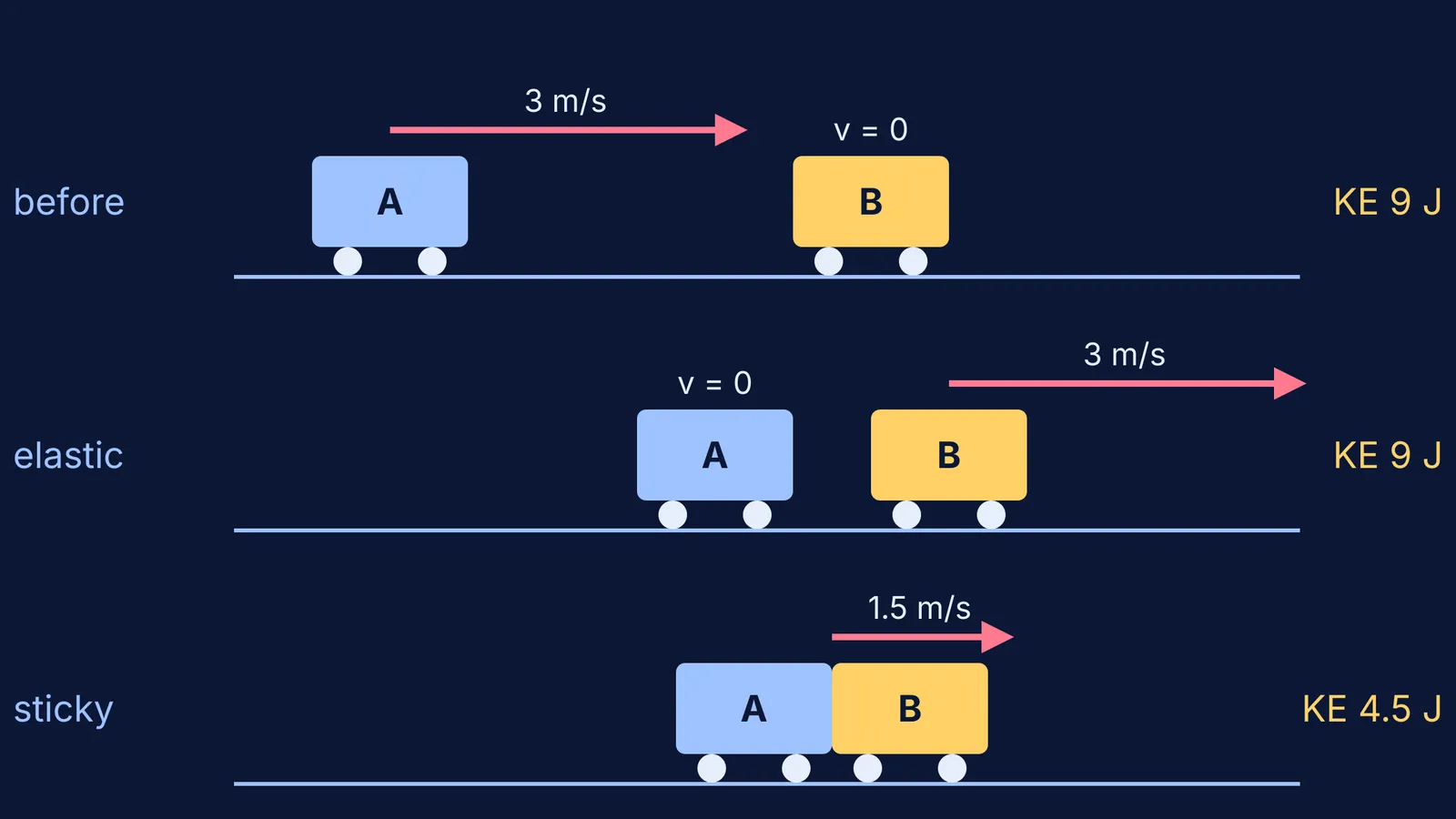
Set up cart A (2 kg) moving at 3 m/s towards cart B (2 kg) at rest. Total momentum before is 2 × 3 = 6 kg·m/s.
Run the same start with elasticity at 1, then 0.5, then 0, predicting total momentum after each collision. Because a closed system always conserves momentum, it should read 6 kg·m/s every time. If not, check whether a cart hit a wall.
Prediction 2: where does kinetic energy go in a sticky collision?
Set elasticity to 0 so the carts stick. Momentum conservation gives the shared final speed: v = (m₁u₁ + m₂u₂) / (m₁ + m₂) = 6 / 4 = 1.5 m/s.
Work out the energy before you look:
Kinetic energy before: ½ × 2 × 3² = 9 J.
Kinetic energy after: ½ × 4 × 1.5² = 4.5 J.
Energy lost: 4.5 J, exactly half.
In a real crash, the missing energy goes into deformation, heat and sound, which a simple cart simulation does not show. For two equal masses with one at rest, a sticky collision always removes half the kinetic energy. Now try 1 kg hitting 3 kg and predict the fraction first. (Answer: three quarters is lost.) Our post on using p²/2m for kinetic energy in collision problems gives a faster route to the same numbers.
Prediction 3: why do equal masses swap velocities?
Set elasticity back to 1. For a one-dimensional elastic collision, course notes from the University of Texas at Austin give the final velocities and show that, when the masses are equal, "the two particles simply exchange velocities when they collide."
So with the same two 2 kg carts, predict that A stops dead and B leaves at 3 m/s. Check both conservation laws: momentum is 0 + 2 × 3 = 6 kg·m/s, and kinetic energy is ½ × 2 × 3² = 9 J. Nothing is lost.
Now break the symmetry. Make A 1 kg at 3 m/s and B 2 kg at rest. The same formulas give A bouncing back at −1 m/s and B moving forward at 2 m/s. Check: momentum 1 × (−1) + 2 × 2 = 3 kg·m/s, as before; kinetic energy 0.5 + 4 = 4.5 J, as before. A light cart hitting a heavy one bounces back.
What should you do after the simulation?
Take the habit to paper problems: decide whether the collision is elastic, sticky or has a coefficient of restitution, then check momentum and kinetic energy as above. Next, move to two dimensions with why equal masses fly apart at 90° in an oblique elastic collision, or practise with collisions and momentum problems with restitution.
For more ideas that are easier to see than to read, the Fermi Simulation Lab has interactive simulations you can test predictions against in the same way. When a numerical goes wrong, the Fermi Problem Library has a step-by-step solver that explains the reasoning rather than printing an answer.


