

On this page
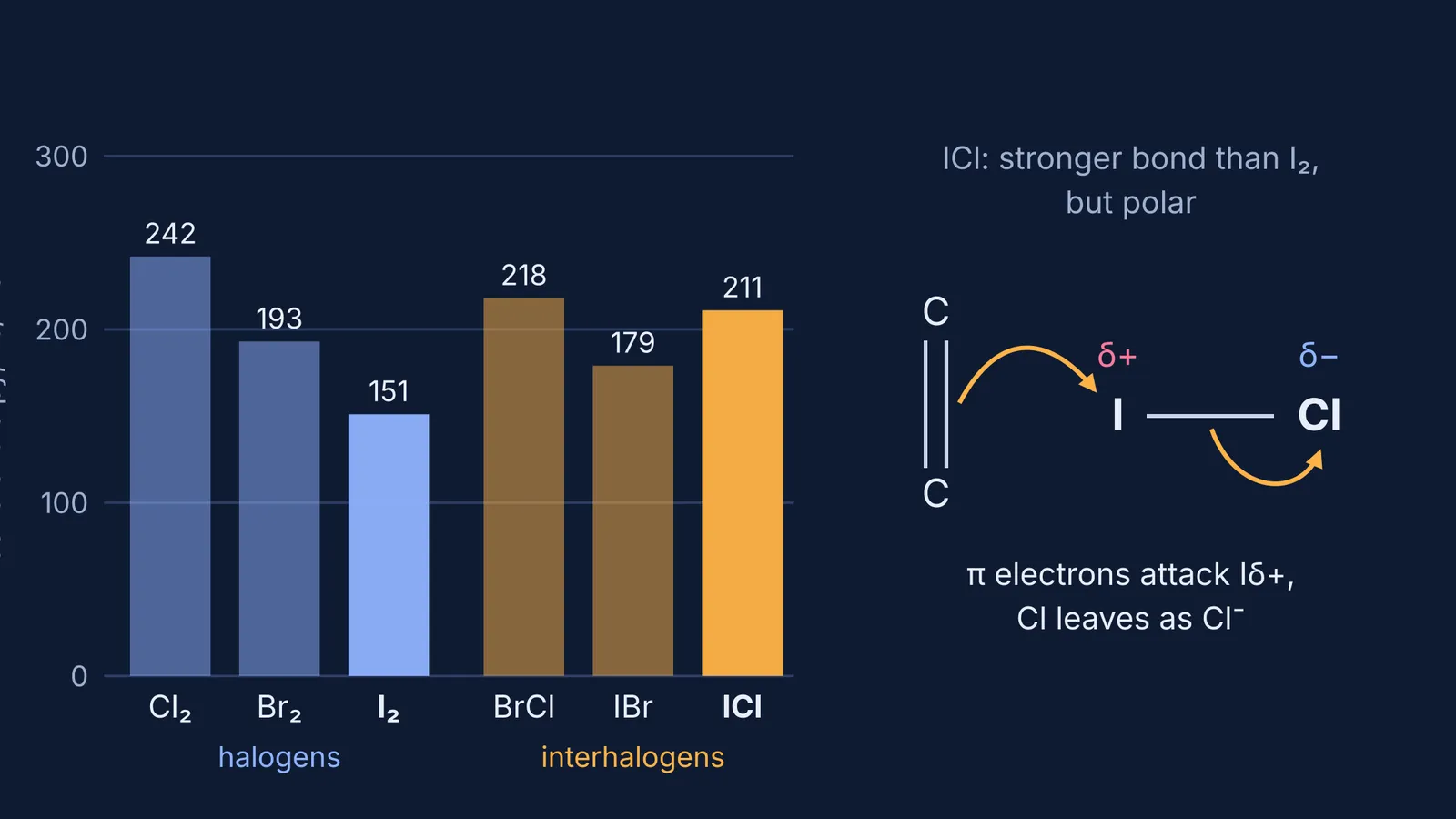
NCERT tells you that interhalogen compounds are more reactive than the halogens (except fluorine) because the X–X′ bond is weaker than the X–X bond. Check that against the data for the most famous example, iodine monochloride. The I–Cl bond enthalpy is about 211 kJ/mol. The I–I bond is only about 151 kJ/mol. So ICl has the stronger bond, yet it is clearly the more reactive iodinating agent. Here are the data, the real reason (bond polarity), two key reactions and what to write in a board answer.
Is the I–Cl bond really weaker than the I–I bond?
No. Here are approximate gas-phase bond dissociation enthalpies. Data tables differ by a few kJ/mol, but the order does not change.
Cl₂: about 242 kJ/mol
Br₂: about 193 kJ/mol
I₂: about 151 kJ/mol
BrCl: about 218 kJ/mol
IBr: about 179 kJ/mol
ICl: about 211 kJ/mol
Each interhalogen bond sits between its two parents, and it is always stronger than the bond in the heavier parent. ICl is weaker than Cl₂ (211 against 242), so the NCERT line works if you compare ICl with chlorine. Compared with I₂, the I–Cl bond is about 60 kJ/mol, or roughly 40%, stronger. If bond weakness were the reason, I₂ should be the more reactive of the two. It is not.
Fluorine is a separate story. F₂ has an unusually weak bond for its own reasons, which is why NCERT carves it out of the rule. That anomaly is explained in why the F–F bond is weaker than Cl–Cl.
Why is the I–Cl bond so strong?
Because it is polar. Pauling noticed that a bond between two different atoms is stronger than the average of the two parent bonds, and the extra strength grows with the electronegativity difference. A quick check:
Average of the parents: (242 + 151) ÷ 2 = 196.5 kJ/mol.
Electronegativity difference: Cl 3.16 minus I 2.66 = 0.50.
Pauling's extra ionic term: 96.5 × (0.50)² ≈ 24 kJ/mol.
Estimate: 196.5 + 24 ≈ 221 kJ/mol, close to the measured 211 kJ/mol.
The same polarity that makes the bond stronger is what makes ICl react.
What really makes ICl more reactive than I₂?
Chlorine is more electronegative than iodine, so the shared electron pair sits closer to chlorine. The molecule is polarised as Iᵟ⁺–Clᵟ⁻. The iodine end already carries a partial positive charge, so it is a ready electrophile. When an electron-rich species (a C=C π bond, an activated benzene ring) attacks the iodine, the bond breaks with chlorine taking both electrons and leaving as a stable Cl⁻ ion.
I₂ has no such head start. Its bond is non-polar, so an attacking molecule has to polarise it first, and the leaving group would be I⁻ instead of Cl⁻.
There is also a reason bond enthalpy is the wrong yardstick here. A bond dissociation enthalpy measures splitting a molecule into two neutral atoms (homolysis). ICl does not react that way with alkenes or aromatic rings. It reacts by heterolysis, I⁺ to the nucleophile and Cl⁻ away. What matters is how easily that polar step happens, and polarity is exactly what makes it easy.
What should you write in an NCERT-style answer?
If a CBSE board question asks "Give reason: interhalogen compounds are more reactive than halogens", the marking scheme expects the NCERT sentence. Write it, and add the polarity line, which is correct and costs nothing.
How does ICl iodinate an aromatic ring?
ICl delivers Iᵟ⁺ to the ring by the usual electrophilic substitution steps.
The π electrons of the ring attack the iodine end of ICl. Cl leaves as Cl⁻.
A σ-complex (arenium ion) forms, with iodine on an sp³ carbon.
Cl⁻ or the solvent removes H⁺ from that carbon, and the ring becomes aromatic again.
Activated rings such as phenol, aniline and anisole react readily. For example, anisole gives mainly 4-iodoanisole:
C₆H₅OCH₃ + ICl → 4-IC₆H₄OCH₃ + HCl
The product is an aryl iodide, not an aryl chloride, because iodine is the electrophilic end. Notice the by-product too. With I₂ the by-product is HI, a reducing agent that can turn the aryl iodide back into the arene, which is why plain iodination needs an oxidant. See why iodination of benzene needs nitric acid. With ICl the by-product is HCl, which does not reduce the product. So ICl wins twice: a better electrophile and a harmless by-product.
How does ICl add across an alkene?
The mechanism is the same as bromine addition, with polarity deciding which atom goes where.
The C=C π electrons attack Iᵟ⁺, and Cl⁻ leaves.
A bridged iodonium ion forms.
Cl⁻ attacks from the opposite face, at the carbon that carries more of the positive charge.
So the addition is anti, and it follows Markovnikov's rule: I, the electrophile, goes to the carbon with more hydrogens, and Cl goes to the more substituted carbon.
This reaction has a practical use. Wijs reagent is ICl dissolved in glacial acetic acid. It adds quickly to the C=C bonds in fats and oils, and the result is reported as the iodine value: grams of I₂ equivalent absorbed by 100 g of fat. For oleic acid (C₁₈H₃₄O₂, M ≈ 282.5 g/mol, one C=C), one mole absorbs one mole of I₂ (253.8 g), so the iodine value is 253.8 ÷ 282.5 × 100 ≈ 89.9. More C=C bonds mean a higher iodine value.
What ICl gives with water is a different question, covered in hydrolysis of interhalogen compounds.
Worked example: what does ICl give with propene?
Question. Predict the major product of CH₃–CH=CH₂ + ICl, and name it.
Find the electrophile. In Iᵟ⁺–Clᵟ⁻, iodine is the electrophile and Cl⁻ is the nucleophile that adds second.
Decide where I goes. In the iodonium ion, the more substituted carbon (C2) carries more of the positive charge, because a secondary centre is more stable than a primary one. So the C2–I bond is the weaker, longer one, and I stays on the CH₂ end (C1).
Add the nucleophile. Cl⁻ attacks C2, the more substituted carbon.
Write the product. CH₃–CHCl–CH₂I.
Name it. Numbering from the CH₂I end gives locants {1, 2}; from the CH₃ end they are {2, 3}. The lower set wins: 2-chloro-1-iodopropane (substituents in alphabetical order).
Check atoms. C₃H₆ + ICl → C₃H₆ClI. Three C, six H, one Cl and one I on each side.
The common wrong answer is 1-chloro-2-iodopropane. It comes from treating Cl as the electrophile. Also, do not apply the peroxide effect here: that reversal is specific to HBr.
If you want to practise more addition and substitution problems like this one, the Fermi Problem Library has a step-by-step solver that explains the reasoning at each step.
Quick checklist
I–Cl (about 211 kJ/mol) is stronger than I–I (about 151 kJ/mol), so bond weakness cannot explain why ICl beats I₂.
The real reason is polarity: Iᵟ⁺–Clᵟ⁻ makes iodine a ready electrophile and Cl⁻ a good leaving group.
Board answers: write the NCERT bond-weakness line and add polarity.
ICl iodinates activated rings to aryl iodides with HCl as the by-product.
ICl adds to alkenes anti and Markovnikov: I on the carbon with more H, Cl on the other.
Propene + ICl gives 2-chloro-1-iodopropane.


