On this page
If a JEE question asks what ICl, ClF3 or BrF5 gives with water, you don't need to remember each answer. One rule covers all of them, and one oxidation-state check makes sure you apply it correctly.
What happens when an interhalogen meets water?
Interhalogens have the general formula XYn, where n is 1, 3, 5 or 7 and X is the less electronegative of the two halogens, according to the Wikipedia overview of interhalogens. The same page notes that when interhalogens are exposed to water, they convert to halide and oxyhalide ions.
The LibreTexts interhalogen module/Descriptive_Chemistry/Elements_Organized_by_Block/2_p-Block_Elements/Group_17%3A_The_Halogens/1Group_17%3A_General_Reactions/Interhalogens) puts it in one line: hydrolysis of interhalogen compounds gives a halogen acid and an oxy-acid.
Which halogen goes where? The smaller, more electronegative halogen (Y) ends up as the halide, HY. The larger, central halogen (X) ends up in the oxoacid.
The reason is charge. Y pulls electron density towards itself, so the central X atom carries a partial positive charge. Water's oxygen attacks that positive atom and Y leaves as a halide ion. ICl shows this clearly: the Wikipedia page on iodine monochloride describes it as highly polar and a source of I+.
How do you predict the products in four steps?
Use this for any XYn on your paper:
Find the central atom X. It is always the larger halogen (I over Br over Cl over F).
Find its oxidation state. Each Y counts as -1, so X is +n: +1 in ICl, +3 in ClF3, +5 in BrF5, +7 in IF7.
Pick the oxoacid of X with that same oxidation state: +1 gives HOX, +3 gives HXO2, +5 gives HXO3, +7 gives HXO4.
Balance. You get n molecules of HY, and you need (n + 1)/2 molecules of water.
Step 4 is just counting atoms. The oxoacid needs (n + 1)/2 oxygen atoms, and each water brings one. Hydrogen then balances by itself. Try ClF3 on your own with the same steps before reading on; you should land on HClO2 + 3HF from 2H2O.
If oxidation states still feel shaky, the Fermi Concept Library has a lesson for every concept in chemistry, so you can revise that one idea before coming back to these equations.
What are the products of ICl hydrolysis?
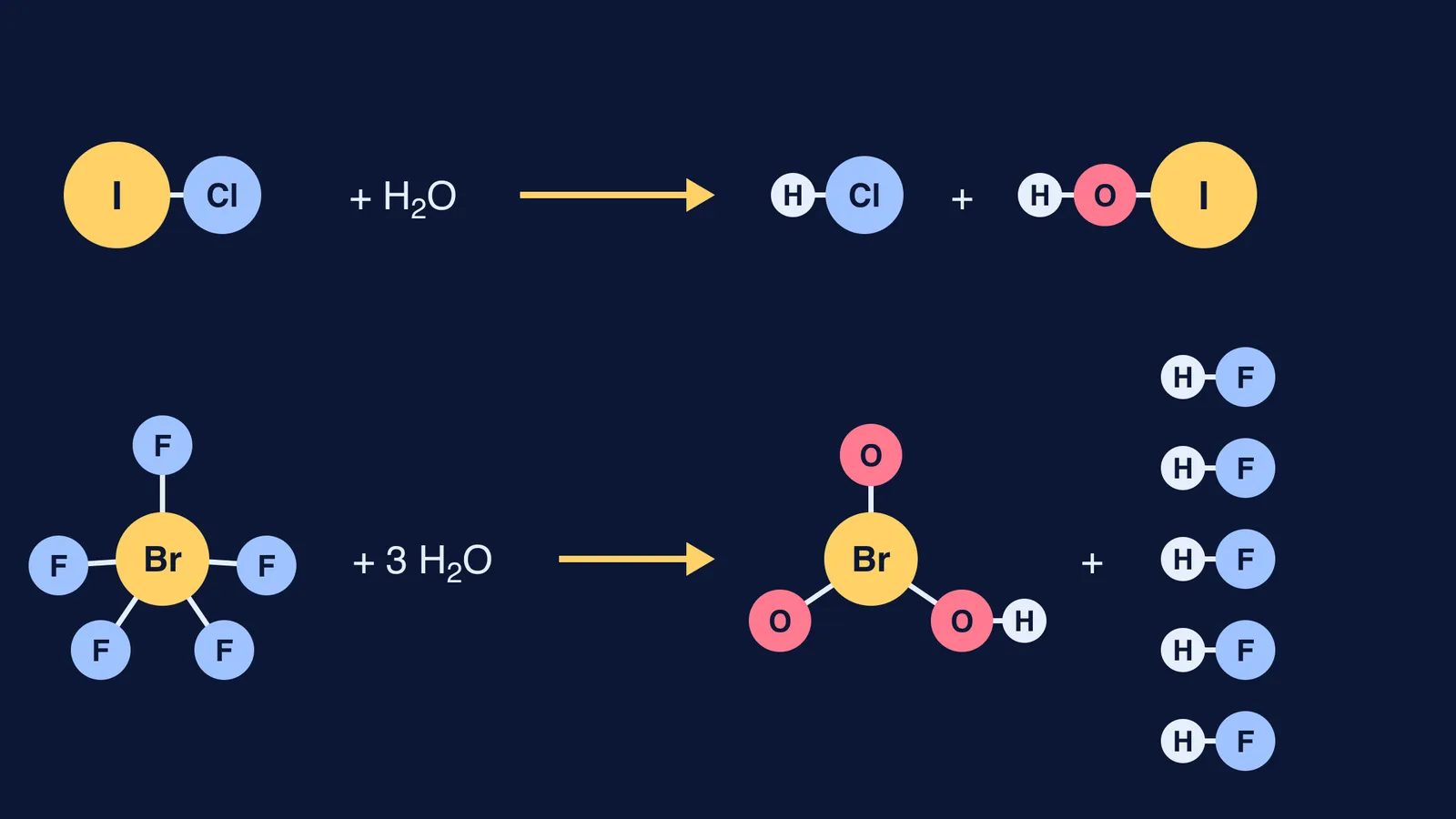
Iodine is the larger atom, and it is +1 in ICl. The +1 oxoacid of iodine is hypoiodous acid, HOI. Chlorine leaves as HCl:
ICl + H2O → HCl + HOI
This first step is extremely fast. A Purdue University dissertation by Yi Lai Wang measured the hydrolysis of iodine monochloride to HOI and chloride with a first-order rate constant of 2.4 × 10^6 per second.
HOI is not where the story ends in a real beaker. The Wikipedia page on iodine monochloride says ICl reacts with pure water to form HCl, HI, iodine and iodic acid, and lists 5ICl + 3H2O → 5HCl + HIO3 + 2I2 as one route. For a board or JEE answer that asks for hydrolysis products, HCl + HOI is the answer the rule gives. The extra products show that HOI goes on to react further.
What does BrF5 give with water?
Bromine is central and +5 in BrF5. The +5 oxoacid of bromine is bromic acid, HBrO3. Fluorine leaves as HF. With n = 5 you need three waters:
BrF5 + 3H2O → HBrO3 + 5HF
That is the balanced equation given on the Wikipedia page for bromine pentafluoride. Check it: 6 H on each side (1 in HBrO3, 5 in HF), 3 O on each side, 5 F on each side. Bromine stays +5, so nothing is oxidised or reduced. This is hydrolysis, not a redox reaction.
That warning comes from the NOAA CAMEO Chemicals entry for bromine pentafluoride, which also lists it as highly corrosive and toxic. If you want to see why BrF5 is square pyramidal in the first place, our guide to shapes of ClF3, BrF5 and IF7 works through the lone pairs.
Which mistakes cost marks?
Swapping the halogens: writing HOCl + HI for ICl. The oxoacid always belongs to the larger atom.
Changing the oxidation state: writing HBrO4 for BrF5. Bromine is +5 before and after.
Forgetting the coefficient on HY: BrF5 gives five HF, not one.
Mixing this up with covalent halides such as SiCl4, which follow a different pattern; our guide on why SiCl4 hydrolyses but CCl4 does not covers that case.
Not recognising the oxoacid name. The same oxoacid families (HOX, HXO2, HXO3, HXO4) come up again in acidity questions; our post on acidity of chlorine oxoacids explains the trend for chlorine.
A good self-test: cover the right-hand side of each equation above, write the products for ICl, ClF3, BrF5 and IF7 from the four steps, then check atoms on both sides. If you get a step wrong, the Fermi Problem Library has worked problems with a step-by-step solver that explains the reasoning rather than just printing an answer.