

On this page
Four acids, one chlorine atom each, and strengths that range from weak to very strong. If you can explain that order in two sentences and draw all four structures, you have covered a favourite of give-reasons questions and entrance-exam MCQs.
What is the acidity order of HOCl, HClO2, HClO3 and HClO4?
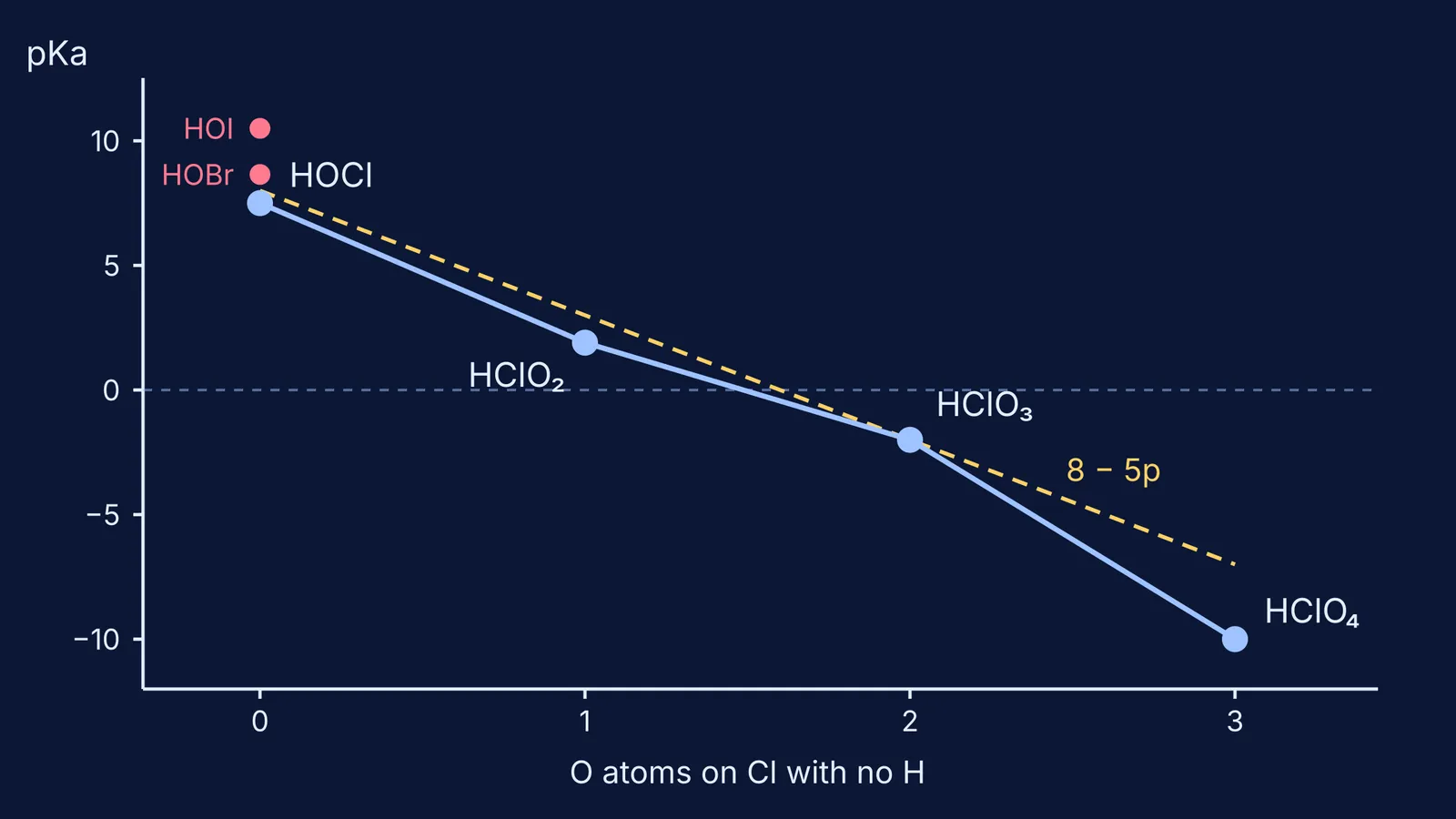
The order is hypochlorous < chlorous < chloric < perchloric acid: HOCl < HClO2 < HClO3 < HClO4. In the LibreTexts table of chlorine oxyacids/10%3A_The_Halogens/10.04%3A_Oxyacids_of_Chlorine), the pKa values are 7.5 for HOCl, 1.9 for HClO2, −2 for HClO3 and −10 for HClO4.
A lower pKa means a stronger acid, and each step of 1 in pKa is a factor of 10 in Ka. So the gap between HOCl and HClO4 is roughly 17 powers of ten. If the link between pKa, Ka and the conjugate base feels shaky, our post on conjugate acid-base pairs and Ka × Kb = Kw covers it first.
Why does acid strength rise with the number of oxygens?
In all four acids the acidic hydrogen sits on an oxygen, never on chlorine. What changes is how many extra oxygens, with no hydrogen, are bonded to chlorine. Two effects follow, both pushing the same way.
Pull on the O–H bond. Oxygen is more electronegative than chlorine (Pauling values 3.44 and 3.16 in the electronegativity data table)). Each extra oxygen draws electron density through chlorine and away from the O–H bond, so the proton leaves more easily.
A more stable anion. After the proton leaves, the negative charge on ClO4− is shared over four oxygens, but on ClO− it sits on one. LibreTexts puts it directly/10%3A_The_Halogens/10.04%3A_Oxyacids_of_Chlorine): the more oxygen atoms there are, the more the negative charge on the anion can be delocalized.
A stable conjugate base means a strong acid. That is the whole argument in one line.
What do the chlorine oxoacids look like?
Count the electron pairs around chlorine and apply VSEPR (our four-step VSEPR guide walks through the method). Chlorine has seven valence electrons; in the usual exam drawings it forms one single bond to the OH group and a double bond to each extra oxygen.
HOCl (H–O–Cl): one bond and three lone pairs on chlorine. The molecule is bent at oxygen.
HClO2 (H–O–Cl=O): two bonded atoms and two lone pairs on chlorine, so bent at chlorine. The chlorite ion is bent, with an O–Cl–O angle of 111° according to Wikipedia's chlorite entry.
HClO3 (H–O–ClO2): three bonded atoms and one lone pair, so pyramidal. LibreTexts describes the chlorate ion as pyramidal in solid salts and in solution.
HClO4 (H–O–ClO3): four bonded atoms and no lone pair, so tetrahedral around chlorine.
LibreTexts adds that pure chlorous acid is unknown because it is too unstable, while chloric acid reaches only about 40% in water.
The same counting habit decides basicity in the oxoacids of phosphorus and sulphur.
Why is HOCl a stronger acid than HOBr and HOI?
Here the structure stays fixed (H–O–X) and only the halogen changes. In the LibreTexts comparison of hypohalous acids/CHEM_431_Readings/09%3A_Acid-Base_and_Donor-Acceptor_Chemistry/9.03%3A_Brnsted-Lowry_Concept/9.3.06%3A_The_Acidity_of_an_Oxoacid_is_Determined_by_the_Electronegativity_and_Oxidation_State_of_the_Oxoacid's_Central_Atom), Ka is 4.0 × 10⁻⁸ for HOCl, 2.8 × 10⁻⁹ for HOBr and 3.2 × 10⁻¹¹ for HOI.
The reason is electronegativity. Chlorine (3.16) pulls harder on the shared electrons than bromine (2.96) or iodine (2.66), using the Pauling values in the electronegativity data table). A stronger pull makes the O–H bond more polar and steadies the XO− anion, so HOCl > HOBr > HOI. Within chlorine, oxygen count decides; across halogens with the same formula, electronegativity does.
Worked example: can you predict the pKa without memorising it?
Pauling's empirical rule, given on the same LibreTexts oxoacid page/CHEM_431_Readings/09%3A_Acid-Base_and_Donor-Acceptor_Chemistry/9.03%3A_Brnsted-Lowry_Concept/9.3.06%3A_The_Acidity_of_an_Oxoacid_is_Determined_by_the_Electronegativity_and_Oxidation_State_of_the_Oxoacid's_Central_Atom), is pKa ≈ 8 − 5p, where p is the number of oxygens on the central atom that carry no hydrogen. Try it on chlorine.
HOCl: p = 0, predicted 8, listed 7.5.
HClO2: p = 1, predicted 3, listed 1.9.
HClO3: p = 2, predicted −2, listed −2.
HClO4: p = 3, predicted −7, listed −10.
The rule gets the order right and lands close for HOCl and HClO3, but it understates how strong HClO4 is. For a give-reasons answer, a three-line script works:
Order: HClO4 > HClO3 > HClO2 > HOCl.
Cause: more oxygens without hydrogen pull electron density from the O–H bond.
Anion: the charge on ClO4− is spread over four oxygens, so it is the most stable conjugate base.
If the stall is in the idea itself, the Fermi Concept Library gives each chemistry concept its own lesson. If you get the idea but slip on questions, the Fermi Problem Library has a step-by-step solver that explains the reasoning rather than printing an answer.
Next step: redo the self-test tomorrow from a blank page.


