On this page
NCERT's Class 12 chemistry textbook covers this in one sentence in the Haloalkanes and Haloarenes unit: "Reactions with iodine are reversible in nature and require the presence of an oxidising agent (HNO3, HIO4) to oxidise the HI formed during iodination" (NCERT Class 12 Chemistry Part II, page 287). Here is what that sentence means, and why chlorine and bromine do not need an oxidant.
Why is iodination of benzene reversible?
The reaction is C6H6 + I2 ⇌ C6H5I + HI, and its backward step, C6H5I + HI → C6H6 + I2, really happens.
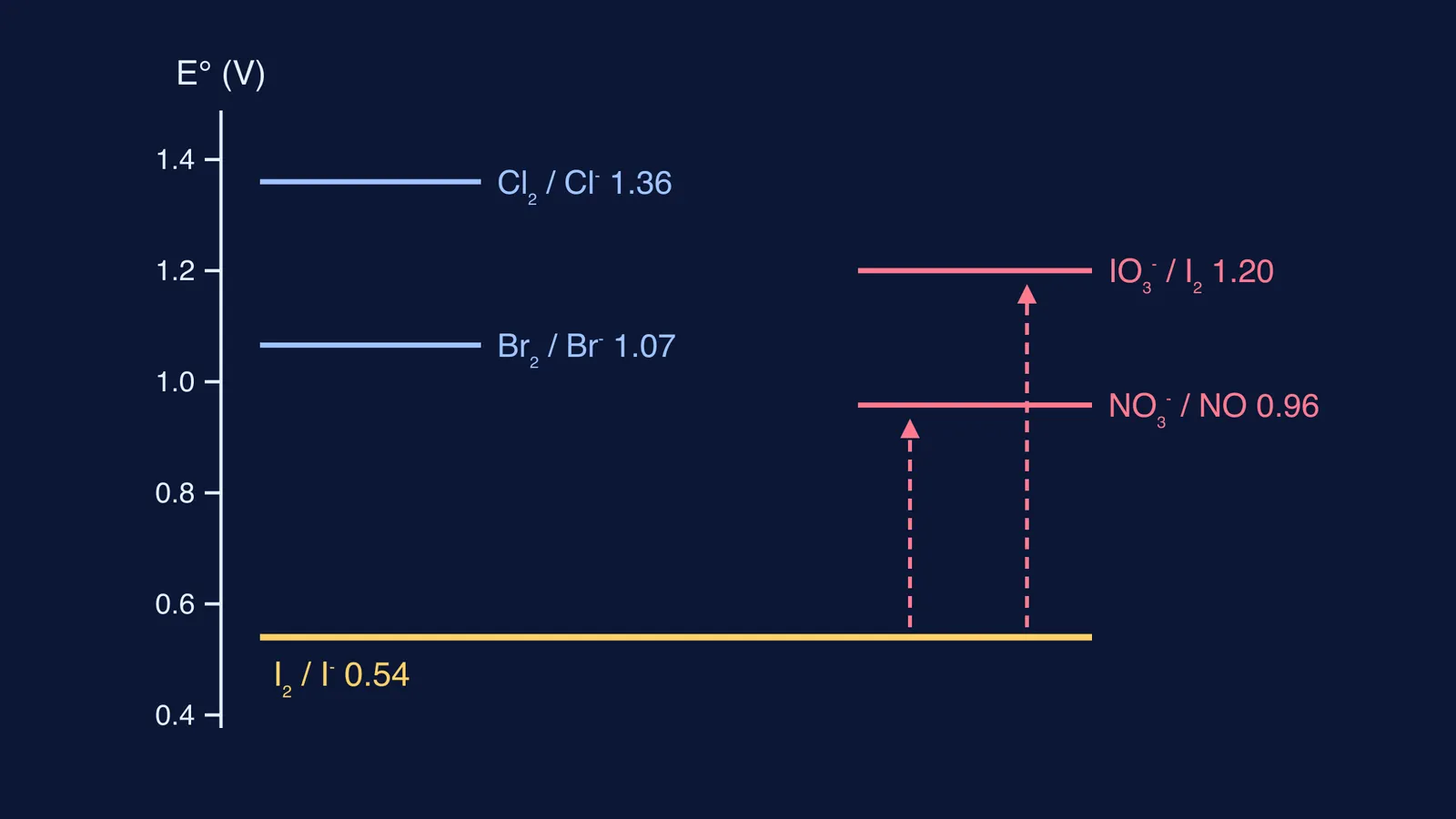
The reason is that HI is a good reducing agent. The standard electrode potential of I2/I⁻ is 0.54 V, against 1.07 V for Br2/Br⁻ and 1.36 V for Cl2/Cl⁻ (standard electrode potential data)). A lower value means the halide gives up electrons more easily, so iodide is the easiest to oxidise.
Two more facts push the same way:
NCERT gives bond enthalpies of 234 kJ/mol for CH3–I and 351 kJ/mol for CH3–Cl (NCERT Class 12 Chemistry Part II, page 286); see why the C–I bond is the weakest carbon–halogen bond.
Iodine is a poor electrophile: "iodine itself is unreactive toward aromatic rings", says OpenStax (OpenStax Organic Chemistry, section 16.2/16:_Chemistry_of_Benzene_-_Electrophilic_Aromatic_Substitution/16.02:_Other_Aromatic_Substitutions)).
Slow forward, easy backward: little iodobenzene builds up.
How does nitric acid make iodination of benzene work?
Nitric acid does two jobs at once.
It removes HI. Nitric acid oxidises the HI as it forms: 6HI + 2HNO3 → 3I2 + 2NO + 4H2O. The NO3⁻/NO couple sits at 0.96 V, above iodine's 0.54 V (standard electrode potential data)), so this is favourable. With the HI gone, the backward reaction stops and, by Le Chatelier's principle, the equilibrium shifts towards iodobenzene.
It makes the electrophile. In iodination, "iodine (I2) is treated with an oxidizing agent such as nitric acid to obtain the electrophilic iodine" (Wikipedia, electrophilic halogenation). OpenStax says an oxidising agent converts iodine into a species that "reacts as if it were I⁺" (OpenStax, section 16.2/16:_Chemistry_of_Benzene_-_Electrophilic_Aromatic_Substitution/16.02:_Other_Aromatic_Substitutions)). The ring attacks I⁺, forms an arenium ion, then loses H⁺.
Add the steps together and you get 6C6H6 + 3I2 + 2HNO3 → 6C6H5I + 2NO + 4H2O. In practice, iodobenzene "can be produced by refluxing iodine and nitric acid with benzene" (Wikipedia, iodobenzene).
What about HIO3 and HIO4?
NCERT names HIO4, periodic acid. Iodic acid, HIO3, does the same job, and I2/HIO3/H2SO4 mixtures work well even on deactivated rings (Wikipedia, electrophilic halogenation). In HIO3 + 5HI → 3I2 + 3H2O, even the oxidant's iodine becomes usable I2. A 2005 study in *Molecules* iodinated benzene, halobenzenes and even nitrobenzene using iodic acid as the only iodinating reagent, with yields of 39–83% (Krassowska-Swiebocka, Prokopienko and Skulski, 2005).
Chlorination vs bromination vs iodination: what changes?
NCERT says aryl chlorides and bromides are made "in the presence of Lewis acid catalysts like iron or iron(III) chloride" (NCERT Class 12 Chemistry Part II, page 287). The catalyst polarises the halogen molecule and is regenerated at the end (Chemguide, halogenation of benzene). Compare the four halogens side by side, with potentials from the standard electrode potential data page):
Chlorination: Cl2 with FeCl3 or Fe. The by-product, HCl, is a weak reducing agent (Cl2/Cl⁻ is 1.36 V), so there is no backward reaction to fight.
Bromination: Br2 with FeBr3 or Fe. HBr (Br2/Br⁻ is 1.07 V) does not undo the product either.
Iodination: I2 with an oxidant such as HNO3, HIO3 or HIO4. HI (I2/I⁻ is 0.54 V) reduces iodobenzene, so it has to be destroyed as it forms.
Fluorination: not done this way. NCERT notes fluoro compounds are not prepared by this method "due to high reactivity of fluorine".
Remember it this way: a Lewis acid fixes a weak electrophile, but an oxidant fixes a weak electrophile and a reversible reaction. More on the iron catalyst: the role of FeCl3 in the chlorination of benzene.
How do you write this in an exam answer?
Try this question: *Benzene treated with iodine alone gives very little iodobenzene. Adding concentrated HNO3 raises the yield. Explain.* Cover five points, in this order:
The equilibrium, with a double arrow: C6H6 + I2 ⇌ C6H5I + HI.
HI is a strong reducing agent and reduces iodobenzene back to benzene.
The oxidant removes HI: 6HI + 2HNO3 → 3I2 + 2NO + 4H2O.
The oxidant also produces the electrophile, I⁺.
Contrast: HCl and HBr are poor reducing agents, so a Lewis acid is enough for Cl2 and Br2.
Avoid three traps: calling HNO3 a "catalyst" (it is used up), writing FeI3 by analogy with FeCl3 (a Lewis acid does nothing about the HI), and drawing a one-way arrow. For another reversible substitution, read why sulphonation of benzene is reversible.
If you understand the theory but lose marks writing mechanisms, the Fermi Problem Library has worked problems with a step-by-step solver that explains the reasoning rather than printing an answer. To revise electrode potentials first, the Fermi Concept Library has a lesson for each concept in chemistry.