

On this page
When studying electrophilic aromatic substitution for JEE Main and JEE Advanced, most reactions appear to be one-way streets. Nitration drops benzene into a thermodynamic well, chlorination binds chlorine firmly, and Friedel-Crafts alkylation adds an enduring alkyl group. Sulphonation is the notable exception. Fuming sulphuric acid installs a sulphonic acid group (-SO3H), while boiling the product in dilute acid removes it. Understanding this reversibility provides both insight into reaction kinetics and a reliable tool for regioselective synthesis.
What makes benzene sulphonation reversible?
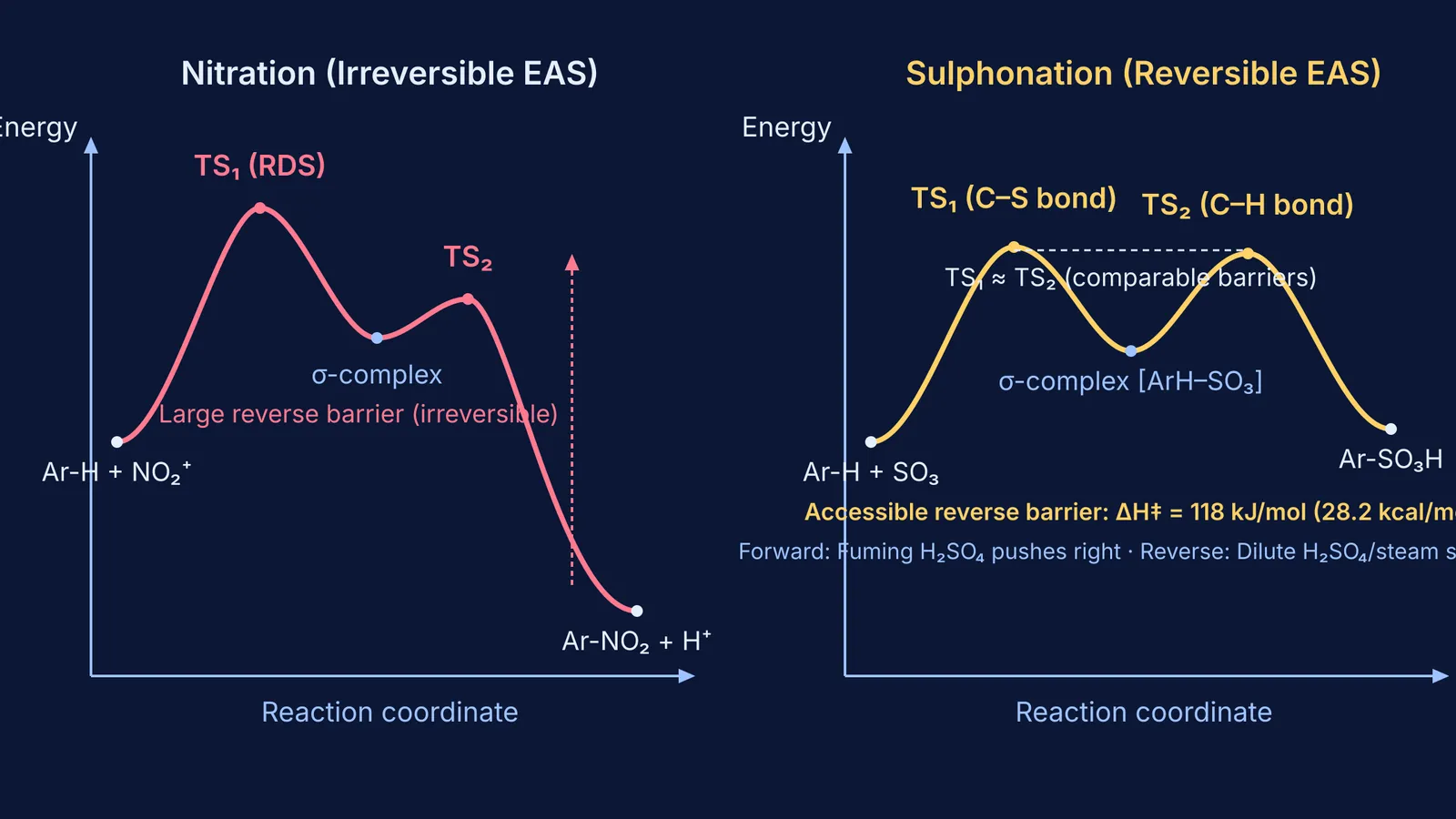
Reversibility in aromatic substitution depends on the energy barriers flanking the Wheland intermediate (sigma complex). In nitration, the activation energy required to expel the nitro group (NO2⁺) from the intermediate is far higher than the barrier to shed a proton, making the second step rapid and irreversible.
Sulphonation presents a much more balanced energy surface. The leaving group in the reverse reaction is neutral sulphur trioxide (SO3), a stable molecule requiring no counter-ion to depart. In the Journal of the Chemical Society, J. C. D. Brand, A. W. P. Jarvie, and W. C. Horning demonstrated that aromatic sulphonation exhibits a primary kinetic isotope effect, with k_H / k_D ratios ranging from 1.1 for nitrobenzene to 3.0 for benzene across various acid concentrations. This confirms that carbon-hydrogen bond cleavage is partially rate-determining: the rate of the intermediate reverting to benzene and SO3 is comparable to the rate of deprotonation. With forward and reverse transition states at similar heights, dynamic equilibrium prevails.
Why is sulphur trioxide the active electrophile?
In concentrated sulphuric acid, self-dissociation generates small amounts of sulphur trioxide: 2 H2SO4 ⇌ H3O⁺ + HSO4⁻ + SO3. In fuming sulphuric acid (oleum), free SO3 is present in high concentration.
As Everett E. Gilbert highlighted in Chemical Reviews, sulphur trioxide is a powerful neutral electrophile. Three electronegative oxygen atoms pull electron density away from the central sulphur atom, generating a substantial partial positive charge. In the initial step of electrophilic aromatic substitution in benzene, the benzene pi cloud attacks this electron-deficient sulphur. This forms a zwitterionic Wheland intermediate bearing a delocalised positive charge on the ring and a negative charge on the sulphonate group. Recognizing neutral electrophiles is a foundational skill when distinguishing between nucleophiles and electrophiles.
How does heating with dilute acid remove the -SO3H group?
By microscopic reversibility, desulphonation follows the exact reverse coordinate of sulphonation. Heating benzenesulphonic acid with dilute sulphuric acid allows hydronium ions (H3O⁺) to attack the ipso carbon bearing the -SO3H group.
This regenerates the Wheland intermediate. Because expelling neutral SO3 has a modest activation barrier, the carbon-sulphur bond cleaves readily to restore aromaticity. Equilibrium shifts according to Le Chatelier's principle:
Fuming acid supplies abundant SO3 and consumes water, pushing the equilibrium toward benzenesulphonic acid.
Dilute acid supplies excess water, which hydrates departing SO3 into sulphuric acid (SO3 + H2O → H2SO4), permanently stripping SO3 from the system and driving the reaction backward to benzene.
In Recueil des Travaux Chimiques des Pays-Bas, A. C. M. Wanders and Hans Cerfontain studied desulphonation kinetics between 120 °C and 155 °C in 65 to 85 wt-% aqueous sulphuric acid. They confirmed first-order kinetics with an activation enthalpy of 28.2 kcal/mol (118 kJ/mol), reflecting an accessible barrier overcome by heat.
How do chemists use sulphonation as a blocking group?
Substituted benzenes with ortho/para-directing activators often yield unwanted mixtures on electrophilic attack. Because the para position is less sterically hindered, direct substitution overwhelmingly favours the para product over the ortho isomer.
Chemists install the bulky -SO3H group first to block the para position, forcing the next substituent into the vacant ortho position. Heating with dilute acid then unblocks the position, delivering pure ortho product.
How does reversible sulphonation isolate ortho-chlorotoluene?
Direct chlorination of toluene yields a mixture of ortho- and para-chlorotoluene whose close boiling points (159 °C vs 162 °C) hinder separation. As reviewed by Hans Cerfontain in Recueil des Travaux Chimiques des Pays-Bas, reversible sulphonation resolves regiochemical mixtures cleanly in three steps:
Block the para position: Heat toluene with concentrated H2SO4 at 100 °C to produce para-toluenesulphonic acid as the major thermodynamic product, occupying position 4.
Chlorinate the ortho position: Treat the product with Cl2 and FeCl3. The methyl group directs ortho (positions 2 and 6), while -SO3H directs meta (positions 2 and 6). Both groups reinforce substitution at position 2, forming 2-chloro-4-methylbenzenesulphonic acid.
Deblock with dilute acid: Heat with dilute aqueous H2SO4 and superheated steam at 150 °C to remove -SO3H, isolating pure ortho-chlorotoluene.
How can you master reversible mechanisms for JEE Advanced?
Recognising when a functional group serves as a permanent modification versus a removable blocking agent is essential for solving complex synthesis problems in JEE Advanced.
To deepen your mechanistic understanding, explore the Fermi Concept Library, which covers every concept in physics, chemistry, biology, mathematics and computing, each with its own lesson and its place in the map. When tackling synthesis pathways, consult the Fermi Problem Library for worked problems with a step-by-step solver that explains the reasoning rather than printing an answer.


