

On this page
If you have been told "alkyl iodides react fastest" and wondered why, the answer sits in two columns of one NCERT table. As the halogen gets bigger, the carbon–halogen bond gets longer, and the longer bond is the weaker one.
Why is the C–I bond the weakest carbon–halogen bond?
Going down group 17, the halogen atom gets bigger: fluorine is the smallest and iodine the largest, so the carbon–halogen bond length increases from C–F to C–I, as the NCERT Class 12 chapter on haloalkanes and haloarenes puts it.
In a longer bond, the shared pair of electrons sits further from the nuclei holding it, so less energy is needed to pull the two atoms apart. That energy is the bond enthalpy. Iodine makes the longest bond with carbon, so C–I is the easiest to break.
You can check the size argument yourself. Covalent radii from Cordero and colleagues' 2008 paper "Covalent radii revisited" are 76 pm for sp3 carbon, 57 pm for F, 102 pm for Cl, 120 pm for Br and 139 pm for I. Add carbon's radius to each and you get 133, 178, 196 and 215 pm, close to the measured C–X lengths below.
How do C–X bond lengths and enthalpies compare?
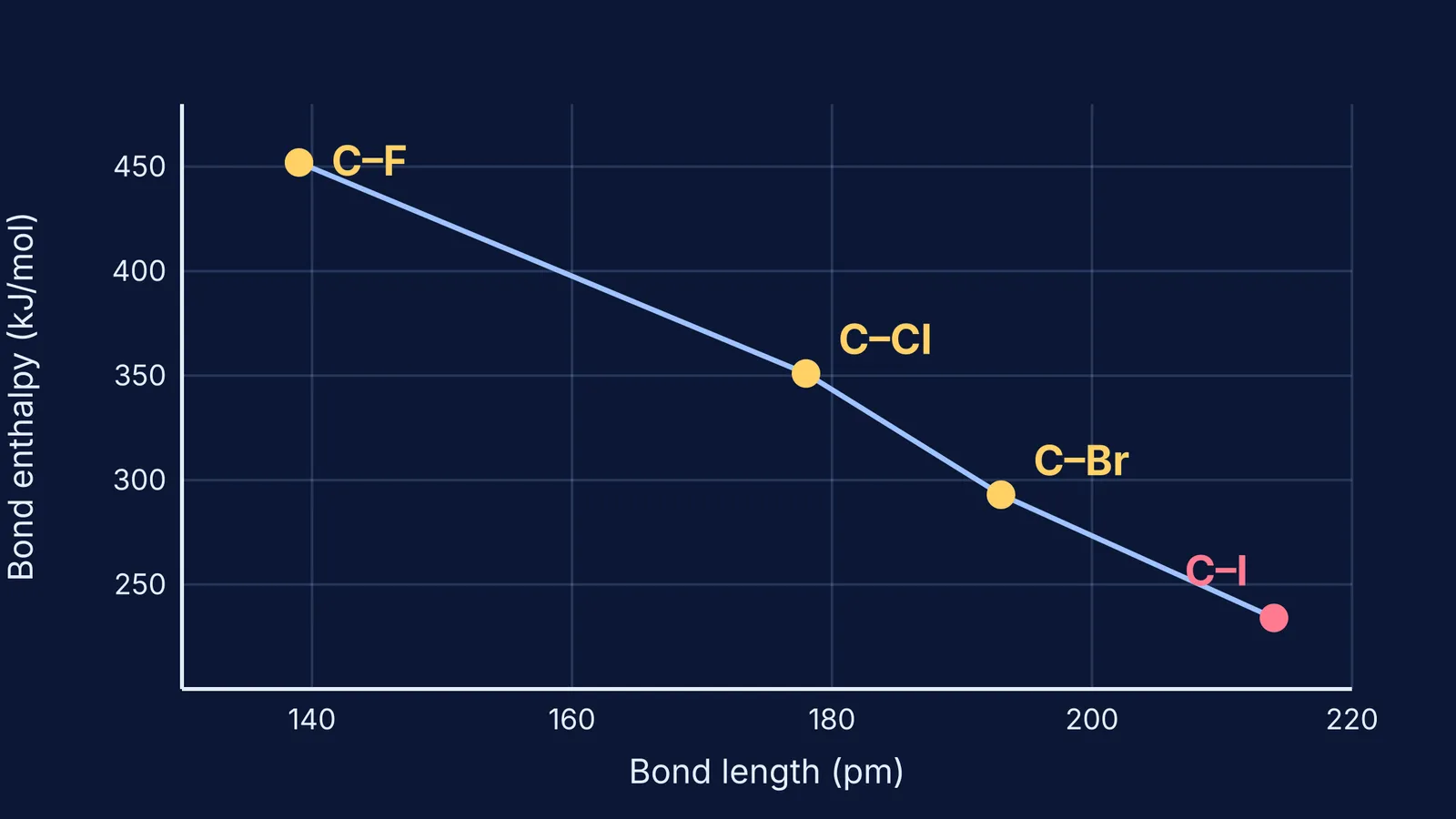
Table 6.2 of the NCERT haloalkanes chapter gives these values for the methyl halides (CH3–X):
C–F: 139 pm, 452 kJ/mol
C–Cl: 178 pm, 351 kJ/mol
C–Br: 193 pm, 293 kJ/mol
C–I: 214 pm, 234 kJ/mol
The C–I bond is 75 pm longer than C–F, and its bond enthalpy of 234 kJ/mol is about half of the 452 kJ/mol for C–F.
The same chapter states the reactivity order that follows: for a given alkyl group, R–I > R–Br > R–Cl >> R–F in both SN1 and SN2 reactions. Its Example 6.6 says a primary iodoalkane undergoes SN2 faster than the matching chloroalkane because iodine, with its large size, is a better leaving group. Our explainer on leaving group ability order goes further into why some groups leave easily.
If C–F is the most polar bond, why don't fluorides react fastest?
This is the trap. Fluorine is the most electronegative halogen, so you might expect the carbon in C–F to attract nucleophiles most strongly. It doesn't win.
The dipole moments in the same NCERT table barely move: CH3Cl has 1.860 D, CH3F 1.847 D, CH3Br 1.830 D and CH3I 1.636 D. The molecular dipole moment changes little across the series while bond enthalpy almost halves.
The Chemguide page on halogenoalkanes and silver nitrate says it plainly: in these reactions, bond strength is the main factor deciding the relative rates. A primary iodo compound gives its very pale yellow precipitate quite quickly, the bromo compound takes longer, and the chloro compound may show nothing for a very long time.
Worked example: how do you rank four halides by reactivity?
Question: arrange CH3CH2CH2F, CH3CH2CH2Cl, CH3CH2CH2Br and CH3CH2CH2I in order of increasing rate of reaction with aqueous NaOH.
Check the alkyl group. All four are primary propyl halides, so crowding around carbon is the same. Only the halogen changes.
Recall the size order: F < Cl < Br < I, so bond length rises from C–F to C–I.
Turn length into strength: longer bond, lower bond enthalpy (452, 351, 293 and 234 kJ/mol for the methyl halides in the NCERT table).
A weaker bond breaks more easily, so the halide leaves more readily.
Answer: propyl fluoride < propyl chloride < propyl bromide < propyl iodide.
Step 1 matters. If a question pairs a tertiary chloride with a primary iodide, the mechanism and the alkyl group come into play too, so do not apply the halogen order blindly.
If you keep spotting the right trend but writing the wrong final order, practise similar questions in the Fermi Problem Library. Its step-by-step solver explains the reasoning rather than printing an answer, so you can see exactly which step slipped.
How should you write this in a board or JEE answer?
A short written answer should make these points, in this order (values from the NCERT chapter):
Halogen size increases from F to I down group 17.
So C–X bond length increases, from 139 pm to 214 pm.
So C–X bond enthalpy decreases, from 452 to 234 kJ/mol; C–I is the weakest.
So reactivity follows R–I > R–Br > R–Cl >> R–F.
Bond strength, not polarity, decides the rate.
Don't mix this up with physical properties. NCERT also lists boiling points rising from RF to RI, but that comes from stronger van der Waals forces, not bond strength; our post on haloalkane boiling point and density trends covers it. If the link between length and strength still feels like a rule to memorise, bond length versus bond order explains the general idea.
To see where this sits next to nucleophiles, leaving groups and SN1 versus SN2, look up haloalkanes in the Fermi Concept Library.


