

On this page
When you compare molecules in chemistry, two properties tell you how tightly atoms are held together: bond order and bond length. Bond order is simply the number of chemical bonds between a pair of atoms. Bond length is the average distance between the nuclei of those two bonded atoms.
What is the relation between bond order and bond length?
According to the principles of molecular geometry, bond length is inversely related to bond order. When more electrons participate in bond formation, the atoms pull closer together, making the bond shorter. This also means that bond length is inversely related to bond strength and dissociation energy: all other factors being equal, a higher bond order yields a stronger, shorter bond.
To explore how these properties connect across the entire periodic table, the Fermi Concept Library maps every concept in physics and chemistry, each with its own lesson and its place in the map.
How does bond order change carbon-carbon bonds?
Carbon forms single, double, and triple bonds, providing a perfect example of this rule in action.
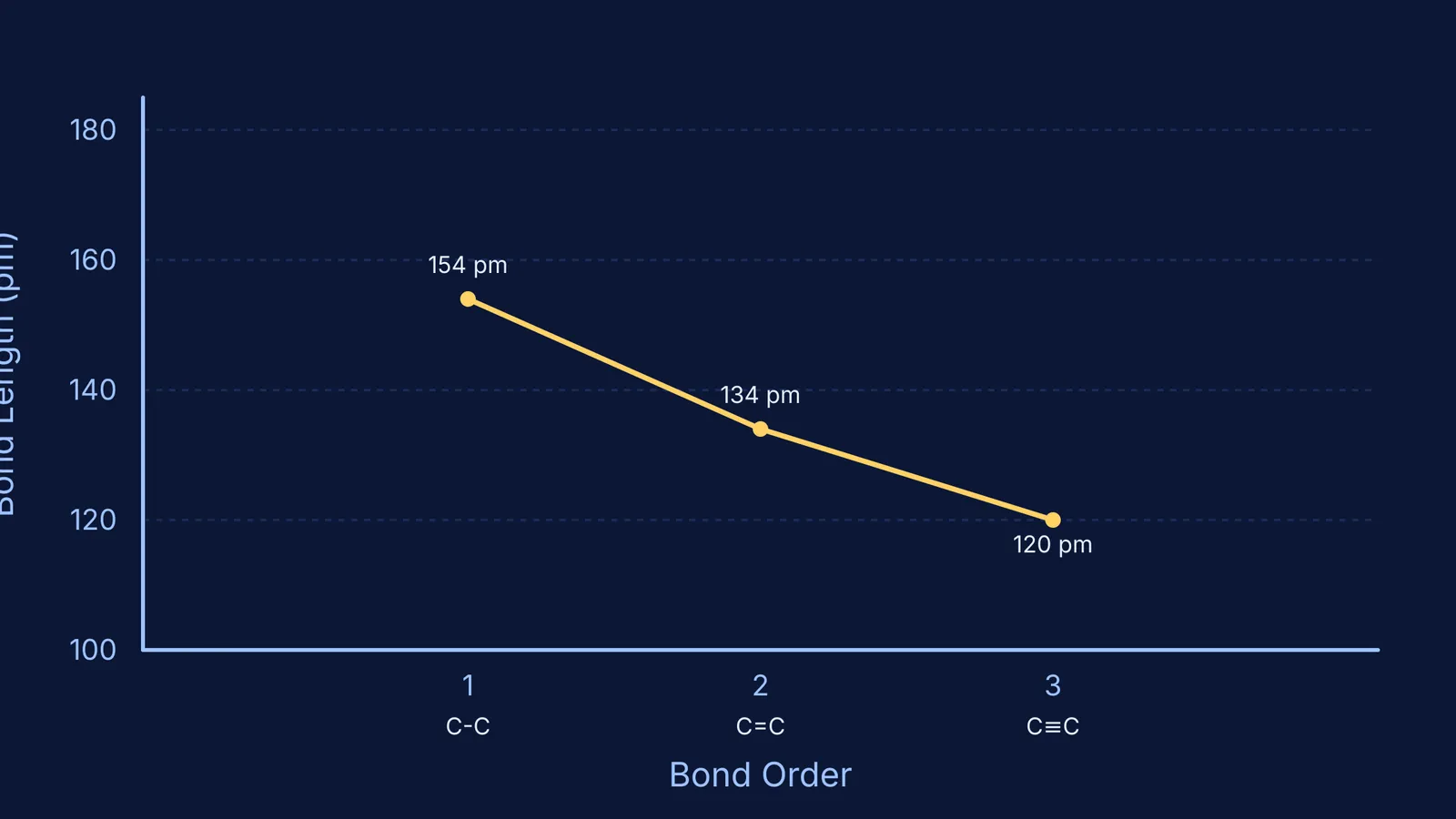
A carbon-carbon single bond (C–C), which has a bond order of 1, has a length of 154 pm.
A carbon-carbon double bond (C=C), like the one in ethene, has a bond order of 2 and a shorter length of 134 pm.
A carbon-carbon triple bond (C≡C) has a bond order of 3 and is even shorter at 120 pm.
The pattern is clear: as the bond order increases from 1 to 3, the bond length decreases from 154 pm to 120 pm. This is partly due to the increased s-character of the sigma bond in alkenes and alkynes. Even in resonance structures, this rule holds true. Benzene has delocalized pi electrons that give it a fractional bond order of 1.5, and its carbon-carbon bonds all share a uniform length of 139 pm, neatly sitting between a single and a double bond.
You can read more about how this works for other molecules in our guide to average bond order from resonance: nitrate, ozone and oxyanions.
Why is N2 a stronger bond than N2+?
To compare molecules like N2 and its ion N2+, we use molecular orbital (MO) theory. In this theory, electrons are not assigned to individual bonds but are treated as moving under the influence of all the atomic nuclei in the molecule.
Bond order is calculated as half the difference between the number of bonding electrons and the number of antibonding electrons.
For a molecule of diatomic nitrogen (N2), there are 8 bonding valence electrons and 2 antibonding valence electrons. Bond order = (8 − 2) / 2 = 3. This matches the Lewis structure of N≡N, which is a triple bond.
If we remove one electron to create the N2+ ion, that electron is lost from a bonding orbital. This leaves 7 bonding valence electrons and 2 antibonding valence electrons. Bond order = (7 − 2) / 2 = 2.5.
Because N2 has a higher bond order (3) than N2+ (2.5), N2 has a shorter bond length and a stronger bond. A lower bond order generally means the bond is less stable. You can see a similar logic when comparing bond angles: NH₃ vs PH₃ and H₂O vs H₂S explained.
How can you solve bond order problems quickly?
When preparing for exams, use this straightforward framework to tackle bond comparison questions:
Count the total number of valence electrons for the molecule or ion.
Fill the molecular orbitals according to their energy levels to find the number of bonding and antibonding electrons.
Calculate the bond order using the formula: (Bonding Electrons − Antibonding Electrons) / 2.
Compare the results: the species with the highest bond order has the shortest bond length and the highest bond dissociation energy.
If two species have the same bond order, the one with more antibonding electrons will generally be less stable and have a slightly longer bond.
If you struggle to remember the molecular orbital diagrams or get the wrong electron counts, the Fermi Problem Library offers worked problems with a step-by-step solver that explains the reasoning rather than just printing an answer. And if you still find yourself stuck, Fermi's AI tutor can work out what you already know and build a plan for the session, teaching you the rules of molecular geometry as you go.


