

On this page
When you replace a hydrogen atom in an alkane with a halogen, the physical properties of the molecule shift entirely. The new carbon-halogen bond is polar, and the halogen atom brings extra mass and electrons to the structure.
These changes govern how haloalkanes boil and how dense they are compared to water. These properties are often tested in organic chemistry exams.
How does halogen size and chain length affect boiling point?
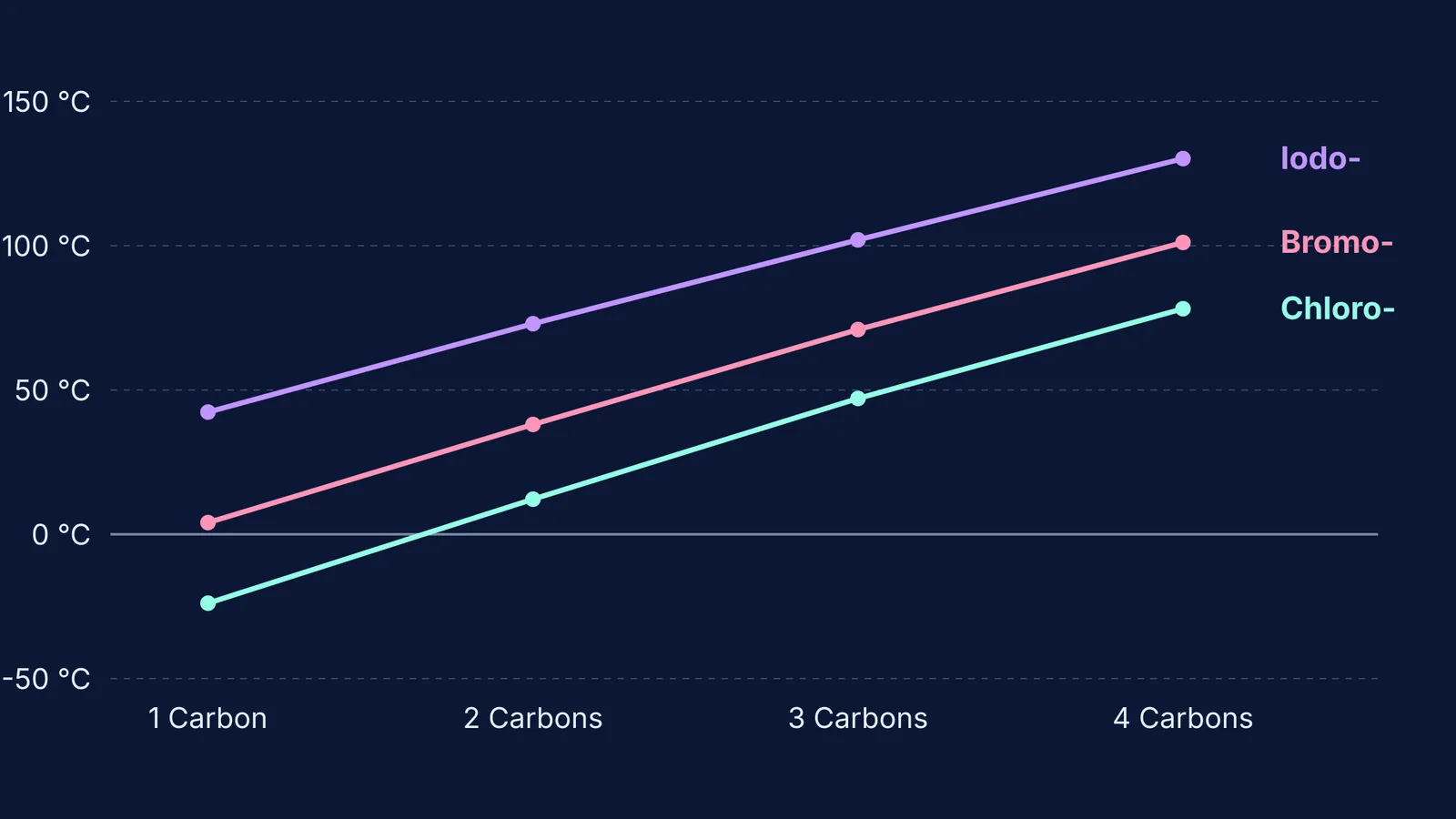
Boiling points increase as the halogen gets larger (from fluorine to iodine) and as the carbon chain gets longer.
For example, the boiling point of 1-chlorobutane is 78 °C. This rises to 101 °C for 1-bromobutane and 130 °C for 1-iodobutane.
This happens because larger halogen atoms and longer carbon chains possess more electrons and a greater surface area. A larger surface area strengthens the London dispersion forces (a type of van der Waals force) between the molecules, meaning more heat energy is required to separate them into a gas. Halogen atoms lower on the periodic table, like iodine, have electron clouds that are further from the nucleus, making them more polarisable and resulting in even stronger intermolecular attractions.
Why does branching lower the boiling point?
If you take the exact same number of atoms and rearrange them into a branched shape, the boiling point drops.
A straight-chain 1-bromobutane boils at 101 °C, but if you move the bromine to the middle carbon to make 2-bromobutane, the boiling point falls to 91 °C. If you branch the carbon chain itself to create tert-butyl bromide, the boiling point drops further to 73 °C.
Branching makes the molecule more compact and spherical. A spherical shape reduces the surface area available for molecules to interact with one another. A smaller contact area means weaker van der Waals forces, so less energy is needed to boil the liquid. This is why highly branched isomers will always have lower boiling points than their straight-chain counterparts.
Which haloalkanes are denser than water?
The density of a haloalkane depends heavily on the atomic mass of the halogen it contains.
A molecule like 1-chlorobutane has a density of 0.89 g/mL, which is lighter than water (1.00 g/mL).
However, as you move down the periodic table to heavier halogens, the atom's mass increases much faster than the overall volume of the molecule. Because of this, 1-bromobutane has a density of 1.27 g/mL and 1-iodobutane sits at 1.62 g/mL, making both of these compounds significantly denser than water. The heavy halogen atoms pack a lot of mass into a relatively small space.
In general, alkyl bromides, alkyl iodides, and polychloro compounds will sink in water, while alkyl fluorides and monochloroalkanes will float. If you need to synthesize the heavier iodides or lighter fluorides, the Finkelstein and Swarts reactions are the standard methods for making them.
How to compare haloalkane properties for exams
When an exam asks you to arrange haloalkanes by boiling point or density, use this order of priority:
Count the halogens: More halogen atoms on the same chain mean a higher boiling point and a higher density.
Check the halogen size: The properties follow the order I > Br > Cl > F for both boiling point and density.
Count the carbons: A longer chain means a higher boiling point.
Look at the branching: For isomers with the exact same molecular formula, the straight chain has the highest boiling point, and the most branched isomer has the lowest.
Understanding these physical trends is a foundational skill in organic chemistry, and they often dictate how molecules behave in reactions, such as choosing between aqueous vs alcoholic KOH for substitution or elimination.
If you get stuck on why a certain property changes across a group, the Fermi Concept Library covers every concept in physics, chemistry, biology, mathematics and computing, each with its own lesson and its place in the map. When you need help applying these rules to a tricky multiple-choice question, the Fermi Problem Library has worked problems with a step-by-step solver that explains the reasoning rather than printing an answer.


